People Power Party to Launch 'Gukmin-ui Mirae' on 15th
Democratic Party Forms 'Integrated Proportional Party'
Satellite Party Leadership Selection Crucial... Communication Key
Jo Guk New Party and Song Young-gil New Party May Join
Ahead of the April 10 general election, the Democratic Party of Korea, which holds the key to electoral reform, unanimously adopted the current semi-proportional representation system, prompting both ruling and opposition parties to launch satellite parties. The People Power Party and the Democratic Party criticized each other’s “cunning satellite parties” but acknowledged that forming satellite parties to secure proportional seats was inevitable.
To understand the background of satellite party formation in the political sphere, one must first understand the current electoral system, the semi-proportional representation system. This system links constituency seats and proportional seats in the general election. The core is to fill proportional seats based on party vote share for seats not won in constituencies. When the party vote share is linked 100% to fill the missing seats, it is called a “fully proportional representation system.” The current system links only 50% of proportional seats to party vote share, hence called “semi-proportional representation.” Originally introduced to enable small parties to enter the National Assembly, the system’s purpose has been undermined as the two major parties create satellite parties to select proportional representatives. They aim to secure even one more seat in the assembly through satellite parties, leveraging their high party support rates.
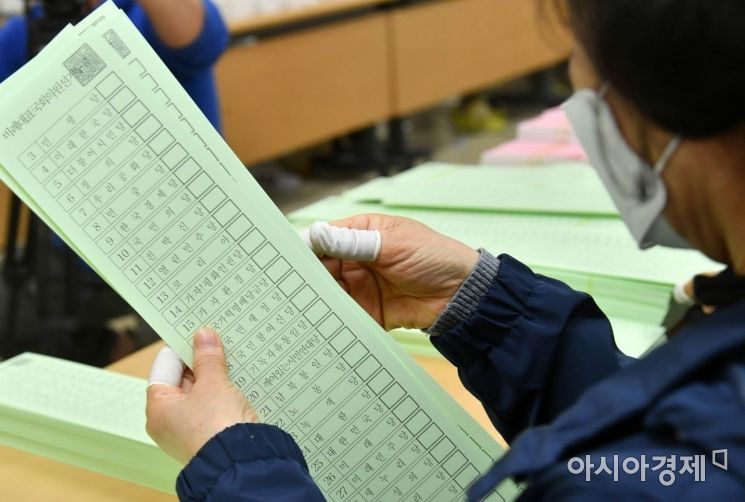 On the 7th, officials from the Yeongdeungpo Election Commission in Seoul are inspecting the ballot papers for the 21st general election. Photo by Dongju Yoon doso7@
People Power Party’s Satellite Party ‘People’s Future’ to Launch on 15th... Key Issue is Party Leader Appointment
The People Power Party’s satellite party, tentatively named People’s Future, formed a central party preparatory committee on the 31st of last month in accordance with the Political Parties Act and reported it to the National Election Commission. The People’s Future preparatory committee completed the founding member meetings for city and provincial parties on the 1st and 2nd of this month and plans to hold city and provincial party founding conventions in six regions (Busan, Daegu, Ulsan, Gyeonggi, North Gyeongsang, South Gyeongsang) over nine days from the 5th to the 13th.
The preparatory committee stated, “We are conducting party founding activities in compliance with the Constitution and Political Parties Act and plan to complete registration applications for city and provincial parties in six regions by the 14th.” The central party founding convention is scheduled for the 15th at the People Power Party building auditorium in Yeouido, Seoul, marking the start of full-scale election preparations.
As the satellite party formation accelerates, the People Power Party is deliberating on leadership appointments. The satellite party’s leadership, including the party leader, is likely to be appointed at the central party founding convention. This leadership appointment is crucial to ensure smooth communication and avoid discord with the People Power Party leadership. Past conflicts between the party and its satellite party include the so-called “Han Seon-gyo rebellion” during the 21st general election. Han Seon-gyo, leader of the satellite party Future Korea Party, refused “directed nominations” and independently nominated proportional candidates, causing integrated party recruits to lose their election chances.
For these reasons, the prevailing opinion is that someone who communicates well with Chairman Han and is either not running in the general election or has been cut off (excluded from nomination) should lead the satellite party. Within the party, Representative Jang Je-won is mentioned as a candidate for the satellite party leader. However, Jang Dong-hyuk, Secretary-General of the People Power Party, recently told reporters that there has been “no consideration” of recruiting Representative Jang as leader. Many of the People Power Party’s recruited talents hoping to run as proportional representatives are likely to join the satellite party to receive nominations. Political circles mention former Samsung Electronics President Ko Dong-jin and former Hyundai Steel Senior Researcher Park Chung-kwon as major satellite party candidates.
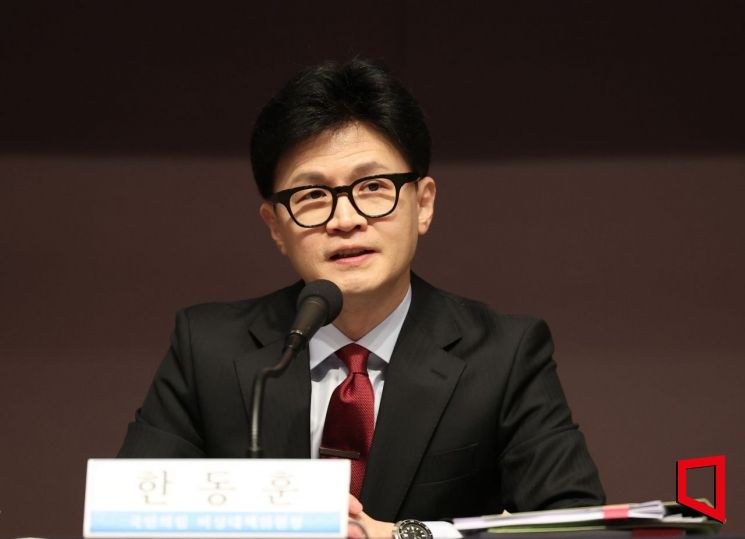 Handonghun, Emergency Response Committee Chairman of the People Power Party, is speaking at the Kwanhun Club invitation debate held at the Korea Press Center in Jung-gu, Seoul on the 7th. Photo by National Assembly Press Photographers Group
Democratic Party Forms ‘Integrated Proportional Party’... Jo Guk’s New Party and Song Young-gil’s New Party Join as Variables
The Democratic Party has also begun discussions to select proportional candidates for the progressive camp. On the 6th, the Democratic Party officially announced the formation of an “integrated proportional party” centered on the opposition and appointed three-term Representative Park Hong-geun, a former floor leader, as head of the proportional party promotion team. The New Progressive Alliance, formed by the Basic Income Party, Social Democratic Party, and Open Democratic Party, is expected to join the Democratic Party’s coalition. The party is also open to the inclusion of a new party being prepared by former Minister of Justice Jo Guk. Supreme Council member Jang Kyung-tae previously said on a broadcast, when asked if Jo Guk’s new party could join the integrated proportional party, “We have no intention of excluding anyone.”
The method of selecting proportional candidates will also be a key issue for the opposition’s integrated satellite party. It is known that a plan for all parties to jointly conduct the entire process from founding member meetings to candidate screening is being seriously considered. Another method under discussion is dividing seat shares among parties, each selecting candidates, and then merging the lists in the proportional party.
Tensions are also visible between the Democratic Party and smaller opposition parties during this process. Voices have emerged questioning whether it is fair to allocate the top proportional candidate rankings in the Democratic Party’s satellite party to smaller parties. In the 21st general election, the Democratic Party’s satellite party, the Together Citizens’ Party, allocated top proportional candidate slots to smaller parties. Within the Democratic Party, some argue that rather than automatically conceding top slots to smaller parties, distribution based on support rates would be fairer.
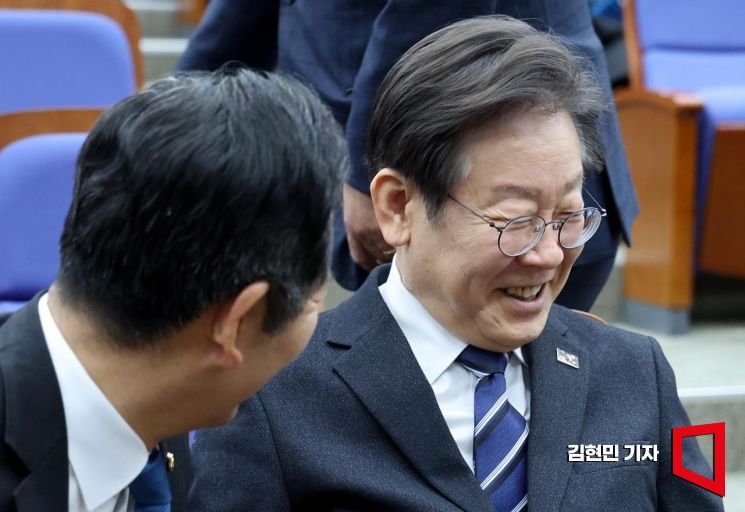 Lee Jae-myung, leader of the Democratic Party of Korea, is conversing with Jeong Cheong-rae, Supreme Council member, at the party meeting held at the National Assembly on the 6th. Photo by Kim Hyun-min kimhyun81@
Concerns Over Repetition of Cunning Campaign Tactics by Satellite Parties
There are concerns that various cunning campaign tactics involving satellite parties will be repeated once election campaigning intensifies after the Lunar New Year holiday. Representative cunning tactics from the 21st general election include joint campaigns and suggestive campaigns. Joint campaigns involve candidates from major parties and their satellite parties campaigning together. Wearing clothes of similar colors and using similar slogans and fonts, they conduct joint campaign activities, also called “screen campaigns.”
Screen campaigns are a means to circumvent election laws that prohibit major opposition parties from directly mentioning satellite party candidates during promotion. A notable example from the last general election was Future Korea Party leader Won Yu-chul wearing a reversed jacket with the Future United Party’s name during a joint campaign. The strategy aimed to leverage the high recognition of party figures to boost satellite party promotion.
Another typical cunning tactic is “loaning a lawmaker” to secure the number 3 ballot number. To get a favorable ballot number, incumbent lawmakers from both major parties resign and join the satellite party. Ballot order is determined by the number of incumbent lawmakers, and re-merging occurs after the election. This also allows for additional election subsidies. Parties forming negotiation groups receive 50% of the total subsidy equally, parties with 5 to less than 20 seats receive 5%, and parties with fewer than 5 seats receive 2%.
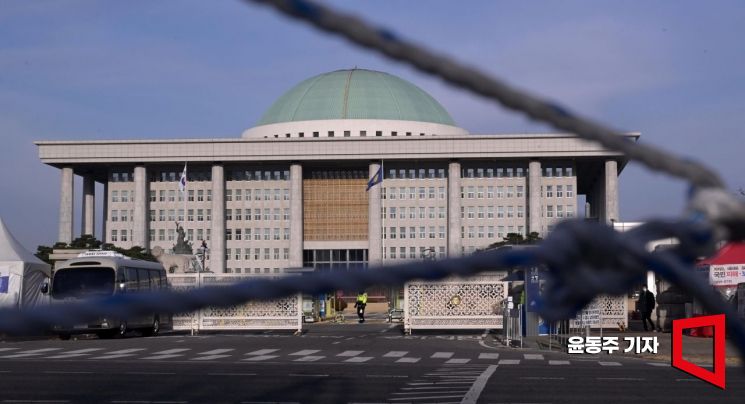 The ruling and opposition parties are sharply divided over the dismissal proposal of Minister Lee Sang-min, casting a red light on the passage of next year's budget. On the 12th, the National Assembly building was shrouded in silence.
 Photo by Yoon Dong-joo doso7@
© The Asia Business Daily(www.asiae.co.kr). All rights reserved.
![Clutching a Stolen Dior Bag, Saying "I Hate Being Poor but Real"... The Grotesque Con of a "Human Knockoff" [Slate]](https://cwcontent.asiae.co.kr/asiaresize/183/2026021902243444107_1771435474.jpg)


















