Push upward from the midpoint between the patient's solar plexus and navel
Do not apply ice directly to burns
During the Lunar New Year holiday, families are supposed to gather and spend warm and happy times together, but sometimes unexpected accidents occur. The government plans to check the operation status of hospitals, clinics, and pharmacies that are open to minimize medical service gaps during the holiday. However, knowing emergency response procedures for various situations in advance can help you respond immediately in case of an emergency.
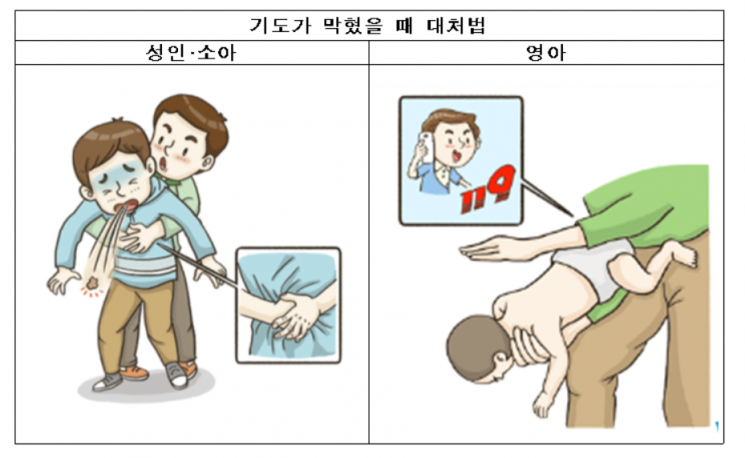
When the Airway is Blocked by Food
During the holiday season, accidents where food gets stuck in the throat and blocks the airway often occur. There are cases where people visit the emergency room after choking on rice cakes. Airway obstruction accidents frequently happen when the amount of food intake increases or when eating foods like rice cakes that are not usually consumed. Especially children are more prone to this because their teeth may not be fully developed or in good condition, causing them to swallow without properly chewing.
If the airway is not completely blocked, the person can make sounds and respond, but if they cannot make any sound at all, it means the airway is fully blocked, and it is important to remove the foreign object from the airway using the Heimlich maneuver.
If the patient can cough, encourage them to do so; if not, perform emergency treatment for airway obstruction (Heimlich maneuver).
If the patient is an adult, stand behind them and wrap your arms around their waist. Make a fist with one hand and grasp it with the other hand, then place it between the patient’s navel and sternum and push upward. This should not be done on infants under 1 year old or those weighing less than 10 kg, as it may cause internal injuries. For infants, tilt the head downward at a 45-degree angle, support the chest with one hand, and gently tap the back about five times with the palm. Then, use the index and middle fingers to press firmly on the center of the infant’s nipple to check if the foreign object has been expelled.
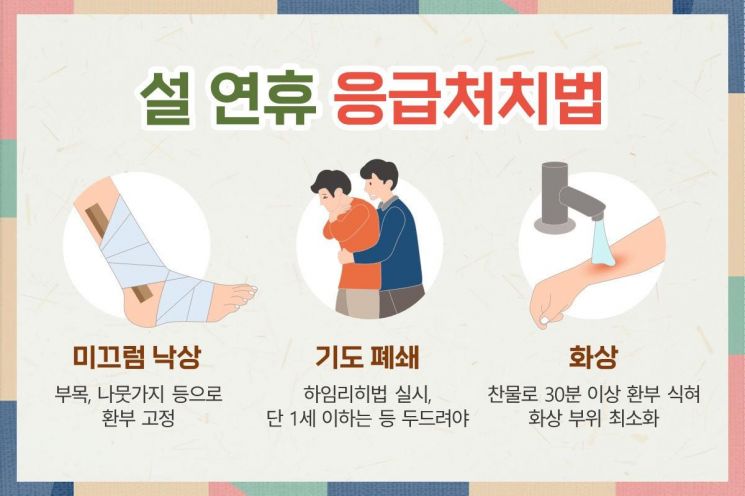
Responding to Slip and Fall Injuries by Immobilizing the Affected Area
Unexpected falls can happen during visits to ancestral graves or outings. Even in warm weather above freezing, the ground may still be icy or shaded areas may have thin ice, making slips likely. Thick clothing can also restrict movement, increasing the risk of severe sprains to the wrist or foot, or fractures to the hip or spine. Elderly people are especially vulnerable to fractures due to weaker bones and have a higher risk of complications during recovery, so prompt emergency treatment and transport are crucial when a fall occurs.
If someone slips and falls and experiences severe pain with swelling at the injury site, a fracture is likely. The most important thing is to prevent the fractured area from moving further. Do not try to realign the bones forcibly; instead, immobilize the fracture site with a splint or a sturdy object like a branch to prevent movement. Keeping the injured area still preserves the shape at the time of the accident and prevents additional damage to tendons, blood vessels, and other soft tissues. Call 119 and wait for the ambulance while applying cold compresses to reduce pain. If there is bleeding along with the fracture, stop the bleeding by applying a clean towel or clothing to the wound.
Burns: Cooling the Burn Area to Minimize Damage
During holiday cooking, burns can occur when hot oil splashes onto the skin. All burns are serious, but oil burns can damage not only the epidermis but also the dermis, so extra caution is needed. Emergency treatment is critical for burns, as the initial response can affect the severity and size of scars.
If you get an oil burn, gently pat the oil off the skin with a clean towel or gauze, then cool the burn area under running water for about 30 minutes. Do not apply ice directly to the burn, as it may temporarily relieve pain but reduce blood flow and constrict blood vessels, worsening the injury. Also, avoid intentionally popping blisters caused by burns, as they are prone to bacterial infection. After emergency treatment, cover the burn with a sterile bandage and promptly visit a medical facility to accurately assess the depth and extent of the injury and receive treatment.
Dr. Lee Hyuk-ho, an emergency medicine specialist at Incheon Himchan General Hospital, said, "For minor burns that can happen in daily life, cooling the area with cold water for more than 30 minutes helps prevent the heat from spreading deeper and wider, minimizing the burn area." He added, "It is also good to know the locations and contact information of hospitals, clinics, and pharmacies open during the Lunar New Year holiday to prepare for emergencies."
© The Asia Business Daily(www.asiae.co.kr). All rights reserved.
![Clutching a Stolen Dior Bag, Saying "I Hate Being Poor but Real"... The Grotesque Con of a "Human Knockoff" [Slate]](https://cwcontent.asiae.co.kr/asiaresize/183/2026021902243444107_1771435474.jpg)
















