Ministry of Land, Designates District... 30,000 Housing Units to be Built
The Jin-an Public Housing District project in Hwaseong-si, Gyeonggi-do, which had been at a standstill for two years and six months due to disagreements among ministries following the government's new town development plan announcement, is now getting back on track.
According to the Ministry of Land, Infrastructure and Transport (MOLIT) and Hwaseong-si on the 7th, MOLIT announced the designation of the Jin-an Public Housing District on this day.
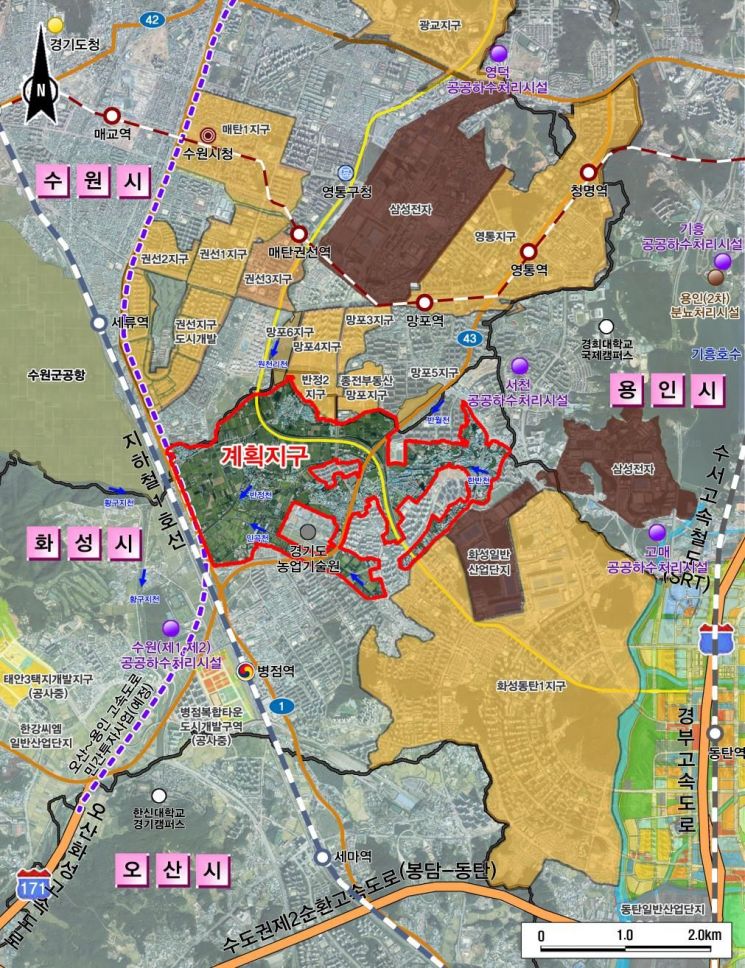
The Jin-an district is a new town-scale public housing district being developed over an area of 4,525,533㎡ in the Jin-an, Banjeong, Gisan, Banwol, and Byeongjeom-dong areas of Hwaseong-si. It is similar in size to Sanbon New Town, a first-generation new town in the Seoul metropolitan area.
In 2021, as a follow-up measure to the February 4 real estate policy, the government announced plans in August of that year to develop a public housing district in this area. A total of 29,860 housing units are planned to be built here to accommodate approximately 70,000 residents.
Although public viewing and announcements were made following the government’s announcement, the project did not progress due to disagreements among related agencies. However, with the conditional approval of the district designation plan by the Central Urban Planning Committee in December last year, the Jin-an district completed the designation process two years and six months after the announcement.
The Jin-an district is located adjacent to the north of Dongtan 1 New Town and lies on the boundary line of Suwon City, making it a strategically important site. It is evaluated as having excellent location due to its proximity to Samsung Electronics’ Suwon plant. The Seoul Metropolitan Subway Line 1 passes along the western side of the district.
Hwaseong-si plans to request the government and the project implementer, Korea Land and Housing Corporation (LH), to expedite the project, as residents have experienced significant inconvenience due to the delay. In particular, the city insists that the development plans, including the implementation plan, should reflect the original development concepts such as ▲creating a self-sufficient city ▲establishing a complex community space ▲building a rail-centered public transportation system ▲and preparing road measures to resolve bottleneck sections.
To this end, the city plans to actively promote the formation of a public-private-community consultative body involving the government, Hwaseong-si, LH, and local residents. Jung Myung-geun, mayor of Hwaseong-si, said, "We will continue close cooperation with related agencies to ensure that plans reflecting the opinions of local residents can be established."
© The Asia Business Daily(www.asiae.co.kr). All rights reserved.
![Clutching a Stolen Dior Bag, Saying "I Hate Being Poor but Real"... The Grotesque Con of a "Human Knockoff" [Slate]](https://cwcontent.asiae.co.kr/asiaresize/183/2026021902243444107_1771435474.jpg)















