Cost of Setting Up Seol Table Around 310,000 Won Similar to Last Year
"Will Ensure Smooth Supply of Seasonal Goods and Provide Discounts"
Ahead of the Seollal holiday, as concerns grew over the high prices of essential holiday goods including the Seollal ancestral rite table causing a heavy burden on the public, the government responded with a rebuttal. Contrary to some institutions' reports of 'record-high' survey results, the government emphasized that the cost of the ancestral rite table is similar to last year’s level, and the prices of the top 10 essential holiday items have actually decreased by more than 3%. They also announced plans to steadily implement price stabilization measures through supply expansion and discount support for essential goods before the holiday.
On the 7th, the Ministry of Agriculture, Food and Rural Affairs held a briefing at the Government Complex Sejong, stating that the average consumer price of the top 10 Seollal essential goods has fallen by 3.1% compared to the same period last year.
The prices presented by the Ministry are based on data surveyed by the Korea Agro-Fisheries & Food Trade Corporation (aT). According to this data, although prices of apples (11.1%) and pears (19.5%) are somewhat higher than last year due to reduced production caused by weather disasters, prices of livestock products such as beef (-2.7%), pork (-6.5%), and eggs (-11.3%) have stabilized, leading to an overall price decline.
Park Soon-yeon, Director of Distribution and Consumer Policy at the Ministry, explained, "In the case of some items like apples, there is a difference between the January consumer price survey results announced by Statistics Korea on the 2nd and the consumer price survey results by aT. This is because government discount support and membership discounts at large supermarkets are reflected in the aT survey but not in the Statistics Korea survey." She added, "The reason for reflecting government discount support prices in the aT survey is to account for the discount effect that lowers consumers’ perceived price burden without affecting wholesale prices."
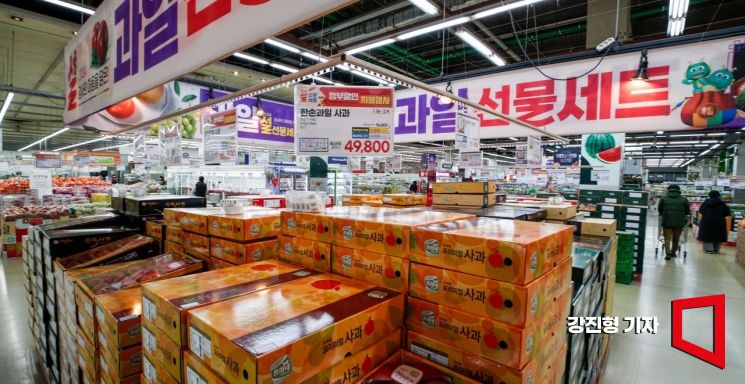 Gift boxes of fruits such as apples and pears are displayed at Hanaro Mart Yangjae Branch in Seocho-gu, Seoul. Photo by Jin-Hyung Kang aymsdream@
According to the aT survey, the cost of the Seollal ancestral rite table this year was 309,641 KRW, a slight increase of 0.7% compared to last year (307,528 KRW). Traditional markets were found to be 15.7% cheaper than large retail stores (large supermarkets). While prices in traditional markets rose by 2.9% to 283,233 KRW compared to last year, prices at large retail stores fell by 1.1% to 336,048 KRW.
Director Park pointed out, "Ahead of the Seollal holiday, six institutions and organizations including aT conduct and publish surveys on the cost of the Seollal ancestral rite table. Differences in survey results can occur due to variations in the specifications and proportions of surveyed items, survey regions and locations, and whether government discount support is reflected."
For example, while aT surveys a total of 50 locations including 16 traditional markets and 34 large retail stores across 23 cities nationwide, other institutions and organizations conduct surveys mostly in limited areas such as 25 locations in 7 cities nationwide, 25 locations in 7 districts of Seoul, or 90 locations in 25 districts of Seoul. Additionally, aT is the only domestic institution that has been conducting daily nationwide surveys on agricultural and fishery product prices since 1983. The surveyed items for the ancestral rite table include 28 items advised by organizations such as the Seonggyungwan Seokjeon Preservation Society, whereas other surveys cover between 22 and 35 items based on family sizes of 4 or 6-7 people.
Considering growing concerns about price instability ahead of the Seollal holiday, the government emphasized that it will steadily implement the previously announced 'Seollal Essential Goods Supply Stabilization Measures,' including expanded supply of essential goods and strengthened government discount support before the holiday.
The Ministry of Agriculture, Food and Rural Affairs is expanding the supply of the top 10 essential goods to 194,000 tons, 1.6 times the usual level, by utilizing government stockpiles and contract cultivation volumes to stabilize supply. As of the 6th, the performance rate stands at 107% of the plan.
Furthermore, to stabilize consumers’ perceived prices of agricultural and livestock products during the Seollal holiday period, the government is investing a record budget of 59 billion KRW to support a 30% discount. In particular, during the remaining week until Seollal, an additional 10 billion KRW budget will be injected to expand discounts on high-priced items such as apples and pears up to 40%.
© The Asia Business Daily(www.asiae.co.kr). All rights reserved.
![Clutching a Stolen Dior Bag, Saying "I Hate Being Poor but Real"... The Grotesque Con of a "Human Knockoff" [Slate]](https://cwcontent.asiae.co.kr/asiaresize/183/2026021902243444107_1771435474.jpg)















