"Notification of Increase Scale to Ministry of Education, Proceeding After Confirming Demand for Increase by University"
The government announced that it will increase the nationwide medical school admission quota for the 2025 academic year from the current 3,058 to 5,058, drawing attention to the scale of increase for each university regarding the additional 2,000 students. The government plans to announce the specific increase for each university separately after confirming the demand from each institution.
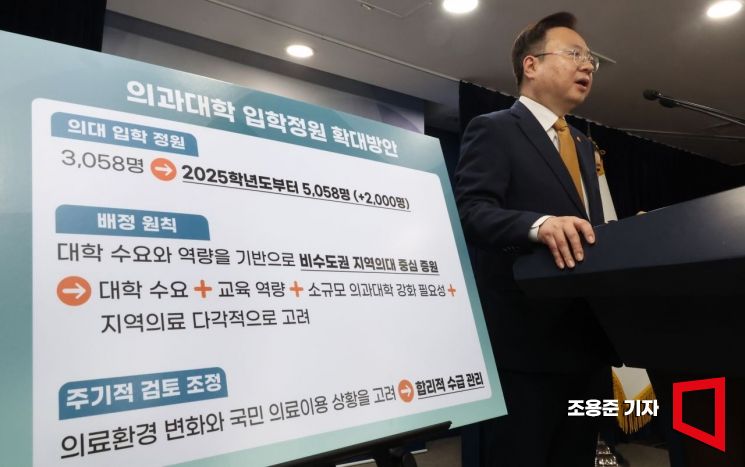 Minister of Health and Welfare Cho Kyu-hong is announcing the expansion of medical school admission quotas on the 6th at the Government Seoul Office in Jongno-gu, Seoul. Photo by Jo Yong-jun jun21@
On the 6th, Cho Kyu-hong, Minister of Health and Welfare, held a briefing after the Health and Medical Policy Deliberation Committee (HMPDC) meeting at the Government Seoul Office and said, "The government decided the scale of medical school quota increase based on the supply and demand forecast for 2035, which is 10 years from now. Out of the demand for 15,000 doctors, we aim to expand the medical workforce by 10,000 by 2035." He added, "To achieve this, starting from the 2025 academic year, the medical school quota will be increased by 2,000, expanding from the current 3,058 to 5,058."
With the medical school admission quota increasing by 2,000 next year, discussions on the distribution of the expanded admission quota among universities are expected to follow.
Minister Cho stated, "In allocating quotas by the Ministry of Education and by school, we will consider the status of regional infrastructure and medical disparities between regions," adding, "We will plan under the principle of concentrating allocations mainly to medical schools outside the metropolitan area."
He explained that various factors will be taken into account, including the demand submitted by each university, educational capacity, the need to strengthen the educational capacity of small-scale medical schools, and the necessity of supporting regional healthcare. He further added, "Once the increase scale is notified to the Ministry of Education, the Ministry will proceed with procedures such as reconfirming the demand for increase by each university."
Additionally, when enrolling in medical schools outside the metropolitan area, more than 60% of admissions will be filled through the 'regional talent selection' process.
The government expects that this increase in medical school quotas will further improve the quality of education, especially for small-scale medical schools.
Minister Cho said, "There are concerns about the decline in education quality due to the increase in medical school quotas, but an increase of 2,000 students is a level that can fully comply with the educational requirements stipulated by law," and added, "Unlike other universities, medical schools have an accreditation system, so we will manage the quality of education through this system."
Regarding the establishment of new regional medical schools, he said, "There are many considerations, so it is physically impossible to decide immediately and reflect it in the 2025 academic year quota."
Minister Cho stated, "There are opinions that the establishment of regional medical schools is essential to resolve regional medical imbalances, while others argue that since the number of medical schools in Korea is already high compared to other countries, it is more important to create conditions that allow graduates from regional medical schools to provide medical services locally rather than establishing new medical schools. We will carefully review these opinions and make a decision."
© The Asia Business Daily(www.asiae.co.kr). All rights reserved.

















