NVIDIA Tripled Last Year, Soars Another 40% This Year
Goldman Sachs Raises Target Price to $800
Barclays Calls AI Chip Demand a Bubble, Recommends Sell
Unlike most investment institutions recommending buying shares of Nvidia, the biggest beneficiary of the global artificial intelligence (AI) boom, a minority opinion advising to sell has drawn attention. Nvidia's stock, which more than tripled last year, has continued to hit record highs this year, rising over 40%.
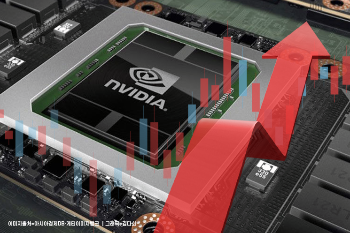
On the 5th (local time) in the U.S. New York stock market, Nvidia's stock closed at $693.32, up 4.79% from the previous session. It broke its record high for three consecutive trading days since the 1st. It has already risen 44% this year alone. As a result, Nvidia's market capitalization increased to $1.7125 trillion. Currently, Nvidia ranks 5th among U.S. companies by market cap. It is widely expected to soon surpass Amazon ($1.7691 trillion) to become the 4th largest company by market cap. Goldman Sachs, the world's largest investment bank (IB), also raised Nvidia's target price to $800 per share.
However, Sandeep Gupta, a TMT (telecommunications, media, and technology) equity expert at another global IB, Barclays, presented a sell opinion on Nvidia in an investment memo, stating, "The competition in generative AI hardware is accelerating, and AI chip demand will eventually slow down once the initial training infrastructure is completed." He argued that Nvidia's near-monopoly 90% market share in graphics processing units (GPU) will not be sustained.
There are three main reasons for the sell recommendation on Nvidia. First, the competition among Nvidia's largest customers, the 'Magnificent 7' (Apple, Microsoft, Google Alphabet, Amazon, Nvidia, Meta, Tesla), to build their own AI chips is intensifying.
In particular, Microsoft (MS) and Meta, which accounted for 46% and 28% of Nvidia's revenue respectively in the last quarter, are the most aggressive in developing AI chips. MS is the largest partner of OpenAI, the developer of ChatGPT, the epicenter of the AI boom, and also plans to invest in humanoid robot startups. Meta, which plans to double its AI investment costs this year, will install its own AI chips in data centers. Barclays' analysis suggests that if these companies become self-sufficient in AI chips and eventually commercialize them, Nvidia's growth slowdown is inevitable.
Barclays also suggested that the hype around Nvidia AI chip demand needs to be deflated. They analyzed that Nvidia's revenue increase over the past two quarters may partly be due to Nvidia funding various AI-related startups. According to startup information provider Crunchbase, Nvidia made a total of 33 investments in the venture capital (VC) sector from January to October last year, with 11 of those made in the third quarter of the last fiscal year. This is a significant increase compared to Nvidia's previous maximum of four investments per quarter since 2005. Startups operate their businesses using Nvidia AI chips, which could lead to a misinterpretation of demand for Nvidia AI chips. For example, CoreWeave, a cloud computing startup supported by Nvidia, secured $2.3 billion in funding backed by Nvidia AI chip usage.
There is also uncertainty regarding Nvidia's business in China. China is an important customer for Nvidia, ranking second in sales by country last year after the U.S. However, there are concerns about difficulties in conducting business in China following U.S. export restrictions on advanced semiconductors to China. It is also unclear how well low-spec AI chips for export to China will sell. Instead, it is known that China modifies Nvidia gaming graphics cards for use as GPUs.
However, some point out that Barclays' investment memo on Nvidia has limited influence on the market. Although Barclays issued a sell stance, it did not harshly criticize Nvidia, and among 64 global institutions, the majority of 58 companies rate Nvidia stock as a 'buy.'
© The Asia Business Daily(www.asiae.co.kr). All rights reserved.
![Clutching a Stolen Dior Bag, Saying "I Hate Being Poor but Real"... The Grotesque Con of a "Human Knockoff" [Slate]](https://cwcontent.asiae.co.kr/asiaresize/183/2026021902243444107_1771435474.jpg)
















