'Shinsok Dongryo Rescue Team' Fails to Perform Due to Staff Shortage
Lack of 'Real Fire Drills' to Improve Fire Scene Response Skills
A, a 5-year veteran firefighter (30), sighed with sorrow over the repeated deaths of firefighters in the line of duty. Every time A stands in front of a burning building, he makes a firm resolution: "The building might collapse, but if there are people to rescue, I will rush into the scene without hesitation." However, the flames spread throughout the building in less than seven minutes, draining the firefighters' lifeblood. A said, "If there were enough personnel, my colleagues could find an escape route from the fire."
On the 1st of this month, two firefighters died in a fire at a food processing factory in Mungyeong, Gyeongbuk, continuing the yearly pattern of firefighters dying in fire suppression operations. Firefighters and experts point to the shortage of personnel as one of the causes of these accidents, but they note that there seems to be little sign of resolution.
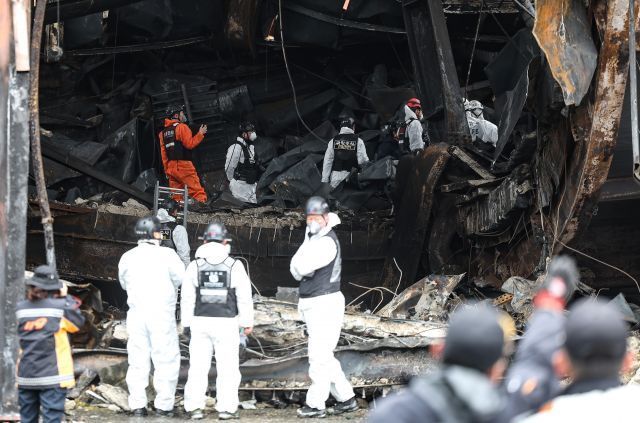 On the morning of the 2nd, a joint investigation by related agencies is underway at the site of a factory fire in Singidong, Mungyeong, Gyeongbuk, where two firefighters died in the line of duty.
 [Image source=Yonhap News]
Chronic Personnel Shortage... 'Firefighter Rescue Teams' Also Engaged in Firefighting
According to statistics from the National Fire Agency, 49 firefighters died in the line of duty from 2011 to 2020, averaging about five deaths per year during rescue or fire suppression operations. Over the same decade, 1,004 firefighters became unable to perform their duties due to illnesses or disabilities incurred on the job.
Active firefighters agree that repeated accidents are not due to a lack of safety measures. Each time a firefighter dies on site, the government promises improved treatment, and the National Fire Agency establishes safety management regulations as countermeasures.
In fact, in 2020, the National Fire Agency enacted the "Regulations on Safety Management of Firefighting Activities at the Scene for Fire Officials," which permanently assigns dedicated safety management personnel to prevent safety accidents during firefighters' activities, and revised these regulations twice by last year.
The problem is that these regulations are not properly enforced on site due to the chronic personnel shortage. A representative example is the "Rapid Buddy Rescue Team." This team consists of two-person units standing by to be immediately deployed to rescue fellow firefighters in case of an accident. They are, in other words, "firefighters who save firefighters."
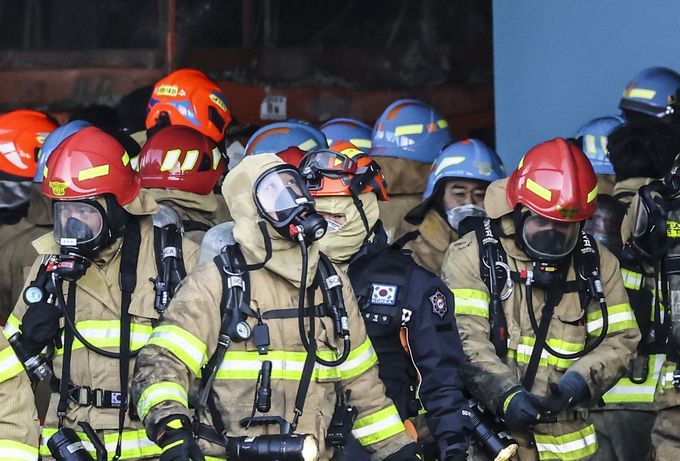 A firefighter is looking up at the sky while leaving the scene of a fire at a newly constructed construction site in Pyeongtaek City.
 [Image source=Yonhap News]
However, in actual scenes, these teams are also deployed to rescue operations. Because there are not enough personnel for fire suppression, they cannot just stand by on the sidelines.
One firefighter said, "In city-level fire stations, usually 4 to 5 personnel are assigned to the ambulance and rescue teams, but if some members take leave, they have to borrow personnel from each other's teams. Rescue teams meant to save firefighters should wait outside the scene, but in crisis situations, they also jump into the rescue."
In county-level areas, fewer rescue personnel are dispatched to scenes compared to urban areas. Typically, frontline fire stations are divided into three teams: rescue, fire suppression, and ambulance, with at least 4 to 5 firefighters assigned. However, in county regions, if multiple incidents such as water accidents and fires occur simultaneously, one team may be split, and only three personnel are dispatched to the scene.
Firefighter A said, "Due to a lack of spare personnel, sometimes three firefighters are dispatched to a traffic accident scene and two to a water accident scene. Moreover, unlike Seoul, local areas have to request additional rescue personnel from other agencies, so support is delayed, creating dangerous situations."
"Training Sites Detached from Reality"… Budget Shortages Limit Progress
Budget shortages are also cited as a reason why firefighters cannot receive sufficient practical training. As of 2022, the total firefighting budget was 7.1437 trillion won, with personnel expenses accounting for 69.4% (about 4.9644 trillion won). Only 5.7% (407.1 billion won) of the total budget was spent on equipment purchases.
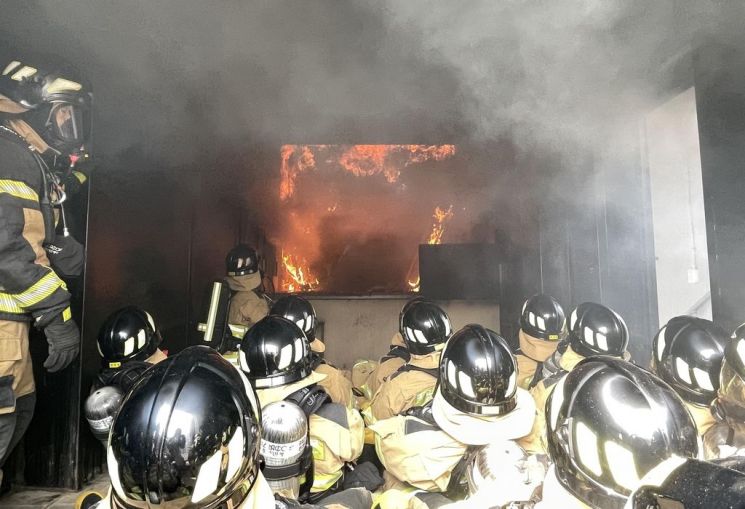
Especially, frontline firefighters complain that due to budget constraints, they cannot receive enough "live fire training," which helps develop situational response skills in environments similar to actual fire scenes. It is difficult for each fire station to equip training facilities, and sometimes the training environment is far from reality.
Firefighter B (29) said, "There is only one piece of equipment for live fire training at each regional fire academy. Creating an environment similar to an actual fire scene requires a lot of budget, so the training environment feels disconnected from the field."
Experts emphasize that both budget and personnel improvements are necessary to prevent the repetition of the same tragedies. Professor Lee Chang-woo of the Department of Fire and Disaster Prevention at Soongsil Cyber University pointed out, "A large portion of firefighting resources is spent on personnel expenses, so there is a significant lack of budget for firefighters to autonomously purchase or operate equipment."
Professor Lee added, "Korean firefighters are also deployed for daily safety rescue tasks. Their scope of work is excessively broad compared to firefighters in OECD countries. Due to the wide range of duties and insufficient personnel, both manpower and budget need to be expanded."
© The Asia Business Daily(www.asiae.co.kr). All rights reserved.
![Clutching a Stolen Dior Bag, Saying "I Hate Being Poor but Real"... The Grotesque Con of a "Human Knockoff" [Slate]](https://cwcontent.asiae.co.kr/asiaresize/183/2026021902243444107_1771435474.jpg)

















