Supercar Brands Accelerate to Secure Electrification Technology Gap
Porsche Taycan Leads Early High-Performance EV Market
Lamborghini Advances Gradual Electrification with Hybrid
Aston Martin Partners with Emerging EV Firm for Technology
Ferrari Prepares for SDV by Hiring Semiconductor Expert CEO
As the future car market rapidly shifts toward electrification and SDV (Software-Defined Vehicles), supercar brands are racing to maintain their distinctive performance gap. These companies emphasize brand identity and spare no expense in large-scale investments for electrification. Software (SW) that enhances driving performance and driver convenience is also a key challenge in developing the next generation of supercars.
The standards for supercars in the internal combustion engine era were clear. To be classified as a supercar, a vehicle had to possess engine and driving performance that clearly surpassed that of regular sports cars. However, with the advent of the electric vehicle era, these standards have become ambiguous. New electric vehicle companies like Tesla, Lucid, and Rimac began releasing electric cars with superior driving performance first.
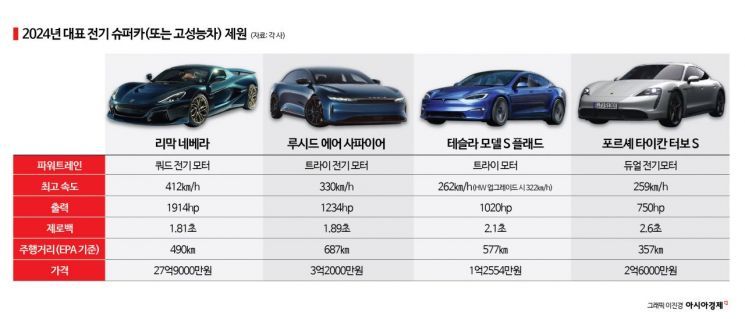
The Tesla Model S Plaid has a maximum output of 1020 horsepower and a zero-to-100 km/h acceleration time of just 2.1 seconds. In contrast, the Lamborghini Aventador, equipped with a gasoline V12 engine, has a maximum output of 780 horsepower and a zero-to-100 km/h time of 2.8 seconds. However, this difference in figures reflects the characteristic instantaneous acceleration of electric vehicles. Typically, Tesla is not included in the supercar category.
Traditional supercar brands such as Lamborghini, Ferrari, Aston Martin, McLaren, and Porsche have been leaders in the internal combustion engine era for over 100 years. They are exploring various strategies to widen the gap in product capabilities from general brands in the electric vehicle market as well.
First and foremost, they focus on strengthening brand identity. Their goal is to maintain the high-performance brand image they have built while enhancing electrification performance. If developing a purely electric vehicle with superior performance requires time, they also consider buying time with hybrids that combine excellent internal combustion engine technology and electric motors.
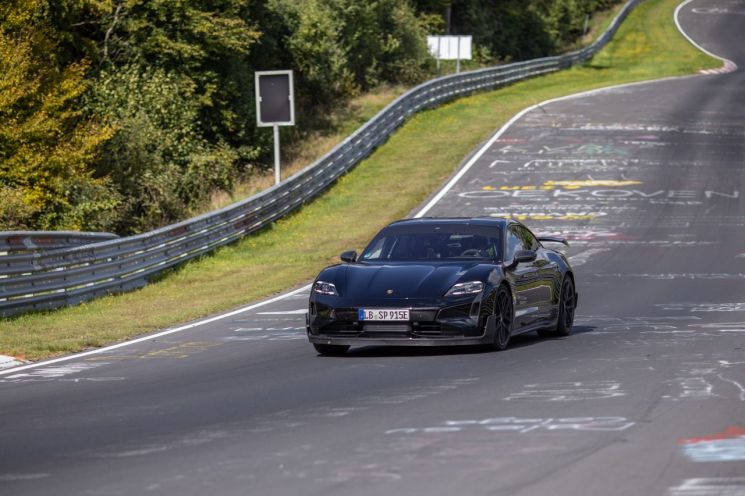
Porsche is the fastest among supercar brands to jump into electrification. Its first pure electric vehicle, the Taycan, inherits Porsche’s internal combustion DNA not only in design but also in driving capability. Thanks to this, the Taycan has become the benchmark high-performance electric vehicle that is compared against whenever a new model is released in the industry.
Typically, electric vehicles have excellent initial acceleration but tend to face issues with battery output or thermal management under repeated harsh driving conditions. To address this, Porsche equipped the Taycan with a 2-speed transmission to improve durability and efficiency. The first gear accelerates quickly from a standstill, while the second gear provides additional power during high-speed driving.
Lamborghini aims to release the ‘best electric car’ in about 4 to 6 years. Until the launch of a pure electric vehicle, the gap will be filled with plug-in hybrids (PHEVs). This year, it plans to hybridize its entire lineup, including the Urus and Hurac?n. The strategy is to leverage superior internal combustion engine technology combined with electric motors to maintain technological superiority in hybrid engines.
Aston Martin has pursued collaboration with startups to rapidly enhance its electric vehicle technology. In June last year, Aston Martin announced plans to acquire core technologies in electric vehicle powertrain and battery system design and manufacturing from Lucid Motors. The Lucid Air Sapphire is known as a ‘monster electric car’ with a maximum output of 1234 horsepower and a zero-to-100 km/h time of 1.89 seconds. While Aston Martin’s technology was superior in the internal combustion era, it is now actively embracing startup innovations to secure market leadership.
Beyond electrification, connectivity and autonomous driving?key aspects of SDV?are also challenges for these brands. Until now, supercar brands have focused solely on driving performance and driving enjoyment, neglecting software development that enhances autonomous driving or driver convenience. However, as the automotive industry trend shifts toward software-centric development, these considerations have been added.
In 2021, Ferrari made a bold move by appointing Benedetto Vigna, a former senior executive of Europe’s largest semiconductor company, as CEO. Semiconductors are essential components for implementing various software in vehicles. However, Ferrari clarified that its software development is solely aimed at ‘driving enjoyment.’ CEO Vigna emphasized, "We will develop software to enhance driving performance, not for autonomous driving or infotainment."
Stephan Winkelmann, Chairman of Lamborghini, stated, "The survival strategy for supercar brands in the future car era lies in embracing innovation without losing identity." He stressed, "While improving performance through electrification, the brand’s essence?sustainability, leading technology, and exceptional driving experience?must be maintained." Winkelmann has led Lamborghini since the early 2000s and has witnessed the growth of the global supercar market over the past 20 years.
© The Asia Business Daily(www.asiae.co.kr). All rights reserved.
![Clutching a Stolen Dior Bag, Saying "I Hate Being Poor but Real"... The Grotesque Con of a "Human Knockoff" [Slate]](https://cwcontent.asiae.co.kr/asiaresize/183/2026021902243444107_1771435474.jpg)
















