Yoon "Utilizing Health Insurance Funds, Over 10 Trillion Won Invested in Essential Medical Care"
Health Insurance Reserves Expected to Deplete by 2028 Without Additional Spending
Medical Community "Separate Fund Establishment and Operation Needed to Strengthen National Support"
As the depletion of health insurance reserves approaches, claims have emerged that implementing the 'Essential Medical Care Policy Package' announced by President Yoon Seok-yeol on the 1st as originally planned would accelerate the depletion timeline by more than a year. The medical community expressed concerns, stating that additional financial input plans must be established, and experts also argue that the financial soundness of health insurance should be considered when formulating detailed plans.
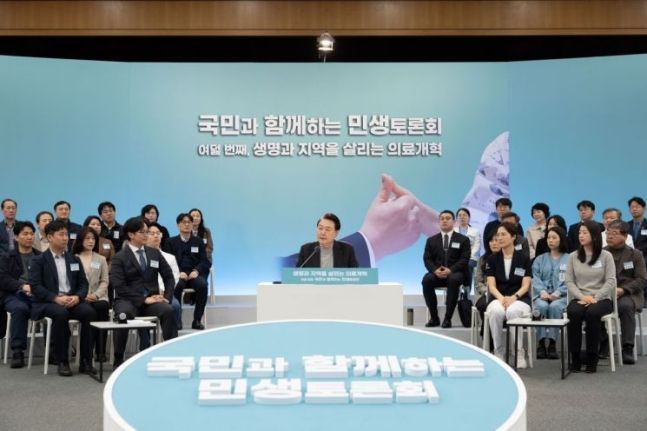 President Yoon Suk-yeol is speaking at the "Eighth Public Discussion on Livelihoods with the People - Medical Reform to Save Lives and Communities," held on the 1st at Bundang Seoul National University Hospital in Seongnam, Gyeonggi Province.
 [Image source=Yonhap News]
On the 1st, President Yoon announced the Essential Medical Care Policy Package at the 8th Public Discussion Forum held at Bundang Seoul National University Hospital in Seongnam, Gyeonggi Province. The package was promoted against the backdrop that expanding the number of doctors is a necessary condition and establishing a package solution to strengthen essential medical care is an urgent sufficient condition to implement the essential medical care innovation strategy that saves lives and regions.
According to the announcement, the government plans to significantly increase medical school quotas starting from the next admission year to prepare for a shortage of about 15,000 doctors by 2035. It aims to strengthen regional medical care through measures such as expanding regional talent admissions to medical schools and introducing a contract-type regional essential doctor system, and to raise essential medical care fees using more than 10 trillion won of health insurance funds by 2028. To gain strong momentum, a presidential special committee on medical reform will also be newly established.
While the medical community agrees with the government's direction, it expressed concerns about the financial soundness of health insurance. A representative of the Korea Medical Association said, "We agree with the direction to solve essential medical care problems, but some provisions appear to be harmful clauses from the medical field's perspective," adding, "Considering financial and other realities, there are doubts about feasibility." They further stated, "A financial input plan to support essential medical care must be established. Instead of adjusting the compensation system by redistributing existing health insurance funds, it is necessary to establish and operate a separate fund to strengthen national support."
In fact, health insurance reserves are at risk of depletion even without additional expenditures. According to the National Assembly Budget Office, the health insurance reserves, which amounted to 25.2 trillion won last year, are expected to be completely depleted by 2028. Even if the current system is maintained, health insurance is expected to start with a deficit of 1.4 trillion won this year and face deficits of several trillion won annually. Starting with a deficit of 3.2 trillion won next year and 6.7 trillion won the following year, the deficit is projected to reach 20 trillion won by 2032.
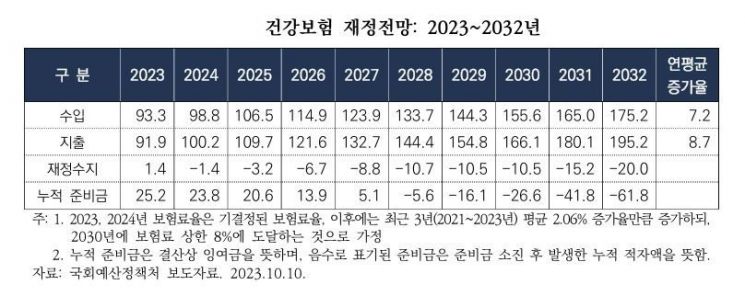 Health Insurance Financial Outlook. [Image source: Korea Medical Association Medical Policy Research Institute]
In this situation, the implementation of the Essential Medical Care Policy Package is expected to accelerate the depletion. First, expanding the number of doctors will directly impact the financial soundness of health insurance. According to a 2007 study by the National Health Insurance Corporation titled 'International Comparison of the Structure and Determinants of National Medical Expenditure,' an increase of one doctor per 1,000 people raises per capita medical expenses by $159. The study statistically calculated that considering various variables such as national insurance systems and doctors' working patterns, an increase of one doctor per 1,000 people leads to about a 22% increase in total medical expenditure in society.
This is due to 'supplier-induced demand' caused by information asymmetry in the medical market. Since doctors, as suppliers of medical services, have superior expertise and information, they make decisions on behalf of patients, the demand side, which differs from general markets. Woo Bong-sik, director of the Korea Medical Association Medical Policy Research Institute, said, "In a situation where a serious health insurance financial collapse is predicted like a time bomb, significantly increasing the number of doctors will deplete health insurance funds sooner and ultimately trigger a bomb of health insurance premium hikes."
Experts said the scale of medical school expansion, the core of the package, should be decided cautiously while considering health insurance finances. Cho Dong-geun, emeritus professor of economics at Myongji University, said, "Healthcare is a market where supply induces demand. Increasing the number of doctors will negatively affect health insurance finances," adding, "To save essential medical care, minimizing medical school expansion and using those resources to adjust essential medical care fees would be more efficient." Kim Won-sik, professor of economics at Konkuk University, said, "In the current health insurance operation system, an increase in doctors leads to competition among hospitals and clinics, which is likely to cause over-treatment. This ultimately leads to increased health insurance expenditures," and added, "The issue of medical school expansion should be approached microscopically."
They also advised caution regarding the plan to spend more than 10 trillion won of health insurance funds to raise essential medical care fees. Professor Kim said, "At the current trend, even without additional health insurance expenditures, reserves will be left with about 5 trillion won by 2027. Additional spending of reserves on essential medical care fees will accelerate the depletion by more than a year, and the cumulative deficit will snowball," adding, "Saying that you will spend 10 trillion won more means collecting more health insurance premiums from the public. Each health insurance-related policy can cause a storm in the medical community, so it must be approached carefully."
Professor Cho also said, "I agree with the direction of raising essential medical care fees. However, considering the financial soundness of health insurance, adjustments in other expenditure areas should be made simultaneously," adding, "Leakage should be stopped by, for example, increasing out-of-pocket payments to nearly 100% for mild illnesses like colds. If out-of-pocket payments increase, patients visiting tertiary hospitals for mild conditions will decrease, reducing unnecessary health insurance expenditures."
Meanwhile, the government maintains that there is no major problem considering the health insurance financial situation. Currently, the accumulated health insurance reserves are about 24 trillion won, and a current account surplus of about 3 trillion won was recorded consecutively in 2022 and 2023. To ensure the financial soundness of health insurance, the government is also pursuing measures to reduce the coverage scope of MRI and ultrasound under health insurance and increase the out-of-pocket ratio for excessive medical users. The government plans to announce health insurance financial projections and sustainability at a briefing on the 2nd Comprehensive Health Insurance Plan (2024?2028) on the 4th.
© The Asia Business Daily(www.asiae.co.kr). All rights reserved.
![Clutching a Stolen Dior Bag, Saying "I Hate Being Poor but Real"... The Grotesque Con of a "Human Knockoff" [Slate]](https://cwcontent.asiae.co.kr/asiaresize/183/2026021902243444107_1771435474.jpg)

















