'Seogye-dong 33 Beonji Area' Briefing Held
Low-rise Multi-family Dense Urban Declining Area
Super Station Area·Development Area 110,000㎡ Large Complex Possible
Up to 39 Floors and 3,000 Households if Zoning Upgraded
On the 1st, at the auditorium on the 2nd floor of the Cheongpa-dong Community Center in Yongsan-gu, Seoul. Despite being a weekday afternoon, the space of about 100 pyeong (approximately 330㎡) was filled with over 300 residents. This was a session where the Seoul Metropolitan Government and Yongsan District Office explained the guidelines of the 'Seogye-dong 33 Beonji Area Rapid Integrated Planning (Shintong Planning)' to residents and property owners. Even before the event started, they showed great interest by underlining pamphlets detailing the redevelopment progress, construction, and move-in schedules, and copying the information into their notebooks.
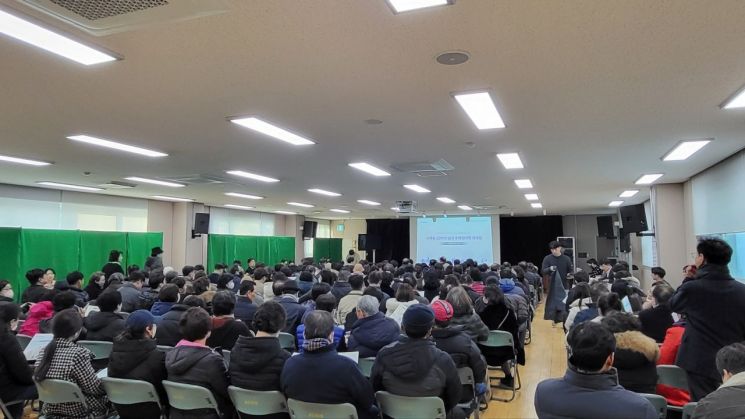 On the 1st, a resident briefing session for the 'Seogye-dong 33 Beonji Area Rapid Integrated Planning (Sintong Planning)' was held in the main auditorium on the 2nd floor of the Cheongpa-dong Community Center in Yongsan-gu, Seoul. Photo by Kwon Hyunji
The Seogye-dong 33 Beonji area, located west of Seoul Station, is an aging urban area densely packed with semi-basement and low-rise multi-family houses. The proportion of housing over 20 years old reaches 87%, and narrow roads make vehicle access and pedestrian movement difficult, resulting in poor living conditions. It stood in stark contrast to the east side of Seoul Station, where large office buildings have been built, and was also called the 'slum of Yongsan-gu.'
On the other hand, its locational advantages are clear. It is an 'ultra-station area' adjacent to Seoul Station, where subway lines 1 and 4, the Gyeongui-Jungang Line, the Airport Railroad, KTX, and conventional railroads pass through. The redevelopment area spans 112,599㎡, allowing for the creation of a large complex. Another feature is the view of Namsan and Namsan N Seoul Tower. A Seoul city official said, "It is one of the few remaining aging residential areas in downtown Seoul and is a particularly high-interest area among Shintong Planning candidate sites."
There have been several redevelopment attempts in the Seogye-dong area in the past. It was designated as a New Town candidate site in 2007, and urban regeneration projects were promoted in 2017. However, it was removed from the candidate list or the projects progressed slowly. After failing the first Shintong Planning public contest in 2021, it was selected as a candidate site after a second attempt in December 2022.
The residents' attention on that day was undoubtedly focused on the 'floor area ratio.' Kim Hyun-joo, head of the Shintong Planning Team 2 at Seoul City, stated at the briefing, "The current zoning, which is type 1 and 2 (up to 7 floors), will be upgraded to type 2, type 3, and semi-residential, and the floor area ratio is planned to be increased up to a maximum of 260%." Applying this would allow for a complex with up to 39 floors and 3,000 households (2,700 apartment units + 300 officetel units).
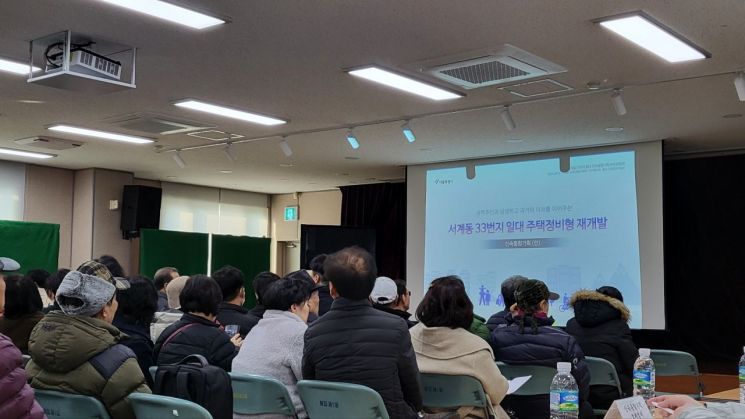 On the 1st, a resident briefing session for the 'Seogye-dong 33 Beonji Area Rapid Integrated Planning (Sintong Planning)' was held in the main auditorium on the 2nd floor of the Cheongpa-dong Community Center in Yongsan-gu, Seoul. Photo by Kwon Hyunji
Additionally, parks will be placed along Mallijae-ro and Cheongpa-ro, and public pedestrian pathways connected to the parks will be created to provide residents with rest areas. Convenient circulation paths will be established, such as connecting the complex with underground parking lots. Considering the high demand from young people in the area, dormitories will be constructed to enhance public benefits.
Residents attending the briefing expressed hopeful expectations. Seo (60), living in Huam-dong, Yongsan-gu, Seoul, said, "Although the contribution fees might be high, I plan to endure whatever it takes because I want to live in a good home as I get older." Oh, a man in his 60s who owns a villa in Hongje-dong, Seoul, also said, "Since Seoul Station is close, it’s convenient to travel to other provinces, and I’m looking forward to the Namsan view being preserved."
However, there were also quite a few residents opposing the announced plan. Park Hong-jae (68, Ahyeon-dong, Seoul) said, "Even around Cheongnyangni Station, a 60-story apartment complex (Cheongnyangni Station Hanyang Sujain Graciel) has been built, so it is disappointing that the area around Seoul Station, called the 'face of Seoul,' is limited to 39 floors." Jeong (72, Seocho-dong, Seoul) also expressed disappointment, saying, "Since apartments are being built on narrow land, the unit sizes come out small," and added, "I plan to express opposition when obtaining residents' consent."
A Seoul city official said, "Although the resident consent rate requirement has been relaxed from two-thirds to more than half (50%), the key is how quickly consent can be obtained," adding, "Internal conflicts over the redevelopment method remain a variable."
© The Asia Business Daily(www.asiae.co.kr). All rights reserved.
![Clutching a Stolen Dior Bag, Saying "I Hate Being Poor but Real"... The Grotesque Con of a "Human Knockoff" [Slate]](https://cwcontent.asiae.co.kr/asiaresize/183/2026021902243444107_1771435474.jpg)

















