Entering 2% Range After 6 Months
Impact of Slowing Petroleum Prices
Fresh Food Prices Soar This Month, Including 56.8% Increase in Apples
Growing Burden on Low-Income Households' Grocery Bills
The consumer price inflation rate for the first month of the new year was recorded at 2.8%. This marks a slowdown to the 2% range for the first time in six months since July last year (2.4%). This was due to the stabilization of international oil prices until mid-January, which led to a decline in petroleum product prices and a slowdown in processed food price increases. However, fresh fruits and vegetables rose by 28.5% compared to the previous year, with apples increasing by 56.8%, increasing the burden on ordinary consumers' grocery bills.
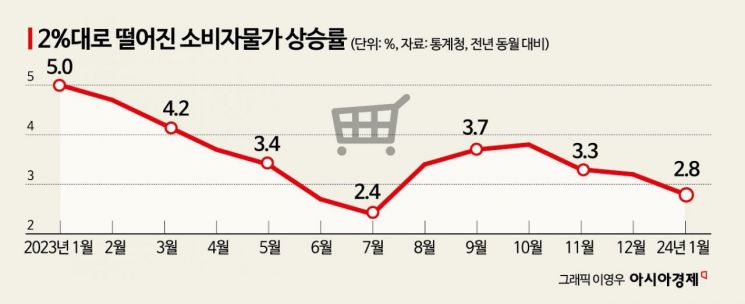
According to the 'January Consumer Price Trends' released by Statistics Korea on the 2nd, the consumer price index last month was 113.15 (based on 2020=100), up 2.8% from the same month last year. The consumer price inflation rate had slowed to 2.4% in July last year but then rose to 3.4% in August and 3.7% in September, maintaining a 3% range for five consecutive months. This was due to ongoing abnormal weather conditions combined with instability in international oil prices. The January consumer price inflation recorded the lowest increase since July last year (2.4%).
The main reasons for the slowdown in consumer price inflation were the decline in petroleum product prices and the continued slowdown in processed food price increases. Petroleum products fell by -5.0% in January this year, following a -5.2% drop in December last year. Until mid-January, international oil prices remained stable as the possibility of the Middle East conflict spreading diminished. Processed food inflation slowed from 4.2% in December to 3.2%, largely due to a reduction in taxes on domestically produced distilled liquor, which lowered soju wholesale prices. Soju prices fell 6.3% compared to the previous month and 0.6% compared to the same month last year.
The government's freeze on electricity rates also had an impact. In January last year, electricity rates rose 9.2% compared to the previous month and 29.5% compared to the same month the previous year, causing a significant jump in prices. In January this year, the price increase rate for electricity, gas, and water slowed from 9.7% in December to 5.0%. Gong Mi-sook, the Economic Trend Statistics Officer at Statistics Korea, explained, “Last year, there was an increase in electricity rates, but this year the rates were frozen in the first quarter, which had an impact.”
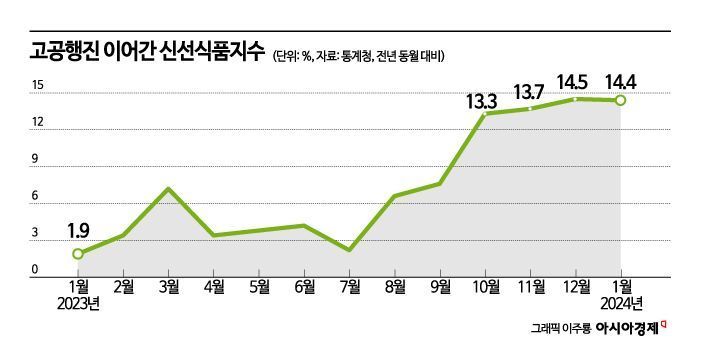
However, fresh food prices continued to rise sharply this month, maintaining the burden on ordinary consumers' grocery bills. The fresh food index rose 14.4% in January this year, following increases of 13.3% in October, 13.7% in November, and 14.5% in December last year. This is the highest increase since January 2017 (15.9%). In particular, the fresh fruit index, which reflects the prices of most fruits except almonds, surged 28.5% compared to the previous year.
Agricultural products rose 15.4% compared to the same month last year. Apples (56.8%), pears (41.2%), tomatoes (51.9%), and green onions (60.8%) showed significant increases. This was due to decreased production caused by adverse weather conditions such as heavy snowfall. A Ministry of Economy and Finance official said, “Apples and pears are harvested about once a year, but production itself has decreased,” adding, “We will speed up measures to stabilize prices during the Lunar New Year period.”
There is an analysis that the slowdown in inflation may be temporary. Following the recent war between Israel and the Palestinian armed group Hamas, the first U.S. military casualty in the Middle East has occurred, escalating tensions in the region again, and signs of a rebound in international oil prices are emerging. Dubai crude, which had been in the $70 range until December last year, has risen to $82.4. The persistent abnormal weather during the winter season is also a factor of concern. On the same day, Choi Sang-mok, Deputy Prime Minister and Minister of Economy and Finance, held an emergency economic ministers' meeting and inflation-related ministers' meeting, stating, “Due to recent instability in the Middle East and the rebound of international oil prices to the $80 range, inflation in February and March could rise again to around 3%.”
He added, “We will do our utmost to ensure that inflation stabilizes quickly in the 2% range so that the public can feel the effect,” and “To stabilize the prices of high-priced items such as apples and pears, we will inject an additional 10 billion KRW into the agricultural and livestock discount support budget and expand the contract cultivation volume of apples and pears by 8,000 tons this year to proactively prepare for future supply and demand instability.”
© The Asia Business Daily(www.asiae.co.kr). All rights reserved.
![Clutching a Stolen Dior Bag, Saying "I Hate Being Poor but Real"... The Grotesque Con of a "Human Knockoff" [Slate]](https://cwcontent.asiae.co.kr/asiaresize/183/2026021902243444107_1771435474.jpg)

















