Import Share Accounts for 36.4%
The Chinese yuan is rapidly replacing the US dollar in Russian trade. Russia is also eager to promote yuan currency connections with other developing countries.
On the 1st, Hong Kong's South China Morning Post (SCMP) cited an interview with Elvira Nabiullina, Governor of the Central Bank of Russia, and local media reports that the share of yuan settlements in Russian export transactions surged from 0.4% in early 2022 to 34.5% by the end of last year. Governor Nabiullina explained, "Until 2022, a significant portion of reserves was in dollars and euros, but foreign economic activities are actively shifting to other currencies such as the yuan."
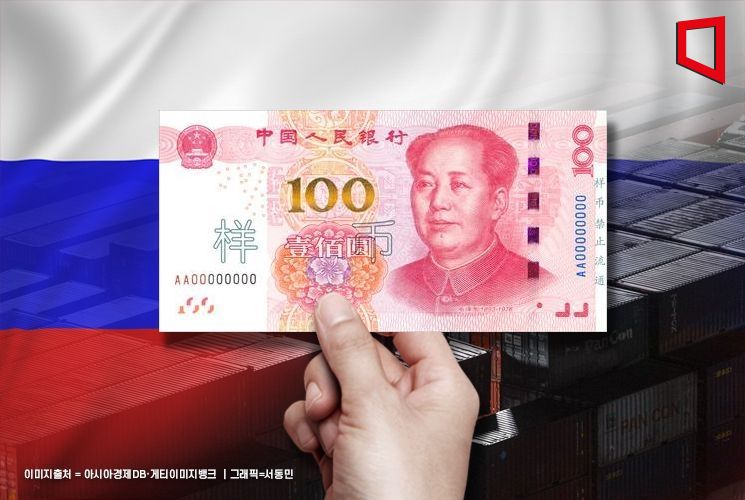
During the same period, the share of yuan in Russia's import transactions also jumped from 4.3% to 36.4%. Andrey Belousov, Russia’s First Deputy Prime Minister, stated in November last year that ruble and yuan settlements accounted for 95% of total trade currency transactions between the two countries.
Since Russia’s invasion of Ukraine, it was excluded from the SWIFT system, which intermediates international interbank financial transactions, in February 2022. Additionally, $300 billion (approximately 397.86 trillion KRW) of the Central Bank of Russia’s overseas assets were frozen. Due to these measures, Russia found it difficult to settle payments in dollars or euros and even demanded ruble payments for energy-related transactions such as natural gas. Facing these challenges, Russia has increasingly circumvented by using the yuan for transactions and holdings. Furthermore, China and Russia have expanded exchanges, concluding 55 cooperation and transaction agreements worth 13.6 billion yuan (approximately 2.51 trillion KRW) in sectors including financial services in the northern city of Shenyang.
Governor Nabiullina emphasized, "This year, Russia is the chair country of the BRICs (Brazil, Russia, India, China, South Africa) group of developing countries," adding, "We will promote cooperation on the use of the yuan and other currencies and the interconnection of payment systems." Since early this year, countries such as Egypt, Ethiopia, Iran, the United Arab Emirates (UAE), and Saudi Arabia have joined, expanding the BRICs group. SCMP evaluated this expansion as "a new opportunity for yuan usage from China’s perspective and also serving as a hedge against the US, which weaponizes the US dollar."
However, some argue that the yuan, which has limited convertibility, is unlikely to replace the dollar. Jean-Pierre Cabestan, Emeritus Professor at Hong Kong Baptist University, pointed out, "BRICs countries are accepting more yuan, but ultimately, only countries with significant Chinese imports will conduct more yuan transactions," adding, "Otherwise, what can be done with a yuan that cannot be freely converted?" He further explained, "We may see China paying for oil in yuan in Saudi Arabia, but most payments will still be made in US dollars."
In India’s case, Russian companies’ proposals to pay for crude oil imports in yuan were rejected. Luke Impy, Professor of Economics at the University of Hong Kong, said, "It might be easier to promote the yuan to countries participating in China’s Belt and Road Initiative (육상 및 해상 실크로드, Yuksang mit Haesang Silk Road) plan."
Meanwhile, according to SWIFT, the yuan accounted for 4.14% of international payments in December last year, making it the fourth most active currency globally.
© The Asia Business Daily(www.asiae.co.kr). All rights reserved.
![Clutching a Stolen Dior Bag, Saying "I Hate Being Poor but Real"... The Grotesque Con of a "Human Knockoff" [Slate]](https://cwcontent.asiae.co.kr/asiaresize/183/2026021902243444107_1771435474.jpg)















