KIDI Holds New Year's Press Conference on the 1st
Establishing Platforms Related to the Insurance Industry
Developing Insurance Products Suitable for the MZ Generation
"The biggest security threat to Korea is the low birthrate rather than North Korea, to the extent that the insurance industry also views low birthrate and aging as serious issues."
On the 1st, Heo Chang-eon, President of the Korea Insurance Development Institute, held a press conference at the Ilex Building in Yeouido, Seoul, stating, "The traditional business model that has driven the growth of the insurance industry so far has reached its limits." Last year, the elderly population aged 65 and over in Korea accounted for 18.4% (9.5 million) of the total population, and by 2025, this proportion is expected to reach 20.6%, entering a super-aged society. It is expected to exceed 30% by 2035.
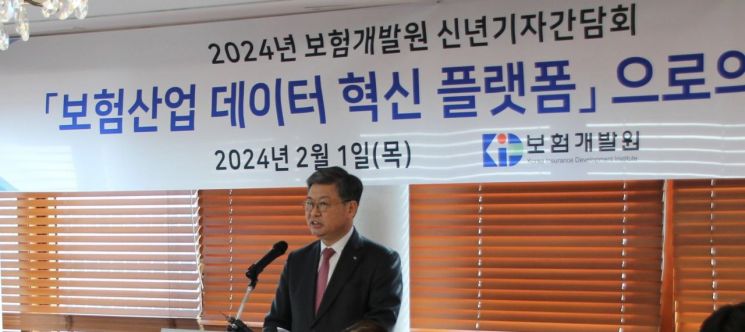 Heo Chang-eon, President of the Korea Insurance Development Institute, held a press conference on the 1st at the Ilex Building in Yeouido, Seoul.
This year, the Korea Insurance Development Institute plans to focus on 'New Business, New Platform, New Where' and will make every effort to overcome the crisis in the insurance industry and create future growth engines. In December last year, the Institute established the 'Data New Growth Office,' which integrates AI-based data planning, combination, and commercialization functions, and assigned specialized personnel.
The Institute plans to propose big data solutions to expand the insurance industry business. This will be done by combining insurance information held by the Institute with financial and non-financial data from other institutions. They plan to analyze potential customers' characteristics from a new perspective and propose new growth solutions for 'product development, customer management, and channel analysis.'
They will also propose new business models based on innovative technologies such as AI and the Internet of Things (IoT). President Heo said, "The insurance industry must go beyond the traditional role of being sellers of insurance products," adding, "The Korea Insurance Development Institute will take the lead in expanding to service providers that contribute to solving chronic social problems such as aging and caregiving."
To develop future-oriented automobile insurance products, the Institute plans to support the revision of rating systems reflecting the characteristics of vehicles and drivers. In response to environmental changes where new technologies such as information and communication technology and autonomous driving technology are actively applied, it is expected to more accurately predict accident risks by reflecting driver and vehicle characteristics. President Heo said, "In the U.S. and Canada, some insurers install security cameras free of charge in homes and offer insurance discounts," explaining, "Because preventing fire and theft with cameras can reduce insurers' loss ratios."
They also plan to support the development of risk rates for caregiving insurance using data from the National Health Insurance Service. Despite approaching a super-aged society, there has been a lack of appropriate statistics related to caregiving risk rates in Korea, making it difficult to actively prepare for the elderly insurance market. The Institute plans to support the activation of the elderly insurance market by utilizing big data.
Efficiency will also be enhanced through the construction of integrated infrastructure. Through consultations on the possibility of data exchange between companies holding driving habit data and the insurance sector, the Institute plans to support the establishment of a data platform that allows driving habit data to be managed internally within the insurance sector. Additionally, based on an AI-based minor accident injury risk analysis program jointly developed with the National Forensic Service, the Korea Road Traffic Authority, and Yonsei University Wonju College of Medicine, they plan to objectively analyze injury risks to minimize disputes related to excessive medical treatment. Furthermore, they plan to expand an automatic review service that automatically pays repair costs by comparing claim estimates with AI estimates using approximately 3 million annual AOS (Automobile repair cost Online Service) data.
To respond to market changes centered on the MZ generation (Millennials + Generation Z), the Institute plans to support product development targeting customers in their 20s and 30s. President Heo said, "We will investigate overseas cases of small-amount short-term insurance products popular among younger age groups and share rating calculation methods with the insurance industry," explaining, "There are many valuable insurance products in advanced countries, such as monthly postpaid cancer insurance or hospitalization/outpatient care due to heatstroke."
They also plan to expand overseas exchange and cooperation projects. President Heo stated, "We will establish a 'K-Insurance' infrastructure in the Southeast Asian insurance market to help insurers find breakthroughs amid market saturation," adding, "We will create sales environments similar to those in Korea in each country to facilitate stable settlement when domestic insurers enter these markets."
© The Asia Business Daily(www.asiae.co.kr). All rights reserved.
![Clutching a Stolen Dior Bag, Saying "I Hate Being Poor but Real"... The Grotesque Con of a "Human Knockoff" [Slate]](https://cwcontent.asiae.co.kr/asiaresize/183/2026021902243444107_1771435474.jpg)















