Selection of Five Major Strategic Tasks Including Offensive Cyber Defense
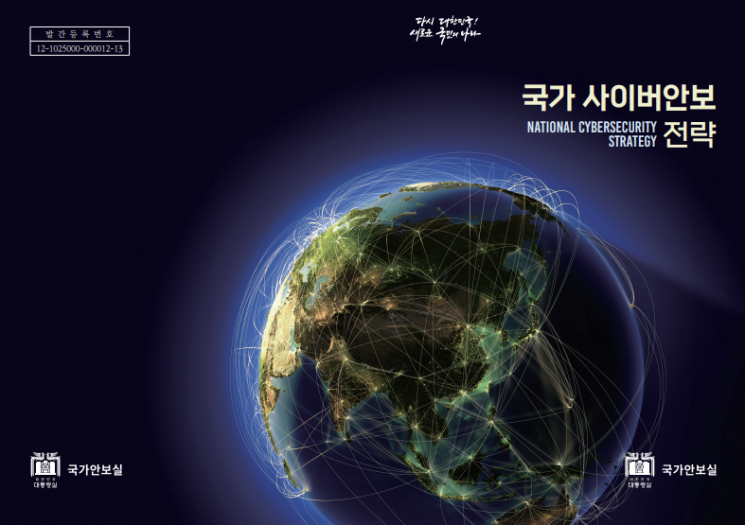
The National Security Office announced the National Cybersecurity Strategy on the 1st, which includes a shift from the existing defense-centered response to proactively identifying and responding to cyber threats, considering the increasing cyber threats from North Korea.
The Presidential Office conveyed through a press release that the National Security Office jointly announced the National Cybersecurity Strategy with the National Intelligence Service, Ministry of Foreign Affairs, Ministry of National Defense, Ministry of Science and ICT, and the National Police Agency. The National Cybersecurity Strategy is the highest-level guideline in the field of cybersecurity that presents the national-level cyber strategy direction, established to reflect the changed security environment and government policy direction.
The Yoon Suk-yeol administration's National Cybersecurity Strategy consists of four chapters: background and vision, goals, strategic tasks, and implementation plans. It also includes ways to realize the government's diplomatic and security philosophy, such as protecting the values of liberal democracy, realizing a global pivotal state, and safeguarding an order based on the rule of law and norms.
The Presidential Office explained, "By setting the vision of the National Cybersecurity Strategy as a 'global pivotal state that fulfills international roles and responsibilities while protecting the values of freedom, human rights, and the rule of law in cyberspace,' it aligns with the direction of the National Security Strategy announced by the Yoon Suk-yeol government in June 2023."
The five strategic tasks selected are ▲ strengthening offensive cyber defense activities ▲ establishing a global cooperation system ▲ enhancing cyber resilience of national critical infrastructure ▲ securing competitive advantage in new technologies ▲ and strengthening the operational foundation.
First, the strategy focuses on North Korea's cyber threats. It plans to present policies and response measures to counter North Korea's cyber threats, including cyber threats to our infrastructure, virtual asset theft to secure funds for nuclear and missile development, and the spread of disinformation.
In particular, it includes an offensive and comprehensive approach that moves away from the existing defense-centered response to proactively identify and respond to cyber threats, as well as measures to strengthen response capabilities for this purpose.
Global cooperation will also be strengthened to enhance cybersecurity. The government has expanded the scope of the Korea-US alliance to cyberspace and strengthened trilateral cyber cooperation among Korea, the US, and Japan through the Camp David cooperation framework. Additionally, a cyber partnership has been established with the United Kingdom. The government also plans to solidify cybersecurity cooperation with countries in the Indo-Pacific region and members of the North Atlantic Treaty Organization (NATO).
Following the administrative network outage incident, a rapid response system will be established, while supporting innovation in information security companies to secure international competitiveness in cyber infrastructure.
The Presidential Office stated, "By establishing the cybersecurity strategy, we will make our best efforts to further strengthen national cybersecurity capabilities and protect the people more safely."
The National Security Office plans to widely publicize the Yoon Suk-yeol administration's National Cybersecurity Strategy domestically and internationally by distributing the National Cybersecurity Strategy booklet (in Korean and English).
© The Asia Business Daily(www.asiae.co.kr). All rights reserved.
![Clutching a Stolen Dior Bag, Saying "I Hate Being Poor but Real"... The Grotesque Con of a "Human Knockoff" [Slate]](https://cwcontent.asiae.co.kr/asiaresize/183/2026021902243444107_1771435474.jpg)











