SK Siltron to Supply Equipment for Wafers Until Next Year
Essential Advanced Semiconductor Item 'Ultra-Pure Water'... Dependence on Japan and Europe
Growing Demand Expected in Advanced Processes Like Display and Substrate
Water treatment specialist Hanseong Cleantec is on the verge of achieving true domestic production of ultrapure water. The company plans to deploy its self-manufactured equipment to SK Siltron, the world's third-largest company based on 12-inch (300mm) wafers, by next year. SK Siltron currently uses ultrapure water-related equipment imported from Japan and Europe, but replacing them starting next year is expected to enhance price competitiveness. Industry insiders say that equipment must also be domestically produced to be recognized as 'domestic ultrapure water.'
Ultrapure water is water that has had impurities such as electrolytes, organic matter, and microorganisms removed. It is used to clean wafers during semiconductor wafer (substrate) manufacturing, front-end processing, and packaging (back-end processing) stages.
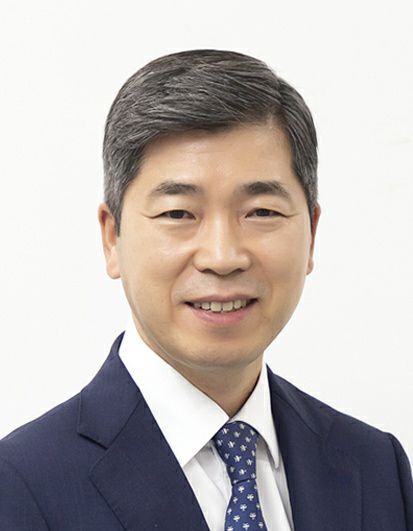
Park Jong-woon, CEO of Hanseong Cleantec, said in an interview at the Seoul headquarters on the 29th of last month, "We are currently producing large-capacity ultrapure water production facilities capable of supplying more than 400 tons of ultrapure water per hour," adding, "These will be supplied to SK Siltron."
SK Siltron has been using ultrapure water produced with Hanseong Cleantec's technology at a rate of 1,200 tons per day since May last year. However, the equipment remains imported from Japan, Europe, and other foreign countries. Once Hanseong Cleantec's equipment is introduced next year, SK Siltron's ultrapure water supply volume will double compared to now.
The biggest advantage of domestic ultrapure water production is cost reduction. Gil Dae-su, director of Hanseong Cleantec's Future Technology Research Institute, who was present, said, "This will be an opportunity to lower the ultrapure water cost, which is about 3,000 KRW per wafer." The ultrapure water industry believes that Japanese companies price their products about 20-30% higher than Korean companies. If domestic ultrapure water companies catch up with Japanese technology and increase supply, large corporations like SK Siltron can also reduce production costs.
Ultrapure water is used in advanced processes such as AI semiconductors and foundries (semiconductor contract manufacturing). Especially in the production of AI semiconductors below 7 nanometers (nm; 1 nm = one billionth of a meter) and early 10-nanometer D-RAM, wafers must be washed with ultrapure water to prevent particle contamination that would otherwise pollute the semiconductors. This means ultrapure water is essential for companies like Nvidia AI semiconductors, Samsung Electronics, and SK Hynix to manufacture high-end semiconductors more efficiently. According to the global water industry research organization Global Water Intelligence (GWI), the global utilization rate of ultrapure water by semiconductor companies was about 40% as of 2021. Recently, not only semiconductor and display companies but also substrate manufacturers have started using ultrapure water in their processes.
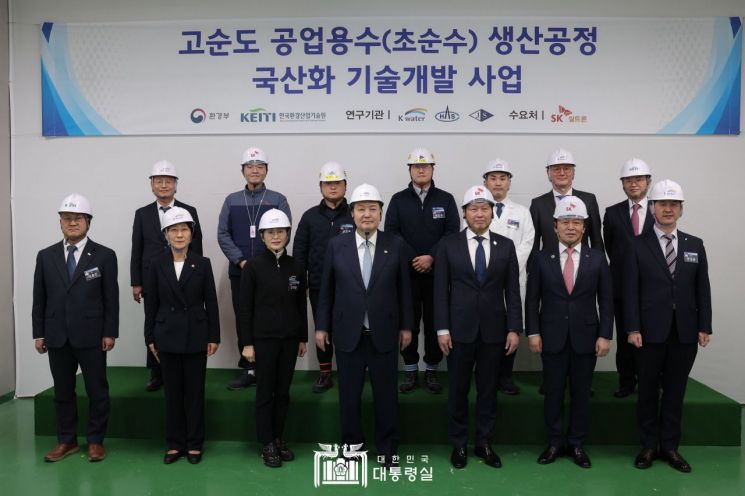 President Yoon Suk-yeol visited the SK Siltron plant in Gumi, Gyeongbuk on February 1st and took a commemorative photo with attendees after inspecting the ultrapure water demonstration plant.
 [Photo by the Office of the President]
Hanseong Cleantec expects that supplying SK Siltron will be a catalyst for expanding major demand. Director Gil said, "Supplying to SK Siltron is proof that our ultrapure water is of world-class quality."
Securing supply to SK Siltron is the result of knocking on doors for the past 20 years. The company took its first step in business by winning the ultrapure water facility project for LG Micron's (now LG Innotek) third plant in 1994, but the process was not easy due to technological gaps. According to research published by Professor Kang Seok-tae of KAIST in September 2022, Korea's ultrapure water technology level is 81% of Japan's, with a technology gap of 3.6 years. While there may be debate over the figures, it is clear that major companies like Samsung Electronics hesitate to use domestic ultrapure water.
After being selected as a company for the Ministry of Environment's ultrapure water production domestic R&D project from 2021 to 2025, with a budget of 30 billion KRW (44.3 billion KRW including private funds), Hanseong Cleantec was able to secure the ultrapure water contract with SK Siltron.
CEO Park is paying close attention to the government's recently announced mega cluster policy. He evaluated it as "a market secured where we can find business opportunities for the next 10 to 20 years." Hanseong Cleantec owns factories in Pyeongtaek, Hwaseong, and Gumi. The ultimate goal is to supply to demand companies in the Gyeonggi-do materials, parts, and equipment cluster. Gyeonggi-do is home to Samsung Electronics' Pyeongtaek and Hwaseong plants and SK Hynix's Icheon plant. Both companies are also building factories in Yongin. CEO Park emphasized, "We plan to remodel the Pyeongtaek plant within three years to enhance production capacity."
© The Asia Business Daily(www.asiae.co.kr). All rights reserved.
![Clutching a Stolen Dior Bag, Saying "I Hate Being Poor but Real"... The Grotesque Con of a "Human Knockoff" [Slate]](https://cwcontent.asiae.co.kr/asiaresize/183/2026021902243444107_1771435474.jpg)
















