Digital Service Public Trust Enhancement Measures on the 31st
Response to Last November's Network Outage Incident
Integrated Monitoring by Agencies... Control Tower Installation
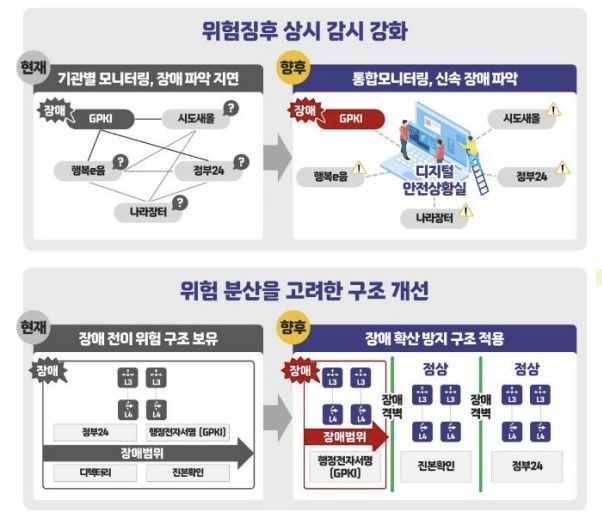
'Fault Isolation Barrier' to Prevent Multiple Systems Connecting to One Device
The government will establish a system to prevent the recurrence of the administrative network paralysis incident that occurred in November last year and to enable rapid recovery in case of occurrence. Monitoring, which was previously conducted separately by each agency, will be integrated to strengthen surveillance, and a 'fault barrier' will be established to block the spread of service disruptions occurring in one location.
On the 31st, the Ministry of the Interior and Safety and related ministries finalized and announced the "Digital Service National Trust Enhancement Measures" containing these details at the National Affairs Ministers' Meeting chaired by the Prime Minister.

Previously, in November last year, multiple network paralysis incidents occurred, starting from local government administrative networks to online civil service 'Government24' and the Public Procurement Service's Nara Marketplace. In response, the government formed the 'Government-wide Task Force for Administrative Network Improvement,' involving 14 agencies including the Ministry of the Interior and Safety, to devise countermeasures. The measures announced that day consist of three main strategies: ▲thorough ongoing fault prevention ▲rapid response and recovery ▲strengthening the foundation of service stability.
First, to prevent network faults on an ongoing basis, the authorities will establish a 'Digital Safety Situation Room' at the National Information Resources Service to conduct integrated monitoring of agencies. Previously, monitoring was conducted separately by agencies such as Nara Marketplace and Government24, which caused delays in fault detection. The 'Digital Safety Situation Room' will serve as a control tower managing the overall situation to prevent fault propagation.
To block the spread to other systems in case of faults, a 'fault barrier' will also be established. The equipment that caused the previous network fault was connected to multiple services and authentication systems, causing system faults to spread to various services. To prevent this, systems connected to a single piece of equipment will be separated so that a fault in one system does not affect multiple systems. As part of preventing fault spread, the application of multiple authentication methods will be mandated for major systems of all administrative and public institutions.
As part of a 'structural reform' to enhance the stability of the administrative network, the information system grading system will be reorganized. The importance of about 17,000 government information systems will be reassessed and new grades assigned. The GPKI (Government Public Key Infrastructure) system, which was the starting point of the recent administrative network incident and is used by all public officials, had previously been classified as grade 3. A Ministry of the Interior and Safety official explained, "Systems heavily used by public officials and citizens will be grouped into grades 1 and 2, while systems with low citizen usage or unnecessary systems will be classified as grades 3 and 4." The government plans to use the budget saved by consolidating lower-grade information systems to reinforce grade 1 and 2 information systems.
Additionally, conditions for corporate participation in public informatization projects will be improved. First, restrictions on large companies' participation will be lifted. The government announced that to activate competition among companies and advance informatization projects, all companies, including those belonging to mutual investment-restricted corporate groups, will be allowed to participate in 'design and planning projects' and large projects exceeding 70 billion KRW. This reflects opinions raised during the prolonged network paralysis incident last year, suggesting the need for large companies' participation in public informatization projects.
Based on field opinions, the criteria for software development fees will also be raised. A Ministry of Science and ICT official said, "We will strive to ensure more appropriate compensation by raising the software project fee calculation standards, reflecting industry opinions and inflation rates."
The Ministry of the Interior and Safety plans to establish task-specific execution plans next month and continuously manage the comprehensive plan's progress through regular and ad hoc inspections via government-wide consultative bodies.
Minister of the Interior and Safety Lee Sang-min stated, "The foundation of rapidly advancing administrative service digitalization must be trust and stability," adding, "The government will not stop at announcing comprehensive measures but will continuously inspect and supplement the progress to provide services befitting the status of a global digital leading country."
© The Asia Business Daily(www.asiae.co.kr). All rights reserved.
![Clutching a Stolen Dior Bag, Saying "I Hate Being Poor but Real"... The Grotesque Con of a "Human Knockoff" [Slate]](https://cwcontent.asiae.co.kr/asiaresize/183/2026021902243444107_1771435474.jpg)

















