Ministry of Industry's 2024 Major Work Plan
Selection of 'Top 30 Strategic Items' Including Supply Chain and Digital
FTA Network Expands from 85% to 90% of Global GDP
The Ministry of Trade, Industry and Energy has set this year's targets at $700 billion in exports, $35 billion in foreign investment attraction, and 150 trillion KRW in private investment. To achieve this, it has selected 10 strategic markets and 30 strategic items and decided to strengthen customized export support.
The Ministry announced the '2024 Major Work Promotion Plan' containing these details on the 31st. The vision of the promotion plan is set as 'Revitalizing the Livelihood Economy through Exports and Investment.'
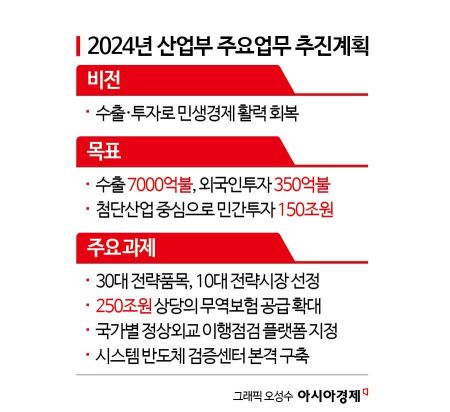
The export target is set at $700 billion, exceeding the record high of $683.6 billion in 2022. To strengthen customized exports, the Ministry will select 10 strategic markets and 30 strategic items. The items are chosen according to the four global core trends: supply chain, digital, carbon neutrality, and demographic structure. The FTA network relative to global GDP will be strengthened from the current 85% to 90%. Additionally, it plans to expand supply chain, green, and technology markets by leveraging Official Development Assistance (ODA).
It will also address the three major difficulties faced by export companies: finance, marketing, and certification. It will provide trade insurance worth a record high of 250 trillion KRW and allocate 31.1 billion KRW for export vouchers, nearly doubling the previous amount. In particular, it will strengthen large-scale project financing in sectors such as defense, nuclear power, and plants. The contract limit for medium- to long-term project export insurance will be raised to 20 trillion KRW, and short-term insurance and credit guarantee fees necessary for small and medium-sized export companies will be uniformly discounted by 50%.
To ensure smooth private investment, policy finance focused on advanced industries will be expanded from 13 trillion KRW last year to 14.7 trillion KRW this year. It will spend 139.2 billion KRW on infrastructure for the rapid establishment of advanced specialized complexes and prepare comprehensive support plans for these complexes, including strengthening research and development (R&D). The tax credit for investment in national strategic technologies will be extended to reduce the financial burden on companies. Along with this, three major regulatory innovation systems will be established: operation of the killer regulation innovation process, development of a regulatory index for advanced industrial complexes, and introduction of regulatory impact analysis.
Furthermore, 100 core companies will be newly designated to secure advanced technologies. Advanced foreign investment incentives will be strengthened to up to 50% of the investment amount, and a dedicated R&D project for foreign-invested companies will be newly established. The subsidy limit for advanced technology return investments will be expanded from 15 billion KRW in the metropolitan area and 30 billion KRW in non-metropolitan areas to 20 billion KRW in the metropolitan area and 40 billion KRW in non-metropolitan areas.
Fabless & Materials, Parts and Equipment, 24 Trillion KRW Preferential Financing... Secondary Battery Policy Finance 5.9 Trillion KRW
The creation of a national advanced strategic industry ecosystem will also be intensified. In the case of semiconductors, the system semiconductor verification center will be fully established starting this year. The fabless and materials, parts and equipment sectors will be guided toward self-reliance through preferential loan and guarantee support amounting to 24 trillion KRW over the next three years. For secondary batteries, 5.09 trillion KRW in policy finance will be supplied to expand domestic mineral processing facilities, and the bio sector will nurture strategic bases through designation of advanced strategic industry specialized complexes. Additional designations for future cars, defense, and robotics will also be discussed.
Detailed strategies for establishing supply chain and economic security are included. The 'Industrial Supply Chain 3050' initiative will be fully implemented to reduce dependence on specific countries for stable supply chain items from 70% in 2022 to below 50% by 2030. Support will be provided to discover alternative import sources for more than 10 items, and various incentive systems such as import insurance will be introduced. Existing specialized complexes for materials, parts and equipment will be developed as production bases for supply chain stabilization.
The transition to carbon-free energy (CFE) aiming for carbon neutrality by 2050 will also begin. CFE implementation standards reflecting domestic corporate conditions will be prepared, and joint working group activities will be conducted for international standardization with major countries. Supply capacity for carbon-free energy sources such as nuclear power and hydrogen will be focused on expanding. Procedures for constructing Shin Hanul Units 3 and 4 will be expedited, and advance payments will be made immediately upon contract for nuclear power auxiliary equipment. The goal is to achieve early orders worth 5 trillion KRW for nuclear power facilities within the year and to make thorough preparations for nuclear power bids in the Czech Republic and Poland.
To promote regional investment and create quality jobs, opportunity development zones will be newly designated in the first half of this year in non-metropolitan areas and some metropolitan areas (population decline areas, border areas). Tax, fiscal, and regulatory easing will be concentrated in these areas. The support limit for regional investment promotion subsidies will also be doubled from 10 billion KRW to 20 billion KRW, and support requirements will be relaxed.
© The Asia Business Daily(www.asiae.co.kr). All rights reserved.


















