Non-major, not an entry requirement but a 'bonus point system'
Up to 10 bonus points lead to tens of billions in differential funding
"Practically no different from forcing non-majors"
Although the government has stepped back by allowing universities to receive funding incentives without mandating a certain ratio of non-major admissions in this year's college entrance, concerns still persist in the academic community. If universities expand non-major recruitment, incentives worth tens of billions of won are expected to be distributed differentially based on additional points, which is seen as "virtually equivalent to a mandate." The education sector also points out the need for authorities to take a breather.
According to the Ministry of Education's basic plan for the 'University Innovation Support Project and National University Development Project' on the 31st, the government will support a total of 15.574 trillion won to 154 universities, including private and national universities, this year. About half of the funding will be allocated to universities based on the number of enrolled students, while the remainder will be distributed as 'incentives' based on qualitative evaluations of each university's innovation performance. Initially, an incentive plan was proposed only if the non-major admission ratio exceeded 20-25%, but following feedback from the field, incentives will be provided even if the recruitment ratio is not met, with additional points awarded to universities that recruit non-majors above a certain level.
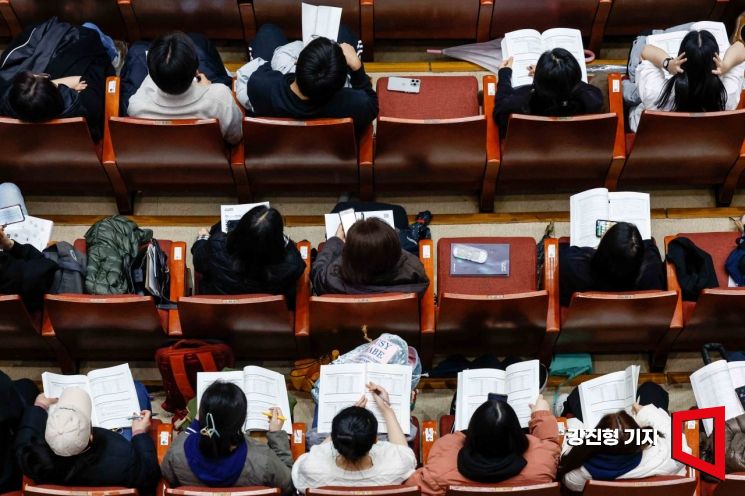 On the 11th, examinees and parents attending the '2024 College Entrance Regular Admission Preparation Briefing for Students and Parents' held at the Han Kyung-jik Memorial Hall of Soongsil University in Dongjak-gu, Seoul, are listening to the explanation. Photo by Kang Jin-hyung aymsdream@
According to the additional point criteria, the more a university expands its non-major recruitment ratio, the more incentives it can receive, potentially tens of billions of won. The maximum additional points added to the qualitative evaluation score of 100 points is 10 points, which can raise the qualitative evaluation grade by up to two levels. Universities receive qualitative evaluation grades such as S (95 points or higher), A (90 to less than 95 points), B (80 to less than 90 points), and C (below 80 points), with different weightings for each grade. Calculating the weighting based on the average incentive amount received by universities, the difference in the amount received between an S-grade university and a C-grade university can be about 3 billion won.
As a result, universities facing financial difficulties pointed out that this is effectively a standard that forces them to expand non-major admissions. Kang Chang-woo, chairman of the National Association of Humanities Deans of National Universities (and dean of the College of Humanities at Seoul National University), who expressed opposition to the introduction of non-major admissions on the 24th, said, "According to the additional points table, a difference of 1 point can cause a difference of at least several hundred million to over 1 billion won," adding, "For universities struggling financially, this may not be significantly different from the previous Ministry of Education evaluation criteria." He emphasized, "In the end, it is practically no different from the Ministry of Education effectively forcing universities to admit a certain proportion of non-majors."
In fact, universities have relied on government financial support due to a tuition freeze policy that has lasted for 16 years. According to a survey conducted by the Korea Council for University Education (KCUE) from the 10th to the 22nd of this month targeting presidents of 135 universities, the top area of interest this year, as last year, was financial support projects (71.9%). Many universities are expected to join the trend of expanding non-major admissions by utilizing the Ministry of Education's financial support measures. Among universities that responded they have not previously recruited non-majors (54.8%, 71 universities), 77% (57 universities) answered that they plan to 'introduce' non-major recruitment. However, universities also expressed concerns about major concentration and opposition from members regarding the introduction and expansion of non-major admissions.
In the education sector, while the goal of nurturing convergent talents through the introduction of non-major admissions is reasonable, voices call for sufficient consideration of the field situation. A professor at a private university explained, "From the Ministry of Education's perspective, it is correct to strive to cultivate talents related to national competitiveness," but added, "(Prospective) students prepare for early admission through student record comprehensive screening centered on majors, so talking about non-major admissions contradicts the admission system. Proceeding with a mid- to long-term roadmap would reduce the burden on universities."
© The Asia Business Daily(www.asiae.co.kr). All rights reserved.

















