Hwang Yoonjae, Distinguished Professor, Department of Economics, Seoul National University
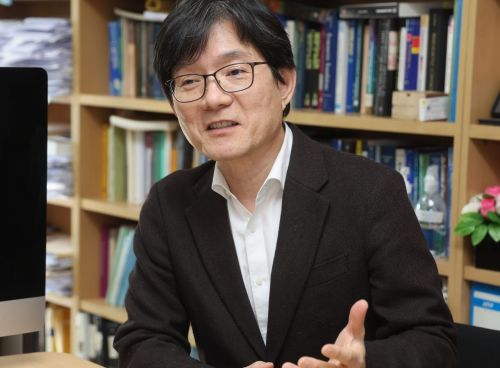 President of the Korean Economic Association, Professor Hwang Yoon-jae, Seoul National University. Photo by Huh Young-han younghan@
It has been argued that big data from social networking services (SNS) and news can be used to measure economic indicators such as expected inflation and appropriately utilized in economic policy.
Hwang Yoon-jae, Chair Professor of the Department of Economics at Seoul National University (President of the Korean Economic Association), will deliver a keynote speech on "Challenges and Tasks of Data-Driven Economic Policy" at the 2024 Joint Economics Conference hosted by the Korean Economic Association at Seoul National University on the 1st.
Professor Hwang stated, "In modern society, with the advancement of information and communication technology, various data are being accumulated," adding, "If such data are properly utilized in economic policy, it is possible to establish more efficient, effective, and reliable policies, as well as improve policies through continuous monitoring and evaluation of results."
He then introduced a method to measure expected inflation using text data, a type of big data. Expected inflation, which refers to the inflation anticipated by economic agents, is one of the key economic indicators used by central banks worldwide, including the Bank of Korea.
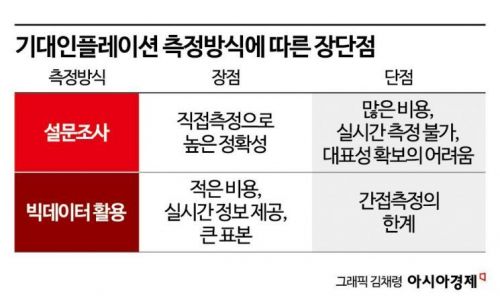
Professor Hwang explained that expected inflation is measured directly through surveys, which ensures high accuracy but involves high costs, difficulty in real-time measurement, response bias depending on the question format, and challenges in securing sample representativeness.
On the other hand, measuring expected inflation using big data has advantages such as utilizing a very large sample size, lower response bias related to question format, provision of real-time information, and lower costs compared to surveys.
Professor Hwang introduced the "Big Data-based Expected Inflation (BIE) Index," developed using text data from Korean communities, news, and Twitter.
He said, "The volume of inflation mentions in big data tended to increase rapidly at times such as public utility fee hikes or announcements of U.S. base rate increases," adding, "Mentions of price decreases surged when news such as the spread of COVID-19 or international oil price drops were announced."
He continued, "The daily BIE index created using the difference in these mention volumes has rapidly increased since March 2020, peaked in the summer of 2022, and recently shown a declining trend," noting, "This BIE index exhibits a trend very similar to actual inflation and had the same peak as the Bank of Korea’s expected inflation indicator after entering a high inflation phase in 2021."
Furthermore, he added, "Compared to the Bank of Korea’s existing indicators, the BIE index appears to have a more leading trend change characteristic," and "This characteristic is similar to the expected inflation in the U.S. and very different from the features of the Bank of Korea’s survey-based expected inflation indicators."
Professor Hwang concluded, "These results suggest that indicators using big data can potentially provide useful information," emphasizing, "For this, a foundation must be established for cooperation among experts in various fields such as economics, psychology, linguistics, computer science, and policy authorities in the future."
© The Asia Business Daily(www.asiae.co.kr). All rights reserved.
![Clutching a Stolen Dior Bag, Saying "I Hate Being Poor but Real"... The Grotesque Con of a "Human Knockoff" [Slate]](https://cwcontent.asiae.co.kr/asiaresize/183/2026021902243444107_1771435474.jpg)
















