Inflation and Economic Growth Expected to Continue
Economic media CNBC reported on the 29th (local time) that there is a forecast that the U.S. economy will go beyond a soft landing and achieve a 'no landing' scenario.
Brett House, an economics professor at Columbia Business School, stated, "In many ways, the U.S. economy has already achieved a soft landing," adding, "The U.S. Federal Reserve (Fed) has very skillfully accomplished the difficult task of threading the needle with the 'Goldilocks' scenario (an economy that is neither too hot nor too cold)."
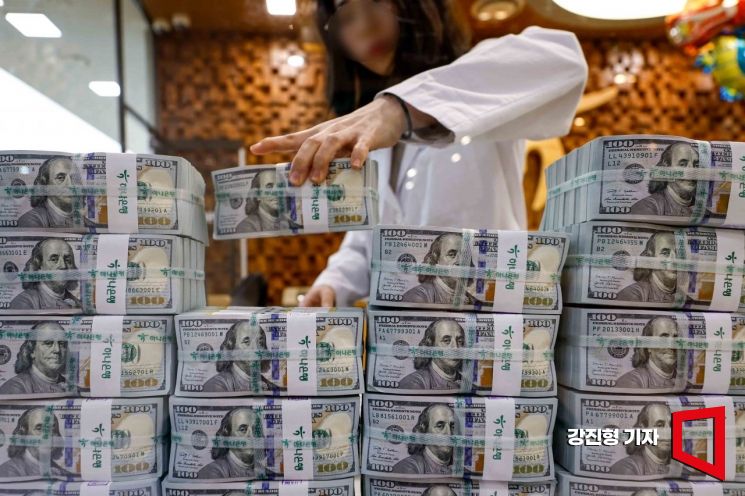 As the USD-KRW exchange rate surpassed 1,340 won early in the trading session, an employee is organizing dollars at the Counterfeit Response Center of Hana Bank in Jung-gu, Seoul on the 17th. Photo by Jinhyung Kang aymsdream@
The U.S. fourth-quarter Gross Domestic Product (GDP) grew by 3.3%, exceeding expectations, supported by a robust labor market and strong consumer spending.
Alejandra Grindal, chief economist at Ned Davis Research, said, "Inflation still exceeds the central bank's target of 2%," and added, "The door to the 'no landing scenario' has opened." Grindal further explained, "No landing means growth and inflation above trend," and "the economy is overheated."
Both soft landing and hard landing scenarios assume that the economy will enter a recession, whether gradually or sharply. In contrast, the no landing scenario forecasts that the economy continues to grow without landing, maintaining high altitude while inflation persists.
Inflation has become a persistent issue for the U.S. economy since the COVID-19 pandemic. In response, the Fed raised interest rates, which have reached the highest level in 22 years. Based on recent figures, the annual inflation rate is 3.4%, exceeding the Fed's annual inflation target of 2%.
However, CNBC explains that the combination of high interest rates and inflation has significantly impacted consumers. In a no landing state, growth continues, but at the same time, the burden on households with budgets and variable-rate debts such as credit cards increases.
There is also a view that inflation, although still high, is continuing to decline. This could signal the Fed's possibility of starting interest rate cuts in the second half of this year. Professor House said, "It appears that a soft landing has been somewhat achieved and is likely to continue." If inflation continues to decrease, the burden on consumers struggling with high borrowing costs such as mortgages, credit cards, and auto loans could be alleviated.
On the other hand, some voices still point to the possibility of a hard landing. Mark Higgins, senior vice president at Index Fund Advisors, said, "The real risk is that the Fed cuts rates too early, which is exactly what the Fed did in the late 1960s," adding, "The risk of allowing inflation to persist is much greater than the risk of causing a recession." He further noted, "The mistake the Fed made in the late 1960s led to entrenched inflation in the 1970s."
According to a survey conducted by the National Association for Business Economics in December last year, 76% of economists believe the probability of a recession in the next 12 months is below 50%. Higgins said, "It is normal for the economy to experience expansion and contraction," and added, "Although it will be painful in the short term, taking the necessary measures to return to price stability will bring better outcomes in the long term."
© The Asia Business Daily(www.asiae.co.kr). All rights reserved.
![Clutching a Stolen Dior Bag, Saying "I Hate Being Poor but Real"... The Grotesque Con of a "Human Knockoff" [Slate]](https://cwcontent.asiae.co.kr/asiaresize/183/2026021902243444107_1771435474.jpg)
















