Phone Financial Fraud Losses Surge in November-December Last Year
Recently, there has been a sharp increase in damages caused by telephone financial fraud (voice phishing) and investment reading room scams, prompting the police to urge individuals to exercise caution.
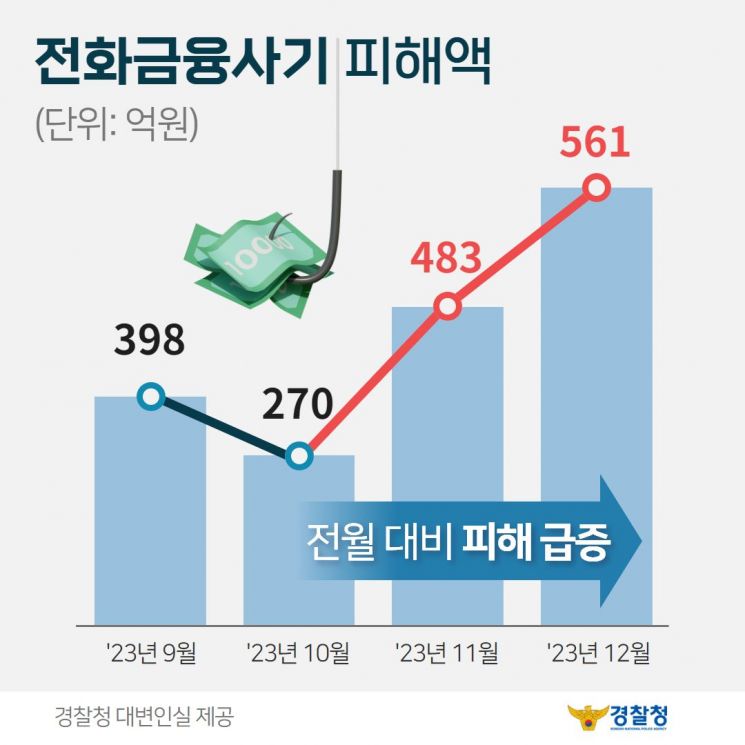
According to the National Police Agency's National Investigation Headquarters on the 30th, the monthly damage amount from telephone financial fraud was 48.3 billion KRW in November last year and 56.1 billion KRW in December. Compared to the average monthly damage amount of 34 billion KRW from January to October last year, which had decreased by about 28% compared to the previous year, this represents a steep upward trend.
Recently, telephone financial fraud criminal organizations mainly use a method called smishing, which involves sending large volumes of bait messages such as delivery notifications, obituary notices, and Health Insurance Corporation messages to install malicious apps. According to the "Integrated Reporting and Response Center for Telecommunication Financial Fraud," smishing crimes accounted for 36% of all reports and tips as of last month. In particular, over 70% of smishing attempts involved impersonation of obituary notices and messages impersonating the Korea Customs Service related to overseas direct purchases.
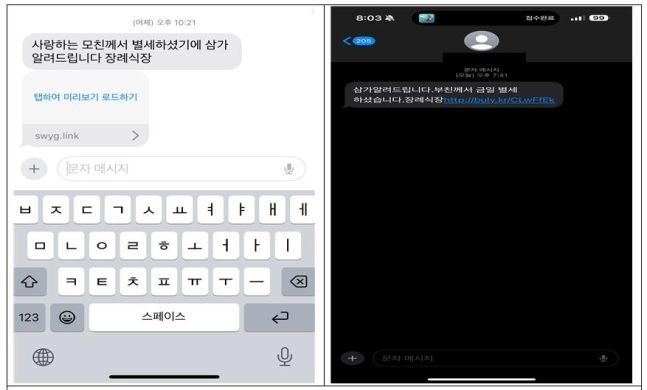
Once the malicious app is installed, all files such as text messages, contacts, and photos are extracted, exposing personal information. Telephone financial fraud organizations use the obtained information and functions like "call interception" to impersonate police, prosecutors, and Financial Supervisory Service employees, extorting large sums of money from victims over an extended period.
Additionally, criminals use mobile phones with installed malicious apps to send other bait messages to acquaintances. Since acquaintances check the messages without suspicion, the malicious app spreads like a virus. To prevent damage, recipients should never click on any internet address (URL) contained in text messages, regardless of who the sender is.
A National Police Agency official said, "Recent damage cases often involve victims falling for the same scenarios that have been ongoing for years," and urged, "Please learn the characteristics and prevention methods of financial frauds such as telephone financial fraud, investment reading rooms, and pyramid schemes, and be sure to share this information with family and relatives during the Lunar New Year holiday."
Investment reading room scams recruit victims through YouTube advertisements, phone calls, and text messages by claiming that principal guarantees and high returns are possible, then use various tricks to lure victims into investing.
When a victim takes the "bait," they are made to join a public chat room. Although it appears that there are hundreds of investors in the room, in reality, one or two criminals use proxy accounts and multi-login programs to play the role of hype men.
The criminals deceive victims by creating fake websites and blogs, as well as promotional YouTube videos impersonating celebrities. They also create fake Home Trading Systems (HTS) linked to real-time data such as the KOSPI index, manipulating only the victim's stocks.
Pyramid schemes and multi-level marketing scams typically take the form of a "Ponzi scheme." They recruit victims by guaranteeing principal and high returns without any means of generating profits, then use the investments of new victims to pay existing investors.
The criminals disappear once a certain target amount is reached, and most victims usually report the damage at this point. A National Police Agency official stated, "If someone guarantees principal and high returns while claiming it is secret information, it should be considered a scam."
© The Asia Business Daily(www.asiae.co.kr). All rights reserved.
![Clutching a Stolen Dior Bag, Saying "I Hate Being Poor but Real"... The Grotesque Con of a "Human Knockoff" [Slate]](https://cwcontent.asiae.co.kr/asiaresize/183/2026021902243444107_1771435474.jpg)
















