Ulsan City Selected for Ministry of Employment and Labor's 'Shipbuilding Industry Hope Savings Project'
This Year: 4.46 Billion KRW from City Funds, 4.95 Billion KRW from National Funds
Ulsan City is launching a support project for shipbuilding industry workers.
On the 30th, Ulsan City announced that it has been selected for the Ministry of Employment and Labor’s “Shipbuilding Industry Employee Hope Savings Project” and will support 9,280 workers from in-house subcontractors of HD Hyundai Heavy Industries and Hyundai Mipo Dockyard, the two major shipbuilding contractors in the Ulsan area.
This Hope Savings Project is a program newly implemented this year by the Ministry of Employment and Labor, following the “Win-Win Agreement for Improving the Dual Structure of the Shipbuilding Labor Market” signed in February last year by Ulsan City, the Ministry of Employment and Labor, shipbuilding contractors, and in-house subcontractors.
The project period is from 2024 to 2026, with a total budget of 37.12 billion KRW (18.56 billion KRW each from national and city funds). For this year, the budget is 9.41 billion KRW (4.95 billion KRW national funds, 4.46 billion KRW city funds).
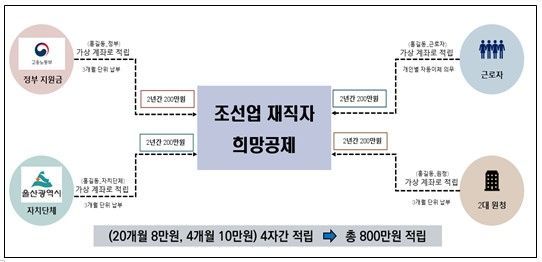
The government, Ulsan City, the contractors, and the workers will each contribute 2 million KRW over two years, and upon maturity, 8 million KRW will be paid to the workers. The purpose is to reduce turnover rates and improve skill proficiency by effectively increasing workers’ real wages.
The savings project will be carried out by the Ulsan Economic and Job Promotion Agency. Starting in February, the project will be promoted to in-house subcontractor workers, and applications and evaluations of eligible participants will be conducted from March to May.
The savings will begin to be accumulated from July, with the contribution period running from July 2024 to June 2026.
An official from Ulsan City expressed expectations that “this project will help maintain the world’s number one competitiveness of the shipbuilding industry, a key local industry, and contribute to increasing skill proficiency and productivity by reducing worker turnover and job changes.”
© The Asia Business Daily(www.asiae.co.kr). All rights reserved.
![Clutching a Stolen Dior Bag, Saying "I Hate Being Poor but Real"... The Grotesque Con of a "Human Knockoff" [Slate]](https://cwcontent.asiae.co.kr/asiaresize/183/2026021902243444107_1771435474.jpg)















