Confirmed as products imported from a factory in China
Suspicions have been raised that foreign substances, presumed to be flies, were found in unopened Chinese-made Gaoliang liquor. On the 30th, Mr. A, who lives in Incheon, ordered Gaoliang liquor at a restaurant in Seoul last September and discovered foreign substances that appeared to be insects inside the transparent bottle. Mr. A claimed, "There was a strange object inside the bottle, and upon closer inspection, it was a fly carcass," adding, "It was definitely inside before opening the bottle cap." He further explained, "A friend dining with me contacted the importer to raise the issue, but their response was insincere," and said, "I reported this to raise awareness about food safety."
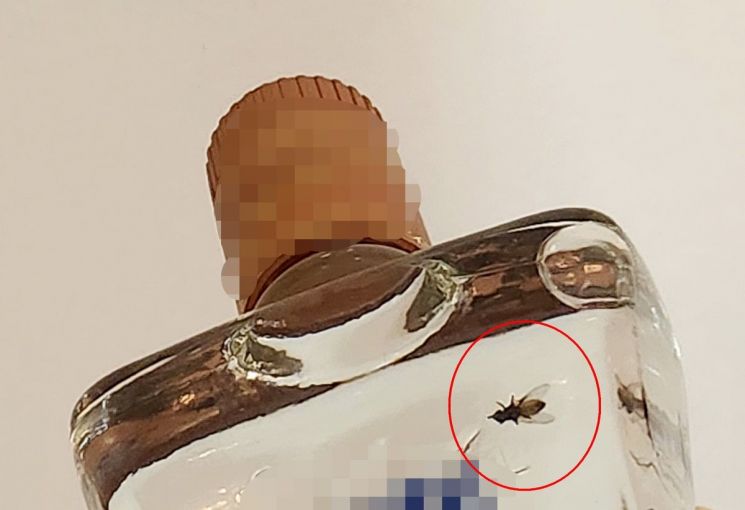 The unopened bottle of sorghum liquor contained a black object presumed to be an insect. This object is about 2 cm long, with an elongated snout, six legs, and a pair of wings, resembling a fly.
 [Photo by Yonhap News]
On the 26th, Yonhap News met with Mr. A and directly inspected the product, confirming that the unopened Gaoliang liquor bottle clearly contained a black object presumed to be an insect. The object was about 2 cm long, with a slender proboscis, six legs, and a pair of wings, resembling a fly. The importer confirmed that the liquor was produced at a manufacturing plant in China and distributed through a domestic importer.
The importer stated that after receiving customer complaints about the foreign substance, they intended to actively proceed with follow-up measures such as product recall, detailed investigation, and compensation negotiations. However, the importer explained, "We initially offered a case of liquor, but heard that a compensation amount of 100 million won was being demanded," adding, "Despite our efforts to request dialogue, we could not meet the complainant and were unable to verify the product in person."
On the other hand, Mr. A rebutted, "The 100 million won figure was mentioned by the restaurant owner who sold us the liquor, comparing it to the 'Chinese beer urination incident,' implying that even 100 million won would not be too much compensation; it was not something I said." He also added, "We never proposed a specific compensation amount," and said, "The importer has continuously treated us as malicious complainants, distorted our intentions, and we decided to report this regardless of compensation."
Qingdao 'Urination' Controversy Causes Sharp Drop in Chinese Beer Imports
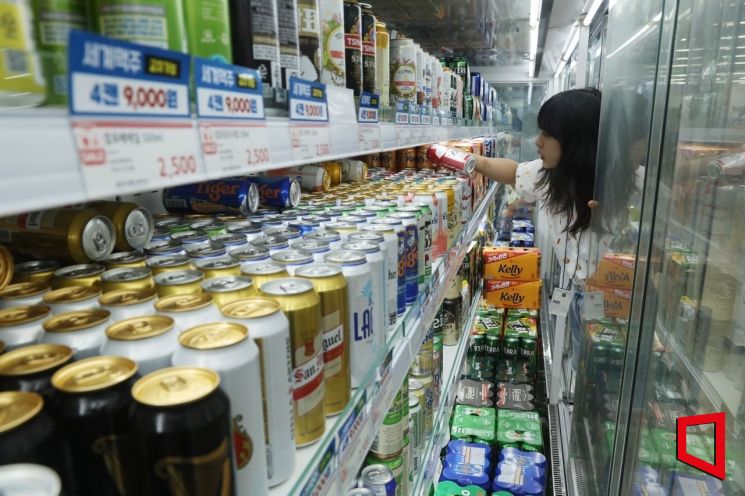 Around October last year, shortly after a video surfaced showing an employee at the local factory of Chinese beer Qingdao allegedly urinating on beer ingredients, sales of Qingdao at domestic convenience stores sharply declined. Due to the many alternatives available in imported beer, demand quickly shifted to beers from other countries, making the 'Qingdao boycott' a reality.
 [Photo by Younghan Heo younghan@]
The case of insects found in Gaoliang liquor recalls the urination controversy in Qingdao last October. At that time, a video surfaced showing an employee at the local Qingdao beer factory in China allegedly urinating into beer ingredients, which led to a sharp decline in Qingdao beer sales at convenience stores. Especially due to the abundance of alternatives in imported beers, demand quickly shifted to beers from other countries, making the 'Qingdao boycott' a reality.
Among this, Japan reclaimed the top spot as the largest beer importer last year after five years. This was the first time since the Japanese government's semiconductor export restrictions on South Korea. Meanwhile, China fell from first to third place as a beer importer due to the fallout from the Qingdao beer 'urination controversy.' Last year, China's beer import value was $30,163,000, down 17.2% from the previous year. The controversy arose after a video showing a man urinating at the Qingdao beer factory in China was released in October last year, directly leading to decreased sales.
Meanwhile, manufacturers found at fault for foreign substance contamination can be sanctioned under the Food Sanitation Act. The current law prohibits selling or manufacturing, importing, processing, using, cooking, storing, subdividing, transporting, preserving, or displaying food or food additives that do not meet standards and specifications for sale.
Based on this, the Ministry of Food and Drug Safety issues administrative measures such as corrective orders, suspension of product manufacturing, and product disposal depending on the degree of foreign substance contamination and fault. Responsible parties may face imprisonment of up to five years or fines up to 50 million won, but if the cause and responsibility for the foreign substance are not identified, it is difficult to hold the company or store accountable.
© The Asia Business Daily(www.asiae.co.kr). All rights reserved.
![Clutching a Stolen Dior Bag, Saying "I Hate Being Poor but Real"... The Grotesque Con of a "Human Knockoff" [Slate]](https://cwcontent.asiae.co.kr/asiaresize/183/2026021902243444107_1771435474.jpg)
















