FOMC on 30-31 This Year’s First
Earnings Reports This Week from MS, Alphabet, Apple, Meta, and More
The three major indices of the U.S. New York stock market showed a flat trend in the early trading session on Monday, the 29th (local time). The market is exhibiting a cautious stance as investors await this week's scheduled Federal Open Market Committee (FOMC) meeting of the U.S. Federal Reserve (Fed) and the earnings announcements of big tech companies.
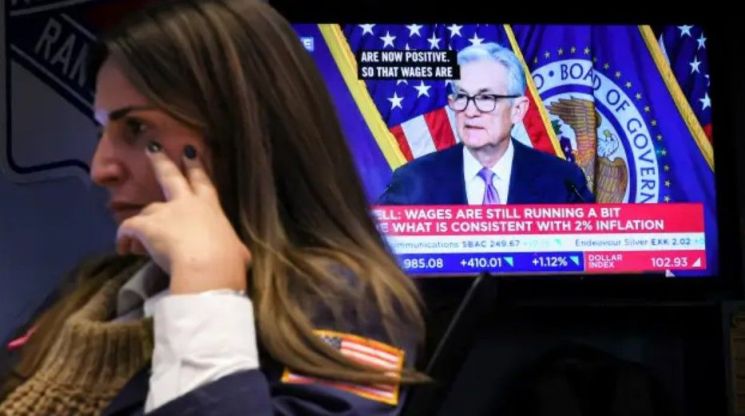
As of 10:23 a.m. at the New York Stock Exchange (NYSE), the Dow Jones Industrial Average was trading at 38,128.6, up 0.05% from the previous trading day. The S&P 500, which is centered on large-cap stocks, rose 0.05% to 4,893.49, while the tech-heavy Nasdaq index was up 0.13% at 15,475.16.
iRobot, the manufacturer of the Roomba robotic vacuum cleaner, is down more than 11%. The stock plunged after the European Union (EU) antitrust authorities rejected Amazon's acquisition of iRobot on antitrust grounds, causing the merger plan to collapse. Digital financial services company SoFi Technologies surged more than 21% in early trading, buoyed by improved earnings.
Investors are awaiting this week's FOMC meeting, big tech earnings reports, and employment data releases. The FOMC outcome, which will provide clues on this year's interest rate path, and the big tech earnings will determine whether the upward trend in stock prices continues.
This week is an earnings super week, with 19% of S&P 500 companies scheduled to report results. On the 30th, Microsoft (MS) and Alphabet will announce earnings, followed by Apple, Amazon, and Meta on the 1st of next month. MS, which is leading the generative artificial intelligence (AI) market in partnership with OpenAI, is expected to report a 15.8% increase in revenue for the fourth quarter of last year. If big tech companies' earnings fall short of market expectations, market volatility could increase.
The first FOMC meeting of the year, held on the 30th and 31st, is the biggest event the market is watching. The January FOMC meeting is widely expected to keep the benchmark interest rate steady at the current 5.25-5.5% range. The key focus is on the message from Fed Chair Jerome Powell. Attention is on what Powell will say regarding the timing and pace of future rate cuts.
Market forecasts are divided over whether there will be a rate cut in March. Economic indicators that will form the basis for the future interest rate path are mixed. Last month, the core Personal Consumption Expenditures (PCE) price index rose 2.9% year-over-year, falling into the 2% range for the first time in two years and nine months since March 2021. On the other hand, the U.S. Gross Domestic Product (GDP) grew 3.3% in the fourth quarter of last year, significantly exceeding market expectations of 2%. As assessments emerge that the U.S. economy is approaching a 'Goldilocks' state (neither overheating nor cooling), reliance on the employment data to be released this week is increasing. On the 30th, the December Job Openings and Labor Turnover Survey (JOLTS) will be released, followed by January's nonfarm payrolls and unemployment rate on the 2nd of next month.
Chris Larkin, Head of Trading and Investments at U.S. online brokerage E-Trade, said, "This week will be critical," adding, "For the market to maintain its recent breakthrough, big tech must avoid disappointing earnings, and the Fed must deliver encouraging news regarding interest rates. Employment should be solid but not too hot." Sonu Varghese, Global Macro Strategist at U.S. investment advisory firm Carson Group, analyzed, "The Fed no longer needs to worry about a hot economy fueling inflation," explaining, "Because we are seeing quite the opposite situation." He added, "The economy is outperforming the trend, and inflation is declining. Based on this, we are increasing equity allocations in our portfolios."
The expansion of conflicts in the Middle East is a source of market instability. Following a drone attack by a pro-Iran armed group that killed three U.S. troops stationed in the Middle East on the 28th, concerns are growing that if the U.S. responds strongly, armed conflict in the region could escalate.
International oil prices rose the previous day amid concerns over escalation in the Middle East but are now falling due to overlapping forecasts of demand slowdown caused by China's real estate crisis. West Texas Intermediate (WTI) crude oil is trading at $77.42 per barrel, down $0.59 from the previous session, while Brent crude futures are down $0.62 at $82.93 per barrel.
Andrea Tueni, Head of Sales Trading at Saxo Bank, said, "This week is very important," analyzing, "Three major factors?earnings, central banks, and geopolitical risks?can move the situation." He added, "Even if volatility remains very low, if just one of these three factors ignites, the situation can become unstable."
In the New York bond market, Treasury yields are declining. The U.S. 10-year Treasury yield, a global bond benchmark, is around 4.11%, while the 2-year Treasury yield, sensitive to monetary policy, is around 4.33%.
© The Asia Business Daily(www.asiae.co.kr). All rights reserved.
![Clutching a Stolen Dior Bag, Saying "I Hate Being Poor but Real"... The Grotesque Con of a "Human Knockoff" [Slate]](https://cwcontent.asiae.co.kr/asiaresize/183/2026021902243444107_1771435474.jpg)
















