265 Billion KRW Invested This Year to Build Clean Energy Ecosystem Including Hydrogen and Wind Power
Mayor Lee Kang-deok: "Accelerating Pohang-Centered Clean Energy Renaissance Through Transition"
Pohang City will invest 26.5 billion KRW this year to create an ecosystem for clean energy industries such as hydrogen, solar power, and wind power, which are future energy sources.
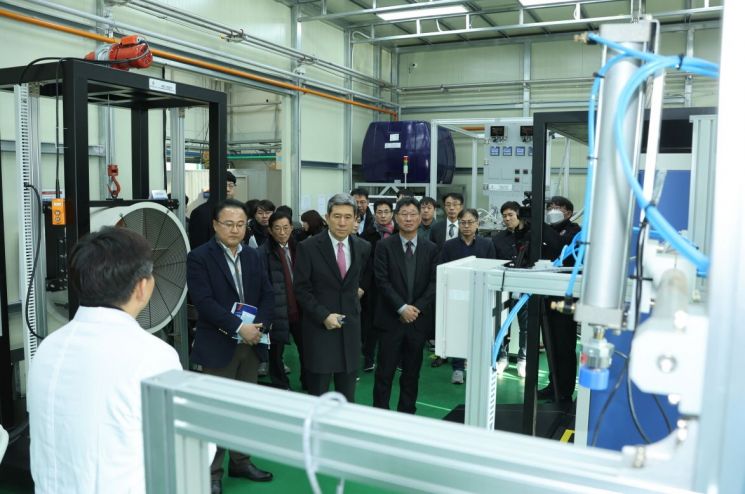 On the 10th, after the 'Business Agreement for the Activation of the Hydrogen Fuel Cell Industry,' Mayor Lee Kang-deok of Pohang is touring the Hydrogen Fuel Cell Certification Center located at Pohang Technopark.
To this end, the city plans to promote projects including ▲Hydrogen Fuel Cell Cluster (6.5 billion KRW) ▲Hydrogen City Development (8 billion KRW) ▲Strengthening Competitiveness of Hydrogen Specialized Industries (1 billion KRW) ▲Public-led Large-scale Offshore Wind Power Support (2.5 billion KRW) ▲Expansion of Renewable Energy Supply (1.13 billion KRW) ▲Energy Efficiency Support (450 million KRW) ▲Support for Urban Gas Non-supply Areas (2.3 billion KRW) ▲LPG Pipeline Network Construction (4.57 billion KRW).
Following the preliminary feasibility study approval of the Hydrogen Fuel Cell Cluster and the full-scale launch of the Hydrogen City Development project last year, Pohang City plans to proactively respond to attracting hydrogen companies by preparing sites and commencing construction of a 16.7 km hydrogen pipeline connecting POSCO to the Blue Valley Industrial Complex this year.
Furthermore, the city will strengthen hydrogen industry competitiveness by supporting technology development and overseas market expansion for local prospective hydrogen specialized companies, accelerating market entry through testing, evaluation, certification, and technology demonstration support using the Hydrogen Fuel Cell Certification Center.
Additionally, the city gained a growth engine for renewable energy by being finally selected last year in the public-led large-scale offshore wind farm development support project competition.
Accordingly, this year, Pohang will install wind measurement devices, collect wind resource data, form a public-private council (including fishermen and residents) to secure acceptance, and establish a coexistence model for fisheries and a resident profit-sharing model to ensure the project benefits all local residents, preparing meticulously for a mutually beneficial initiative.
The city will also promote the expansion of renewable energy supply by installing solar power, solar thermal, and geothermal facilities at 200 locations including local houses, public, and industrial buildings.
Moreover, based on these clean energy infrastructures, Pohang plans to concentrate all capabilities to respond by developing regional specialized new industry models for the first-time designation of hydrogen specialized complexes and distributed energy specialized areas to be implemented this year.
In addition, Pohang City will address energy welfare blind spots by promoting energy efficiency support projects such as replacing LED lighting for vulnerable groups and upgrading to high-efficiency heating and cooling systems in welfare facilities.
The city plans to carry out urban gas expansion supply construction in areas without urban gas and build LPG pipeline networks equivalent to urban gas in rural fishing villages where construction is difficult as part of energy welfare projects.
Mayor Lee Kang-deok said, “To leap from a carbon-dependent economy to a low-carbon economy, we will accelerate the transition to clean and safe energy,” adding, “By fostering the coexistence and development of existing strong industries and new green industries, we will open a clean energy renaissance centered on Pohang through strengthening the region’s industrial competitiveness.”
© The Asia Business Daily(www.asiae.co.kr). All rights reserved.
![Clutching a Stolen Dior Bag, Saying "I Hate Being Poor but Real"... The Grotesque Con of a "Human Knockoff" [Slate]](https://cwcontent.asiae.co.kr/asiaresize/183/2026021902243444107_1771435474.jpg)















