As Interest Rates Fall, Deferred Fundraising Begins
Pension Funds and Insurers Scoop Up Corporate Bonds
IB Industry Says "Super Boom Likely to Continue Through Q1"
The volume of corporate bonds issued by large corporations in January alone this year is expected to approach a record high of 11 trillion won. As market interest rates have shown a noticeable downward trend since the beginning of the year, the market environment has become the most favorable for issuing corporate bonds since the Legoland incident in 2022. Institutional investors such as the National Pension Service also perceive January as the 'peak interest rate of the year' and have been injecting large-scale funds into 'picking up corporate bonds' from the start of the year.

Monthly corporate bond issuance exceeds 10 trillion won for the first time... SK, Hanwha, Hyundai Motor in order
According to the investment banking (IB) industry on the 29th, the total amount of general corporate bonds issued this year to date (excluding financial bonds, equity-related bonds, and bonds with options) reached 10.43 trillion won. Including the volume scheduled to be issued by the 31st of this month, the January corporate bond issuance volume is expected to approach 11 trillion won. This is 1.5 to 1.8 times the average level and is the largest monthly bond issuance volume ever recorded for January.
Among large corporate groups, SK Group issued the largest amount of bonds at 1.985 trillion won. By affiliate, SK E&S (500 billion won), SK Incheon Petrochem (300 billion won), SK Geocentric (300 billion won), SK Rent-a-Car (300 billion won), SK Broadband (230 billion won), SK Siltron (200 billion won), and SK Discovery (100 billion won) issued corporate bonds to raise funds.

Following them were Hanwha Group (1.15 trillion won) and Hyundai Motor Group (1.1 trillion won), both of which have issued over 1 trillion won in bonds so far this year. Within Hanwha Group, Hanwha Aerospace (400 billion won), Hanwha Solutions (350 billion won), Hanwha (250 billion won), and Hanwha Energy (150 billion won) raised funds. Hyundai Motor Group affiliates such as Hyundai Steel (500 billion won), Hyundai Construction (300 billion won), and Hyundai Transys (300 billion won) issued corporate bonds worth several hundred billion won each.
Affiliates of Lotte Group (935 billion won), CJ Group (820 billion won), LG Group (770 billion won), KCC Group (643 billion won), and Shinsegae Group (568 billion won) also joined the corporate bond issuance rally from January. Leading domestic securities firms that underwrite bond issuance, such as Mirae Asset Securities and Samsung Securities, issued corporate bonds worth 560 billion won and 400 billion won, respectively. Considering that securities firms usually do not frequently issue corporate bonds and mainly use repurchase agreements (RP), commercial paper (CP), and short-term bonds as their primary funding sources, this is unusual.
An IB industry insider said, "Although credit ratings remain high, corporate bond issuance has increased among petrochemical companies that need to secure cash liquidity due to somewhat sluggish performance last year, and Hanwha Group affiliates that are increasing new investments in defense and energy sectors," adding, "Except for construction companies facing concerns over project financing (PF) defaults, most companies are increasing bond issuance."
Lowest interest rates in 3 years... Explosive delayed fundraising
The reason companies are rushing to issue corporate bonds is thanks to the stabilization of declining market interest rates. Interest rates in January this year fell to the lowest levels since the Legoland incident, rapidly improving the corporate funding environment. The 3-year government bond yield (based on the Korea Financial Investment Association's final quoted yield) dropped to around 3.10?3.30%, marking the lowest point in about 16 months.
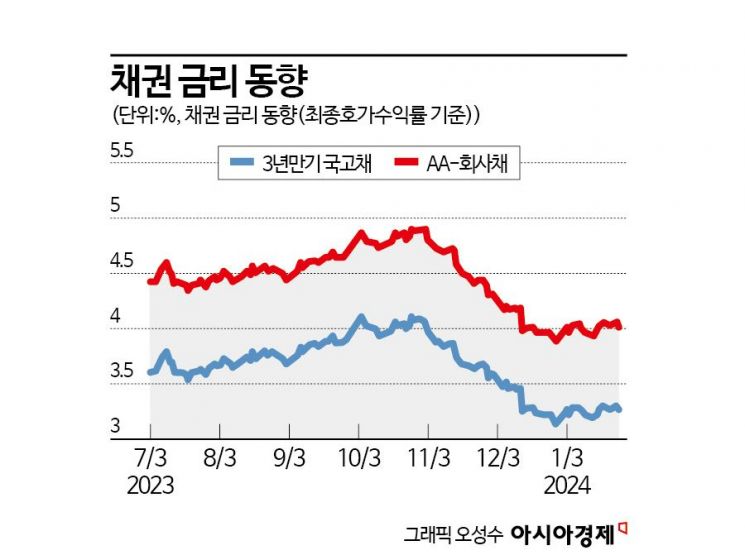
The AA- rated corporate bond yields also fell to around 4%, the lowest since May 2022. Corporate bond issuance rates are determined by adding credit spreads based on corporate credit ratings to government bond yields of the same maturity. In January, along with the decline in government bond yields, credit spreads for high-quality large corporations also narrowed. From the perspective of large corporations, interest burdens from bond issuance have significantly decreased.
A bond manager at an asset management firm said, "Last year, companies burdened by high interest rates secured liquidity by using short-term funding methods such as CP, short-term bonds, and corporate loans instead of issuing corporate bonds," adding, "At the beginning of the year, as interest burdens eased, companies repaid short-term funds and flocked to the corporate bond issuance market to secure new funds."
The influx of large-scale institutional funds into the bond market also influenced the surge in corporate bond issuance volume. Institutional investors such as the National Pension Service, other pension funds, mutual aid associations, banks, insurance companies, and asset management firms evaluated the early-year declining interest rate trend as the 'peak interest rate' and executed large-scale funds into the bond market. It is analyzed that if interest rates fall further, investors can expect not only principal and interest income but also bond valuation gains.
As institutional funds poured into high-quality bonds, high-credit companies with AA ratings such as LG Uplus, Naver, Shinsegae, Daesang, Hyundai Steel, SK Broadband, and Hanwha Aerospace fixed issuance rates in the mid-to-high 3% range for 3- to 5-year maturity corporate bonds. Along with the interest rate decline, actual issuance rates fell further due to demand far exceeding supply in the bond market.
An IB industry insider said, "In January, institutional investment funds flowing into corporate bond demand forecasts (bidding) are at least twice and up to ten times the scheduled bond issuance amount," adding, "There is a growing competition among institutional investors to 'pick up bonds' from the start of the year." The insider predicted, "Once institutional investors secure a certain amount of corporate bonds to meet their funding plans for this year, the competition may ease somewhat, but the bond market boom at the beginning of the year is likely to continue within the first quarter."
© The Asia Business Daily(www.asiae.co.kr). All rights reserved.
![Clutching a Stolen Dior Bag, Saying "I Hate Being Poor but Real"... The Grotesque Con of a "Human Knockoff" [Slate]](https://cwcontent.asiae.co.kr/asiaresize/183/2026021902243444107_1771435474.jpg)


















