Major American fast-food chains such as Starbucks, Coca-Cola, and McDonald's are facing boycotts in the Middle East.
Bloomberg reported on the 25th (local time) that Starbucks appeared on a consumer boycott list circulating on social media in Egypt. Consumers in the Middle East, angered by the passive stance of the US and Europe in stopping Israel's offensive in the Gaza Strip, are avoiding major Anglo-American brands.
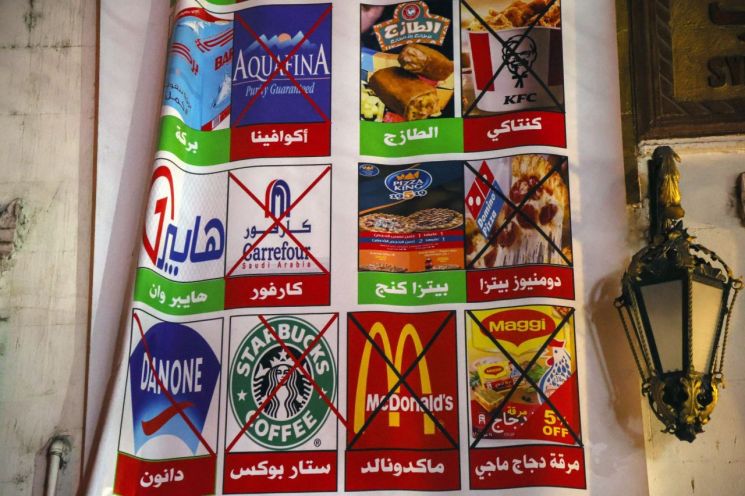
According to the report, dozens of usually bustling Starbucks and McDonald's stores in Cairo have been left empty recently. The same is true elsewhere. Jordan is no exception. Many Starbucks and McDonald's stores in Jordan remain empty about three months after the boycott began, with tags describing foreign brands as "boycott products" displayed everywhere.
In T?rkiye, some officials have promoted a boycott of Coca-Cola, and in November last year, the Turkish parliament announced plans to ban Coca-Cola sales in restaurants.
Some analysts predict that these boycotts will impact profits. McDonald's CEO Chris Kempczinski recently said, "The inflammatory news circulating about McDonald's has put a brake on our business in the Middle East."
In fact, the stock price of Americana Restaurants International PLC, the Middle Eastern franchise operator of KFC, Pizza Hut, Krispy Kreme, and Hardee's, has fallen by 27% since the war began.
However, in Saudi Arabia, the boycott movement has not gained much traction. This is presumed to be because the government restricts most collective actions such as protests, resulting in weak public desire for boycotts.
Local companies are benefiting from the spread of these boycotts. According to Bloomberg, sales of local carbonated beverage manufacturers in Egypt have tripled. Mos Faouri, founder of the Jordanian coffee chain Astrolabe, said, "We exclude American and French products from our stores and source products like syrups locally," adding, "Since the boycott, sales have surged by 30%, and business is booming."
Fawaz Gerges, a professor of Middle Eastern politics at the London School of Economics, explained, "The current boycott is intense, transnational, and led by the younger generation, which makes it particularly prominent," adding, "The younger generation is aware of what is happening and is holding American CEOs accountable for the US's support of Israel."
© The Asia Business Daily(www.asiae.co.kr). All rights reserved.
![Clutching a Stolen Dior Bag, Saying "I Hate Being Poor but Real"... The Grotesque Con of a "Human Knockoff" [Slate]](https://cwcontent.asiae.co.kr/asiaresize/183/2026021902243444107_1771435474.jpg)















