Shin Seong-il and Eom Aeng-ran Develop Romance Through Film
Video Archive Discovers 16 Feature Films from 1960s-70s
Opportunity to Fill Gap in Korea's First Film Renaissance Period
"It is deeply moving to be able to encounter a lost film again like this. 'Betrayal' was a work produced with the goal of breaking away from the typical Korean film grammar of the time and creating it with new techniques."
 Director Jeong Jin-woo of the film 'Betrayal' is giving a greeting at the 'Unreleased and Discovered Film Screening and 50th Anniversary of the Institution Press Conference' held on the morning of the 26th at the Korean Film Archive in Mapo-gu, Seoul.
 [Photo by Yonhap News]
Director Jeong Jin-woo (87), who led the Korean film renaissance in the 1960s, expressed his feelings upon re-encountering his second directorial film, 'Betrayal' (1964), in this way.
On the 26th, the Korean Film Archive revealed 16 newly discovered feature films from the 1960s to 1970s at a briefing held in Sangam-dong, Mapo-gu, Seoul. At the event, partial screenings of five films, including the digitally restored 'Betrayal,' were also held.
Director Jeong, who attended the briefing, explained the directorial intent behind 'Betrayal' at the time: "We applied various attempts to tell the story focusing more on visuals than language. For example, the breakup between the male and female leads, played by Shin Seong-il and Um Aeng-ran, was expressed through the image of a large log splitting in half at the sawmill where the male lead works."
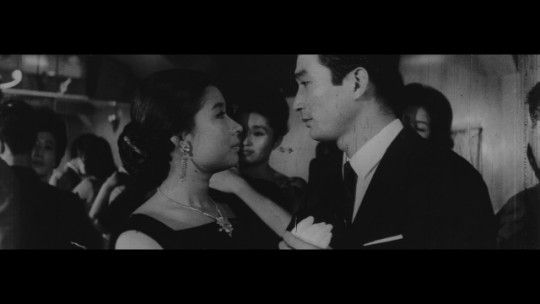 A still photo from the film "Betrayal" (1964), directed by Jeong Jin-woo, starring actors Eom Aeng-ran (left) and Shin Seong-il. [Photo courtesy of the Korean Film Archive]
He continued, "It was first screened at the Seoul Academy Theater, and it was sold out from the first day to the last day," adding, "Starting with 'Betrayal,' subsequent works like 'Secret Meeting' (1965), 'Heavy Rain' (1966), 'Boarder' (1966), and '8240 K.L.O' (1966) all succeeded at the box office, and I think I endured thanks to that momentum."
Director Jeong debuted with the film 'Only Son' in 1963 and made his first film at the age of 23, becoming known as the youngest director in Chungmuro at the time. He was recognized as a young director who experimented beyond conventional film grammar.
His second directorial work, 'Betrayal,' was an experimental film that anticipated the so-called 'cine-poem' trend he later showed, attracting 100,000 viewers at the time and achieving box office success.
The film tells the story of Seong-hoon (played by Shin Seong-il), a member of a violent organization covering up corruption in a construction company, who accidentally meets and falls in love with Ji-won (played by Um Aeng-ran), the boss's (Jang Dong-hwi) girlfriend. It is also known that Um Aeng-ran and Shin Seong-il developed a romantic relationship during the filming of this movie and later married.
In addition to 'Betrayal,' the feature films newly discovered by the Korean Film Archive this time include ▲ Director Ahn Hyun-chul's 'Mother's Strength' (1960) ▲ Director Lee Byung-il's 'The Road to Seoul' (1962) ▲ Director Kim Ki's 'Even If I Call Out Choked' (1968) ▲ Director Kim Soo-yong's 'Seoknyeo' (1969).
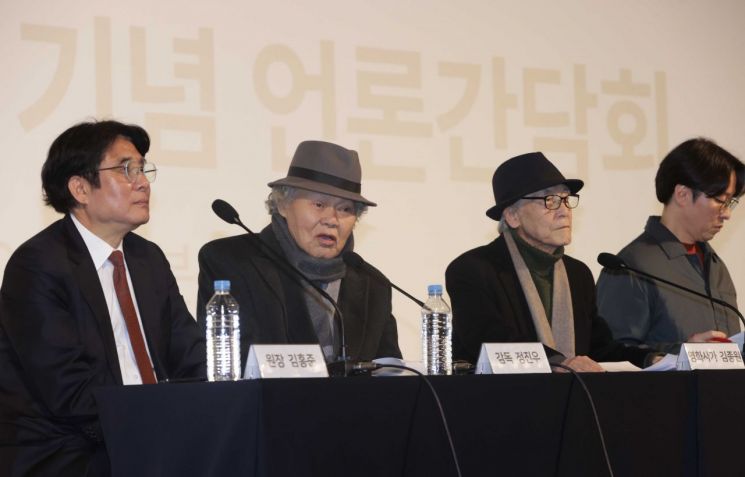 Director Jeong Jin-woo (second from left) of the film "Betrayal" is giving a greeting at the "Unreleased Film Discovery and 50th Anniversary Commemoration Press Conference" held on the morning of the 26th at the Korean Film Archive in Mapo-gu, Seoul. From the left: Kim Hong-jun, Director of the Korean Film Archive; Director Jeong Jin-woo; film researcher Kim Jong-won; and Jeong Jong-hwa, head of the Korean Film Archive's Curatorial Research Team.
 [Image source=Yonhap News]
Among the newly discovered works, Director Im Kwon-taek's 'Binari at the Wharf' (1970) also attracted attention. This work is regarded as a film that established the action film grammar leading to Im's hit 'General's Son' (1990).
These works were discovered through detailed inspection after receiving 88 pieces of 16mm feature film reels stored at the KBS Suwon Center. The Korean Film Archive plans to digitally restore these works and release them sequentially.
Kim Hong-jun, director of the Korean Film Archive, emphasized, "Physical deterioration of analog films is ongoing, and there are still many films urgently needing digital restoration. So far, 795 films have been identified as candidates for digital restoration, among which 48 are in urgent need due to advanced deterioration. At the current pace, it would take about 20 years to complete digital restoration, so increased interest and budget for restoration and digitization of Korean classic films are necessary."
© The Asia Business Daily(www.asiae.co.kr). All rights reserved.
![Clutching a Stolen Dior Bag, Saying "I Hate Being Poor but Real"... The Grotesque Con of a "Human Knockoff" [Slate]](https://cwcontent.asiae.co.kr/asiaresize/183/2026021902243444107_1771435474.jpg)

















