Haitai Confectionery Launches 'Guun Maraling'
Paldog Releases 'King Ttukgyeong Mala Flavor'... Spiciest in Korea
Ottogi Leads with 2 Types of 'Mara Sauce' for Mixing with Rice
The Chinese Sichuan spice 'Mala (麻辣)' has struck the domestic food and dining industry in Korea. Known for its numbing and spicy flavor, Mala initially gained popularity among Chinese international students and Korean-Chinese communities, but since the late 2010s, it has rapidly risen in popularity. Along with the popularization of Chinese dishes like Malatang and Malaxiangguo, Mala has deeply penetrated the domestic food market, from snacks to cup noodles.
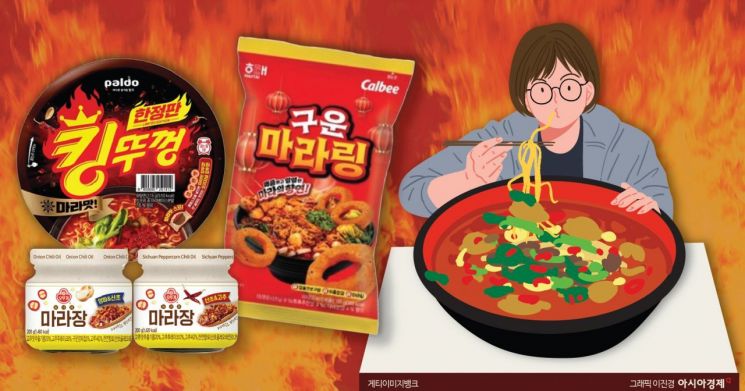
According to the industry on the 29th, Haitai Confectionery recently launched 'Guwon Maraling (60g)' through 7-Eleven. Guwon Maraling is a ring-shaped snack coated with spicy and numbing Mala flavor, targeting young consumers who prefer bold snacks. It contains 8% Mala seasoning and 4% Mala powder. Mala has been incorporated not only into snacks but also into K-noodles. Paldo released 'Paldo King Ttukgyeong Mala Flavor' earlier this month. It is the brand's first limited edition, with 700,000 units available for sale.
Paldo applied Mala to the spiciest King Ttukgyeong cup noodle in Korea, introducing the 'King Ttukgyeong Mala Flavor.' It has a Scoville Heat Unit (SHU) of 12,000, the highest among cup noodles. This is 1.6 times hotter than Nongshim's Shin Ramyun spicy version, 'Shin Ramyun The Red,' which has a SHU of 7,500. The included Mala-flavored soup contains Vietnamese chili, Cheongyang chili, and Mala. Without the included soup, the taste is identical to the original King Ttukgyeong. Yoo Byung-kwon, head of Paldo's Marketing Team 1, said, "King Ttukgyeong Mala Flavor reflects the market trend of seeking diverse flavors. We will continue to deliver new experiences to consumers through unique attempts."
Ottogi launched two types of 'Mala Sauce' that can be easily sprinkled on fried rice, soups, pasta, and more. The newly introduced Mala sauces come in two varieties: 'Sichuan Pepper & Chili' and 'Onion & Sichuan Pepper.' They can be used creatively in various dishes such as Malatang, fried foods, cream pasta, and tteokbokki. The 'Sichuan Pepper & Chili' sauce features the numbing taste of Mala, allowing Mala enthusiasts to enjoy the tingling sensation of Sichuan pepper deliciously. The 'Onion & Sichuan Pepper' sauce highlights the umami of Mala with the sweetness of onion, making it accessible even for Mala beginners. An Ottogi representative said, "As Mala flavor has gained great popularity among many consumers recently, we introduced products that can be mixed into various everyday dishes to enjoy Mala flavor more easily."
Additionally, convenience store CU collaborated with Chinese cuisine master Chef Yeo Kyung-ok to launch the new 'Oksabu's Mala Series' on the 23rd. The new products include four types: Mala Jjajang, Mala Jjamppong, Jjajang rice bowl, and Jjamppong rice bowl.
Meanwhile, as the Mala craze continues, imports of Mala sauce from China are also rapidly increasing. According to customs export-import trade statistics, the volume of sauces imported from China reached a record high of 75,806 tons last year. After maintaining around 60,000 tons annually, the volume jumped to over 70,000 tons starting in 2020 and continues to rise. This includes some Korean sauces like doenjang and gochujang made in China, but most are Chinese sauces such as Doubanjiang, Hoisin sauce, oyster sauce, Malatang sauce, and hot pot sauces.
© The Asia Business Daily(www.asiae.co.kr). All rights reserved.
![Clutching a Stolen Dior Bag, Saying "I Hate Being Poor but Real"... The Grotesque Con of a "Human Knockoff" [Slate]](https://cwcontent.asiae.co.kr/asiaresize/183/2026021902243444107_1771435474.jpg)
















