Purchase of Paper Gift Certificates for Parents' Gifts
Evading Crackdown Using Online Initial Consonants
Transactions Outside Affiliated Stores Are Illegal
Office worker Choi (31) purchased paper-type Onnuri gift certificates worth 500,000 KRW at a 10% discount price of 450,000 KRW on an online secondhand trading site. The purpose was to give them as gifts to his parents ahead of the Lunar New Year holiday next month. Currently, commercial banks sell paper-type gift certificates at a 5% discount. Choi also went to banks several times to try to purchase the gift certificates legally but was unsuccessful. Eventually, he contacted a seller on the secondhand trading site and obtained the gift certificates through a direct transaction.
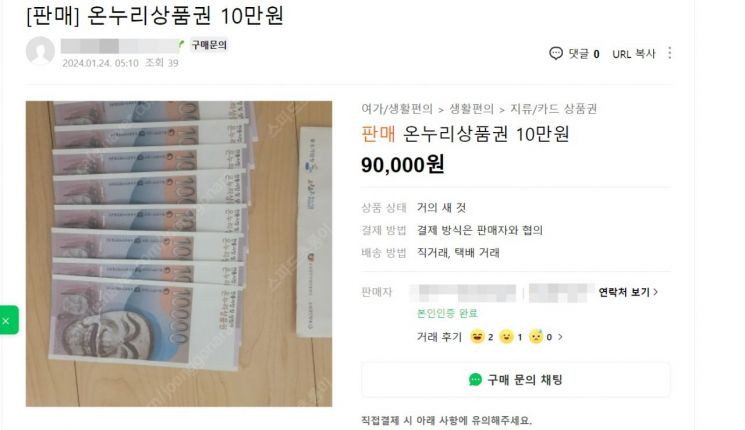 On the 24th, a post selling Onnuri gift certificates was uploaded on an online secondhand trading site. [Image source=Screenshot of secondhand trading cafe screen]
As the holiday approaches, 'gift certificate scams' where Onnuri gift certificates are sold and converted into cash are rampant again online. Although the government and online secondhand trading platforms have been strengthening monitoring for years, it seems difficult to crack down on these activities.
On the 26th, numerous posts offering to sell Onnuri gift certificates for cash were posted on an online secondhand trading site. In the past month alone, 110 posts related to Onnuri gift certificate sales were uploaded on the site. Since August last year, there have been over 500 posts. Sellers mainly sold the gift certificates at a 5-10% discount off the face value. The sales amounts ranged from as little as 10,000 KRW to as much as 1,000,000 KRW.
Under current law, trading Onnuri gift certificates outside affiliated stores is illegal. According to the "Act on the Promotion of Use of Local Love Gift Certificates," enacted in July 2020, local affiliated stores cannot request redemption of local gift certificates received without selling goods or providing services, and consumers are prohibited from reselling gift certificates to others.
To evade crackdowns, sellers used a method of writing the post titles with the initial consonants of Onnuri gift certificates, 'ㅇㄴㄹㅅㅍㄱ' (O N R S P G). They also delete posts immediately after the sale is completed. On that day, 4 to 5 sales posts were uploaded daily but deleted the next day.
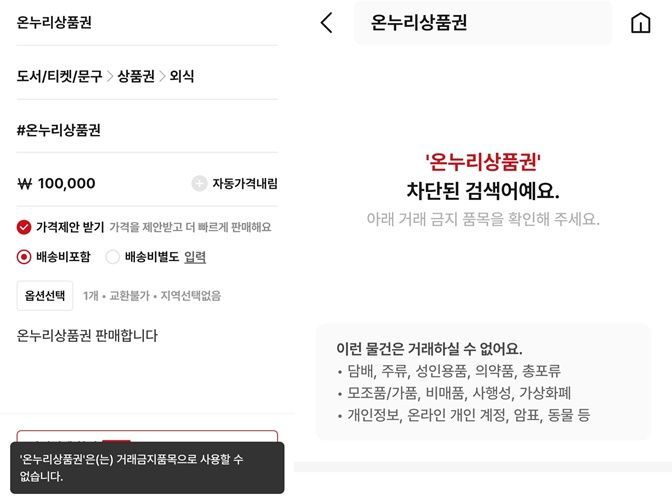 When posting or searching for Onnuri gift certificates on the secondhand trading platform Bungaejangter, a block notification appears. [Image source: Screenshot of Bungaejangter screen]
Secondhand trading intermediaries designate Onnuri gift certificates as prohibited items to block illegal distribution. However, they complain that online secondhand trading cafes created through portal sites have limitations in implementing separate crackdown systems. In fact, when a post selling Onnuri gift certificates was uploaded on the secondhand trading platform Bungaejangter, a prohibited item mark appeared at the bottom of the screen, but online cafes have a structure where intermediaries cannot introduce such self-regulation systems.
A representative from Junggonara said, "On our own platform, we have set Onnuri gift certificates as non-tradable items, so when a sales post is uploaded, an automatic alert function blocks the transaction," but added, "In the case of online cafes, since they are not our own platform and rely on manual monitoring, it seems difficult to keep up with the speed at which illegal sales posts are uploaded."
The Small Enterprise and Market Service (SEMAS), the competent authority, also says there are limits to cracking down on online transactions. Although they introduced a monitoring system to track illegal distribution and detect suspicious transactions, online secondhand trading is excluded from the crackdown scope. A SEMAS official said, "Illegal distribution through online secondhand trading sites is outside the scope of enforcement, so it can only be detected through direct reports or regular self-inspections."
Moreover, illegal distribution routes are diverse, including cases where gift certificates received as gifts from acquaintances are sold, or some merchants urgently needing funds directly dispose of the certificates, making it practically difficult to detect all cases. As of last year, 106 cases of illegal distribution were administratively sanctioned. The estimated amount of illegal redemption is 14.14 billion KRW. A SEMAS official said, "Although we operate a monitoring system, there are limits to detecting private transactions," adding, "We plan to expand mobile and card-type Onnuri gift certificates instead of paper-type ones."
© The Asia Business Daily(www.asiae.co.kr). All rights reserved.
![Clutching a Stolen Dior Bag, Saying "I Hate Being Poor but Real"... The Grotesque Con of a "Human Knockoff" [Slate]](https://cwcontent.asiae.co.kr/asiaresize/183/2026021902243444107_1771435474.jpg)
















