Genexine announced on the 26th that it has completed the Biologics License Application (BLA) for the long-acting anemia treatment for chronic kidney disease, Epeza (active ingredient Epoetin Alfa, GX-E4), with the Korean Ministry of Food and Drug Safety.
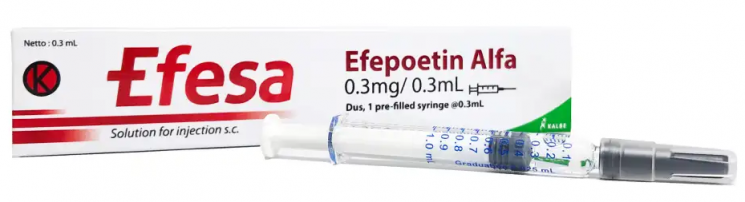
Epeza was developed by KG Bio, a joint venture established by Genexine and Indonesia's Kalbe Farma, which received the technology transfer from Genexine. It obtained marketing approval from Indonesia's National Agency of Drug and Food Control (BPOM) in October last year.
Epeza applies Genexine's long-acting platform technology, hybrid (hy)Fc, to extend the half-life of erythropoietin (EPO), a hormone that promotes red blood cell production. Unlike first-generation anemia treatments that required administration every 2 to 3 days, Epeza was developed as a third-generation treatment that only needs to be injected once every 2 to 4 weeks. In a Phase 3 clinical trial conducted on 391 patients with renal anemia not undergoing dialysis across seven countries including Korea and Indonesia, the primary efficacy endpoint was met. The endpoint was the hemoglobin (Hb) response rate at the end of the evaluation period, with the GX-E4 group showing 75.6% and the control drug 'Micera' group showing 69.3%, demonstrating non-inferiority compared to the control drug. Equivalent results were also observed in safety and tolerability assessments.
A Genexine representative stated, “Based on the Phase 3 clinical trial results, we have completed the marketing approval application with the Korean Ministry of Food and Drug Safety and plan to proceed with the formal approval process. This is a case where a domestic bio company is challenging commercialization from candidate discovery for the first time.”
Meanwhile, Genexine is conducting a Phase 3 clinical trial of Epeza for chronic kidney disease patients undergoing dialysis following those not receiving dialysis. The trial uses another anemia treatment, Aranesp, as the control group to verify efficacy and safety. The study involves 429 patients across more than 60 institutions in 11 countries, including Korea, Indonesia, Taiwan, and 8 European countries. A company official said, “The first patient dosing in Korea proceeded as planned on the 25th, and we expect to receive the advance payment from KG Bio within this month.” They also mentioned plans to recruit clinical trial participants after submitting Investigational New Drug (IND) applications and other procedures in countries outside Korea.
© The Asia Business Daily(www.asiae.co.kr). All rights reserved.
![Clutching a Stolen Dior Bag, Saying "I Hate Being Poor but Real"... The Grotesque Con of a "Human Knockoff" [Slate]](https://cwcontent.asiae.co.kr/asiaresize/183/2026021902243444107_1771435474.jpg)















