Fire Occurs at Chungnam Seocheon Special Market on 22nd
Safety Concerns Rise Ahead of Seol Holiday in Traditional Markets
Urgent Need for Measures Due to Aging and Inadequate Firefighting Facilities
Last year, a small fire broke out at a store in Seoul's Gwangjang Market. Since multiple stores are connected, early suppression was crucial. The alley was narrow, making it difficult for fire trucks to enter easily. Ultimately, the merchants extinguished the fire themselves. Recalling the incident, the merchants said, "Fire safety inspections are conducted, but most are voluntary, and many merchants do not have basic fire extinguishers. If a fire breaks out in the central area, it would spread instantly."
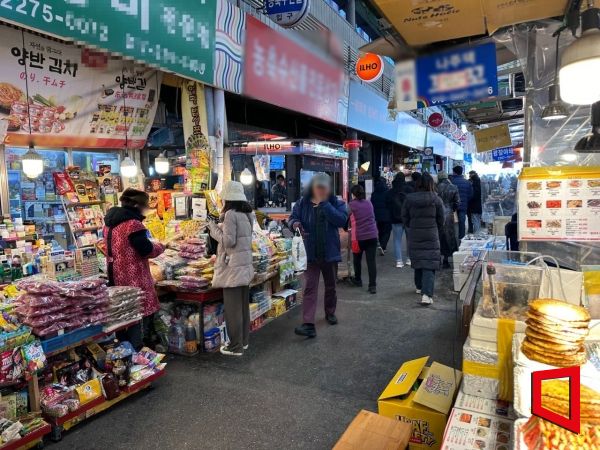 Seoul Jongno-gu Gwangjang Market panorama. A narrow alley where pedestrians are passing by stands out.
 [Photo by Gogi Jeong, Asia Economy]
On the 22nd, a fire occurred at the Chungnam Seocheon Special Market, raising safety concerns about fire-vulnerable facilities such as traditional markets ahead of the Lunar New Year holiday. The Gwangjang Market, which was visited recently, was no different. Mr. A, who has been running a jeon (Korean pancake) restaurant for over 10 years, said, "The biggest problem in the market is the lack of fire safety facilities." Most markets have shops on both sides, and in the middle of the road connecting both sides, stall merchants set up their stands to sell goods. However, since stall merchants can expand their area as they wish as long as they do not damage neighboring stores after renting the space, the alleys are becoming narrower and narrower.
Mr. B, who sells tteokbokki, shared a similar view. He took the reporter to the area near the utility poles lined up in front of the building. The old utility poles standing precariously had dozens of wires hanging like a spider web. The wires were corroded to the point that it was hard to estimate their age, with insulation peeling off. Several merchants had even plugged multi-outlet power strips into wires with peeled insulation. This overlaps with the electrical cause of the fire at Seocheon Market, which has been identified as a ‘short circuit mark.’
Mr. B said, "I think we should modernize the most basic fire preparedness first, rather than other things," adding, "The ventilators and outdoor units attached to the building's exterior wall are also old. When the severe cold hits, heating devices will be used, and I think it is almost impossible for a fire not to occur in an aging market. It feels like we are doing business inside a 'time bomb' that could explode at any moment."
Fire Safety Facilities in Traditional Markets Generally Aged... Fire Risk Increases When Using Heating Devices
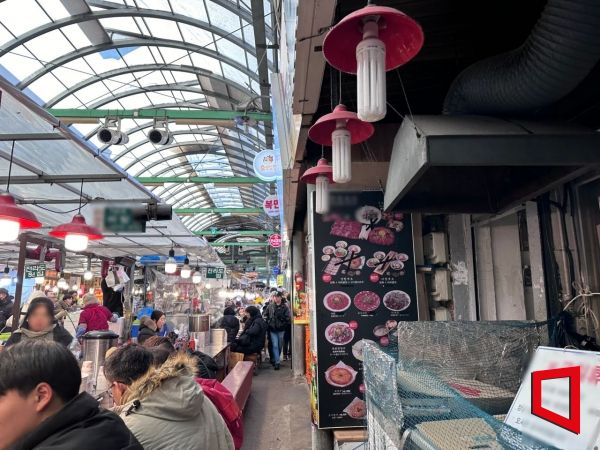 An alley in Gwangjang Market so narrow that fire trucks cannot pass through.
 Photo by Gogi Jeong, Asia Economy
According to the 'Traditional Market and Shopping District Store Management Survey Report' published by the Small Enterprise and Market Service in 2022, the possession rate of fire safety facilities across all markets showed that 'individual store fire extinguishers' had the highest possession rate at 98.2%, followed by 'shared fire extinguishers (90.1%)' and 'fire hydrants (89.8%).'
The overall aging of fire safety facilities was highest for 'aged' at 41.3%, followed by ▲average (26.7%) ▲very aged (20.7%) ▲good (11.3%) ▲very good (1.7%). By external form, mixed-use market buildings with shops and residences showed relatively higher aging compared to other types of markets. Sprinklers and gas detectors were found to be relatively more modernized than other fire safety facilities. The report stated that 98.2% of individual stores possessed fire extinguishers, indicating that most store merchants have basic fire safety equipment. However, aside from fire safety facilities, fire risk factors are scattered everywhere.
Heating facilities are a representative example. The report shows that 83.4% of building-type markets have heating facilities. Street stall-type, longhouse-type, and mixed-use market types were excluded from the inspection, making it difficult to confirm whether individual heating is implemented. Especially in aging markets, if individuals use heating facilities, the risk of fire can skyrocket.
Regarding market building materials, 95.2% are made of reinforced concrete, followed by ▲panels (12.4%) and ▲wood (6.6%). The CEO of Irum Construction expressed concern, saying, "Markets mainly use fire-resistant panels. The characteristic of fire-resistant panels is that they burn slowly once ignited. However, they pose a higher fire risk than reinforced concrete. Wood is particularly vulnerable to fire."
289 Fires Occurred in Traditional Markets Over the Past 5 Years... 26 Injured and 82.8 Billion KRW in Property Damage
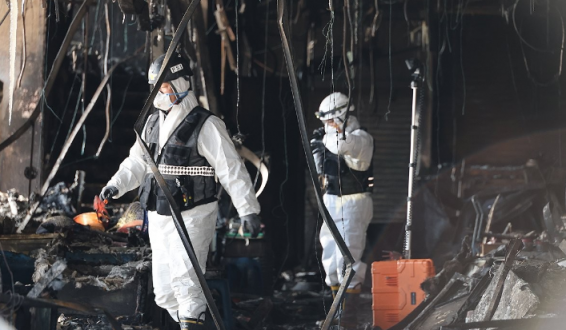 On the 24th, a joint investigation team consisting of police, fire department, and the National Forensic Service conducted an inspection at the Seocheon Specialty Market in Seocheon County, Chungnam, where a large fire occurred.
 [Photo by Yonhap News]
According to data from the National Fire Agency, a total of 289 fires occurred in traditional markets over the past five years from 2019 to 2023. During this period, 26 people were injured, and property damage amounted to 82.8 billion KRW. Looking at the number of incidents by year, there were ▲46 cases in 2019 ▲65 in 2020 ▲57 in 2021 ▲62 in 2022 ▲59 in 2023, all exceeding 50 cases annually.
Regarding the causes of market fires, a survey targeting markets with fire experience showed that 'short circuit' accounted for 72.4%, the highest proportion. This was followed by ▲carelessness (10.3%) ▲others (10.3%) ▲natural disasters (6.9%). However, only 29.3% of merchants had fire insurance, with an average compensation amount of 247.38 million KRW. In 2017, the government launched the 'Traditional Market Exclusive Fire Mutual Aid Insurance,' which the Small Enterprise and Market Service under the Ministry of SMEs and Startups offers at a lower cost than private insurance. However, as of 2021, the nationwide cumulative subscription rate was only 17.7%. Given this situation, the budget for the fire mutual aid project continues to decrease.
The Ministry of the Interior and Safety announced that it would urgently provide 2 billion KRW in special grants to restore fire damage at Seocheon Special Market and conduct a full inspection of fire prevention conditions at traditional markets under its jurisdiction. The identified issues will be addressed by early February, before the Lunar New Year holiday. The National Fire Agency also plans to conduct an emergency fire safety survey of 1,388 traditional markets nationwide by the 31st to prevent fires during the Lunar New Year holiday. They are collaborating with related agencies in fire, architecture, electricity, and gas sectors to strengthen fire prevention patrols and are conducting on-site guidance visits by fire station chiefs.
© The Asia Business Daily(www.asiae.co.kr). All rights reserved.

![User Who Sold Erroneously Deposited Bitcoins to Repay Debt and Fund Entertainment... What Did the Supreme Court Decide in 2021? [Legal Issue Check]](https://cwcontent.asiae.co.kr/asiaresize/183/2026020910431234020_1770601391.png)
















