Economic Production Induced 7.3 Trillion Won
Daegu-Gwangju Travel Time Reduced to 1 Hour Upon Opening
Despite Trillions in Fiscal Investment, Preliminary Feasibility Study Exempted
The special law for the Dalbit Railroad connecting Gwangju and Daegu passed the National Assembly plenary session on the 25th.
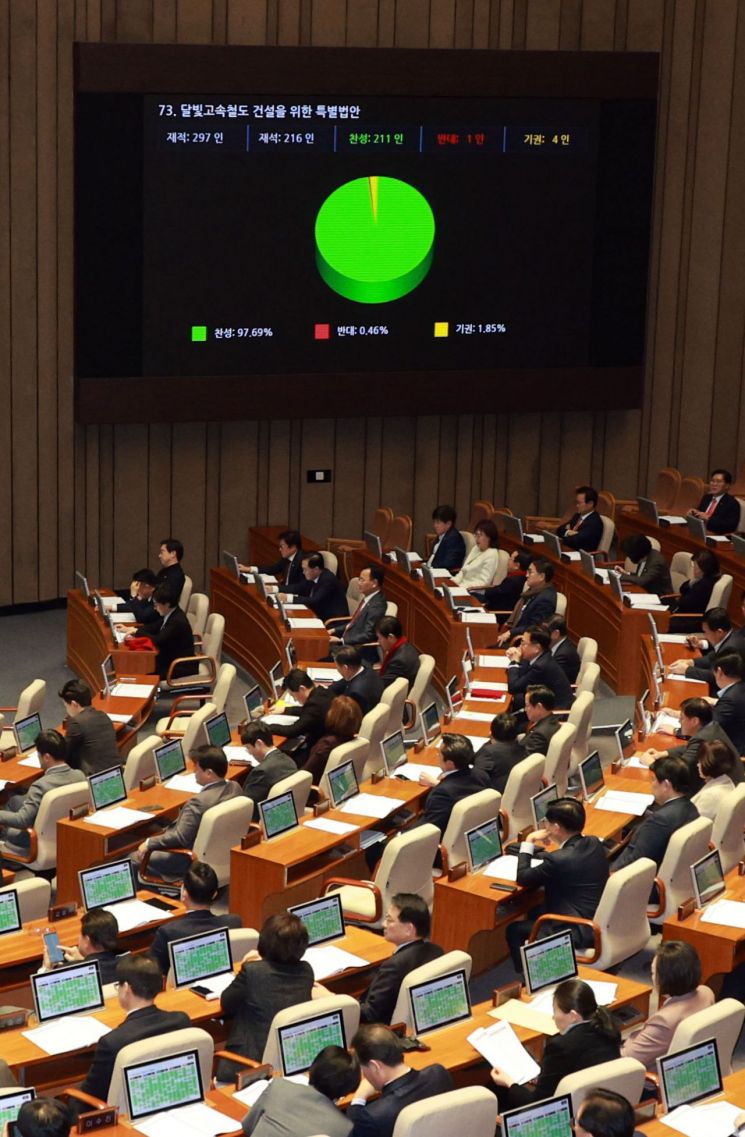
On the afternoon of the same day, the National Assembly held an extraordinary plenary session and passed the "Special Act on the Construction of the Dalbit Railroad" with 211 votes in favor, 1 against, and 4 abstentions out of 216 members present. This bill was originally proposed by Yoon Jae-ok, the floor leader of the People Power Party, in August. It passed after about five months since it was jointly proposed by a record 261 members of the National Assembly in the history of the constitution.
The Dalbit Railroad is a railway connecting Gwangju Metropolitan City and Daegu Metropolitan City. Its name is derived from the first letters of Daegu’s old name ‘Dalgu-bul’ and Gwangju’s pure Korean word ‘Bitgoeul.’ The Dalbit Railroad special law has faced criticism as a ‘populist bill for the general election’ because it exempts the preliminary feasibility study (PFS) by the Ministry of Economy and Finance under the pretext of national balanced development and resolving regional conflicts.
According to the bill, the clause specifying ‘high-speed, double-track’ railway was amended. The term ‘high-speed’ was removed from Dalbit High-Speed Railroad, and the name was changed to Dalbit Railroad. The ‘double-tracking’ was also excluded from the basic direction of the construction project. Additionally, to systematically develop the station area of the Dalbit Railroad, the bill allows for the designation of station area development zones and the promotion of station area development projects.
Areas within 3 km from the planned high-speed rail station can be designated as surrounding development planned areas, and if financial support is needed, necessary costs can be subsidized or loaned within the budget. The Dalbit High-Speed Railroad is expected to pass through Seo Daegu, Goryeong in North Gyeongsang, Hapcheon, Geochang, and Hamyang in South Gyeongsang, Jangsu, Namwon, and Sunchang in North Jeolla, Damyang in South Jeolla, and Songjeong in Gwangju.
The Dalbit Railroad aims to be completed by 2030. Once the railway opens, it is expected to enable travel from Gwangju to Daegu within about an hour. According to an analysis by the Korea Transport Institute, the economic effect of constructing the Dalbit Railroad is estimated to induce production of 7.3 trillion won. It is also expected to generate added value of 2.3 trillion won and create employment for about 38,000 people.
However, since a huge amount of national finances will be invested, there is criticism that the bill is intended for the general election in April. According to the National Finance Act, new projects with a total project cost of 50 billion won (30 billion won in national funds) or more must undergo a preliminary feasibility study, but the Dalbit Railroad construction project can proceed without such a study. The total project cost for constructing the Dalbit Railroad is 4.5158 trillion won.
© The Asia Business Daily(www.asiae.co.kr). All rights reserved.
![Clutching a Stolen Dior Bag, Saying "I Hate Being Poor but Real"... The Grotesque Con of a "Human Knockoff" [Slate]](https://cwcontent.asiae.co.kr/asiaresize/183/2026021902243444107_1771435474.jpg)















