Korean Pork Producers Association and Pork Fund Hold '2024 Pork Industry Crisis Response' Meeting
Consumption Decline and Inventory Increase... Production Costs Soar and Pork Prices Plummet
Request to Government for Feed Purchase Funds and Farm Electricity Bill Support
Korean pork farmers have called for government support to improve management conditions, including the establishment of special feed purchase funds. Amid an economic downturn leading to reduced pork consumption, pig farmers are struggling with rising production costs, including feed expenses, and a sharp drop in pork prices.
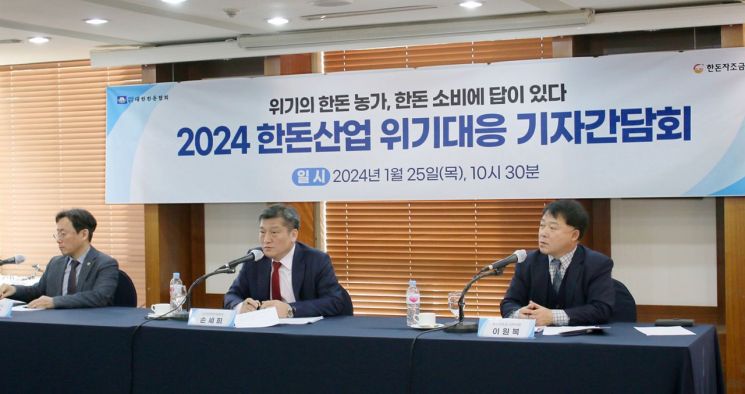 (From left) Jo Jin-hyun, Executive Director of the Korea Pork Producers Association, Son Se-hee, President of the Korea Pork Producers Association, and Lee Won-bok, Secretary General of the Pork Self-Sufficiency Fund, are speaking at the "2024 Pork Industry Crisis Response Press Conference" held on the 25th at the Korea Press Center.
Korean Pork Farmers Face Crisis of Rising Production Costs and Plummeting Pork Prices... Risk of Mass Bankruptcies
The Korea Pork Producers Association and the Korea Pork Checkoff Management Committee held a '2024 Korean Pork Industry Crisis Response Press Conference' on the 25th at the Korea Press Center in Jung-gu, Seoul, demanding measures to stabilize pork prices and ease management burdens. On this day, Son Se-hee, president of the Korea Pork Producers Association, stated, "Please help the Korean pork industry, a pillar of our country's food security, to overcome the current crisis and stand firmly," adding, "Due to price drops, soaring production costs, and consumption stagnation, pork farmers are facing a severe crisis, and government-level countermeasures are urgently needed."
President Son pointed out that the biggest problem is that pork prices have fallen below production costs. According to the Pork Producers Association, the auction price of pork dropped to the mid-4,000 KRW per kilogram range in mid-last month and further declined to 4,348 KRW as of the 24th. In contrast, production costs have steadily increased due to rising feed prices and interest burdens caused by high interest rates and inflation, reaching an average of 5,199 KRW per kilogram for mid-sized farms.
He emphasized that especially the bottom 30% of farms in terms of productivity are facing cash liquidity crises, raising concerns about a domino effect of bankruptcies. Last year, the production cost for the bottom 30% of Korean pork farms averaged 5,709 KRW per kilogram, resulting in a loss of 144 million KRW per farm. With pork prices expected to be between 4,100 and 4,300 KRW per kilogram this month, farms are projected to incur losses of 27 to 31 million KRW each in January alone.
President Son lamented, "Pork consumption has sharply contracted due to the economic downturn, leading to increased inventory across all pork cuts, coinciding with the entry into a period of falling pork prices, causing prices to plummet," adding, "At current pork prices, it is impossible to cover the high production costs." He also noted, "Although we are implementing self-help measures such as large-scale discount sales, corporate and group meal support, tasting events, and consumer promotion campaigns, these efforts are insufficient."
Demand for Establishment of Special Feed Purchase Funds... Self-Help Measures Through Discount Events
The Pork Producers Association holds the position that institutional government support is necessary to improve farm productivity and management conditions. On this day, President Son stressed that measures to ease the burden of feed costs are the most urgent, specifically requesting the establishment of special feed purchase funds for pig farming and the extension of repayment periods for existing feed purchase funds when due. He said, "Feed costs account for nearly 70% of production costs, and unless this issue is resolved, farming cannot continue," adding, "Since October last year, pork prices have fallen below production costs, but to clear the accumulating inventory, we have been forced to conduct discount sales reluctantly."
Additionally, they demanded measures to mitigate vaccine-related damages, which have become an annual issue. They proposed changing the classical swine fever (CSF) vaccine from the current 'Romju' to 'Saengmarker,' which is known to cause less vaccination stress and improve productivity, and switching the foot-and-mouth disease (FMD) vaccine from the current intramuscular injection method to intradermal injection. President Son explained, "By changing vaccines to minimize side effects and reduce the occurrence of abnormal meat, farmers' losses can be reduced."
Other demands include ▲temporary partial support for electricity bills for pork farms ▲relief of livestock manure disposal costs (support of 10,000 KRW per ton) ▲promotion of a public-private joint pig purchase project (purchase and stockpile during the off-season from January to March, shipment during price rise after April) ▲strengthening of pork origin control, among others.
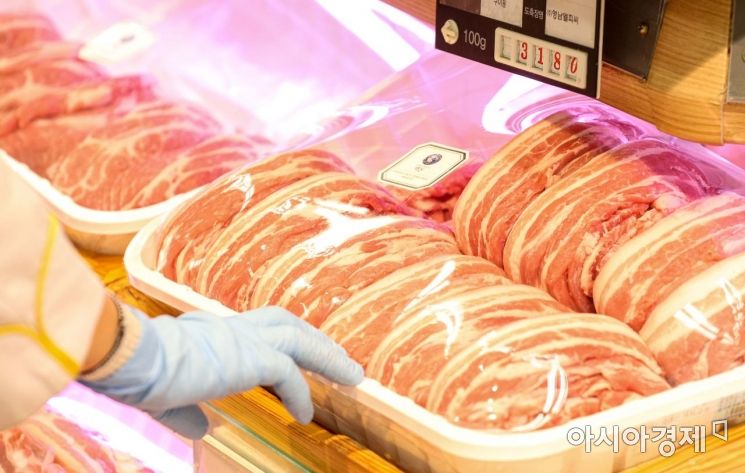
Alongside demands for government management stabilization measures, the association also announced its own sales promotion plans. The Pork Producers Association plans to hold discount events of up to 50% at major distribution channels such as E-Mart, Homeplus, Lotte Mart, certified pork butcher shops, Nonghyup Hanaro Mart, and the Pork Mall. They also plan to expand sales channels through agreements with food companies and platform operators and to promote consumption campaigns linked to events such as Samgyeopsal Day (March 3), holidays, and sports events.
© The Asia Business Daily(www.asiae.co.kr). All rights reserved.
![Clutching a Stolen Dior Bag, Saying "I Hate Being Poor but Real"... The Grotesque Con of a "Human Knockoff" [Slate]](https://cwcontent.asiae.co.kr/asiaresize/183/2026021902243444107_1771435474.jpg)
















