Reflection of D Line Route Passing through Gangdong-gu in Phase 2 Plan

Gangdong-gu, Seoul (Mayor Lee Soo-hee) expressed its welcome and gratitude on the 25th as the GTX-D line passing through Gangdong-gu was included in the 2nd phase GTX plan announced at the public livelihood discussion hosted by President Yoon Suk-yeol titled “The Era of 30-Minute Commute, Resolving Transportation Disparities.”
The Ministry of Land, Infrastructure and Transport’s 2nd phase GTX plan includes the government’s route proposals and implementation plans for the GTX-A, B, and C extension lines, which are pledges of the Yoon Suk-yeol administration, as well as the new D, E, and F lines. The plan specifies the start and end points and major transfer stations for each line.
The newly announced GTX-D line connects Gimpo and Incheon to Paldang and Wonju, forming a “double Y” shape with a branch point at Daejang dividing the route towards Gimpo and Incheon Airport, and another branch point at Samsung dividing the route towards Paldang and Wonju. The Gangdong section runs from Samsung through Jamsil, then Gangdong, Gyosan, and Paldang.
The government plans to incorporate this 2nd phase GTX plan into the “5th National Railroad Network Construction Plan” and aims to open sections in stages (phases 1 and 2) to expedite the project. The first phase, which includes Gangdong, targets opening by 2035, with plans to pass the preliminary feasibility study within the Yoon Suk-yeol administration’s term.
The district expects that once this project is completed, accessibility to major metropolitan centers such as Gangnam will be dramatically improved, and Gangdong-gu will grow into a gateway city linking major new towns in eastern Gyeonggi Province such as Guri, Hanam, and Namyangju with downtown Seoul, becoming a transportation, economic, and cultural hub of the eastern metropolitan area.
Until now, Gangdong-gu has made efforts to expand its transportation network to respond to the rapidly increasing transportation demand caused by large-scale reconstruction, redevelopment, and the creation of business complexes. In particular, to prevent worsening congestion similar to that expected on the Gimpo Gold Line due to the extension of subway lines 5, 8, and 9 to surrounding new towns, the district has focused all efforts on expanding the metropolitan transportation network by securing the GTX-D line passing through Gangdong-gu.
The district conducted its own feasibility study to verify the economic viability and feasibility of the GTX-D line passing through Gangdong-gu and has continuously pursued consultations with related organizations such as the Ministry of Land, Infrastructure and Transport, Korea Transport Institute, and Seoul Metropolitan Government.
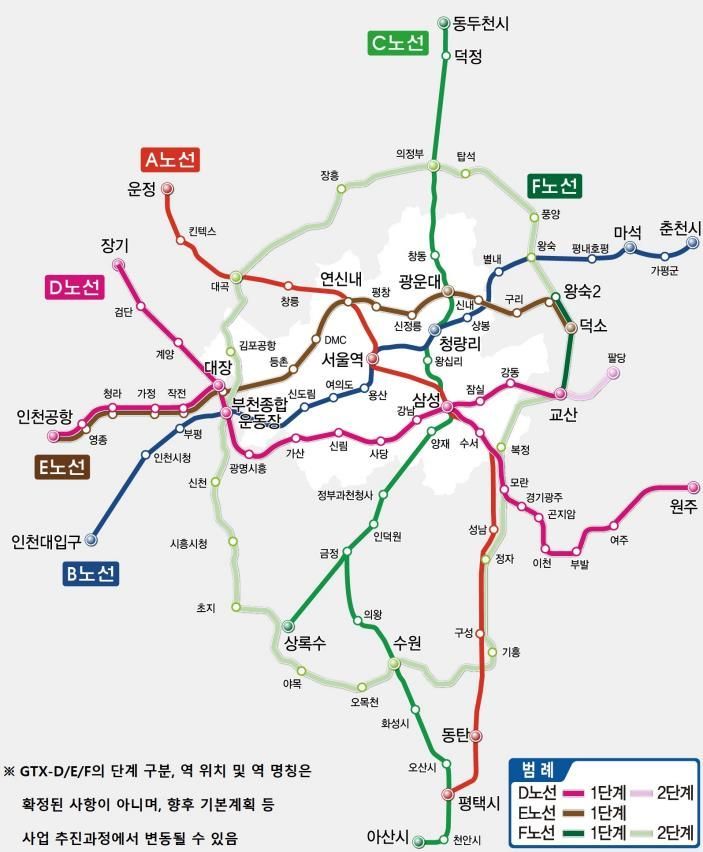
Mayor Lee Soo-hee emphasized the necessity of the GTX-D line passing through Gangdong-gu from the Presidential Transition Committee of President Yoon Suk-yeol and has actively proposed the inclusion of Gangdong-gu in the route by meeting the Minister of Land, Infrastructure and Transport five times.
Mayor Lee Soo-hee stated, “I thank the residents who have wholeheartedly wished for the GTX-D line passing through Gangdong-gu and the Ministry of Land, Infrastructure and Transport for their efforts in establishing the GTX plan. We will do our best to solve the many remaining transportation issues in Gangdong-gu, such as the direct connection of Line 5, extension of Line 9, and expansion of bus routes, so that Gangdong-gu can be reborn as the central city of the eastern metropolitan area.”
© The Asia Business Daily(www.asiae.co.kr). All rights reserved.
![Clutching a Stolen Dior Bag, Saying "I Hate Being Poor but Real"... The Grotesque Con of a "Human Knockoff" [Slate]](https://cwcontent.asiae.co.kr/asiaresize/183/2026021902243444107_1771435474.jpg)
















