Rapid Integration Plan Confirmed... Zoning Upgraded to 'Quasi-Residential'
Diversification of Housing Types Including Single-Person Households and Youth Customization
A complex residential complex with up to 50 floors and around 2,000 households will be built in the 115 area of Garibong-dong, Seoul, which was so-called the ‘beehive village.’
On the 25th, the Seoul Metropolitan Government announced that it had finalized the rapid integrated planning for the ‘Garibong-dong 115 area housing maintenance-type redevelopment project.’ The zoning will be upgraded from the existing Type 2, 7-story area to a ‘quasi-residential area’ to create a mixed residential complex combining commercial, office, and residential functions.
The target site, along with the ‘Garibong-dong 87-177 area (1st candidate site),’ for which rapid integrated planning was finalized in June last year, will serve as a residential complex near workplaces in G Valley (Seoul Digital Industrial Complex). Combined, the two district projects will total 3,380 households. This area was originally designated as a New Town district, but redevelopment projects stalled for a long time, leading to slum conditions and preventing it from functioning as a residential area supporting G Valley.
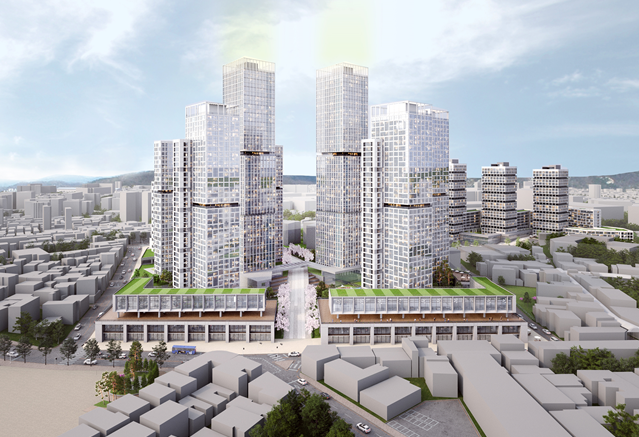 Street plan for the housing maintenance-type redevelopment project in Garibong-dong 115 area, Seoul. Photo by Seoul City
First, the city plans to introduce various housing types such as small-sized residences and officetels for single-person or two-person households and young generations working in G Valley. About 10% of the total floor area in the quasi-residential zone will be allocated to commercial and office facilities, including officetels for G Valley workers.
The road system will also be improved in line with the development project. ‘Uma-gil,’ the local main street in this area, will be converted from a one-way (one lane) to a two-way (two lanes) traffic system. The area including Garibong Market, which was excluded from the redevelopment zone this time, will be managed under a district unit plan.
The existing narrow alleys and steep slopes will be improved by creating a ‘public pedestrian passage’ connecting Guro Nam Elementary School, the complex, and Uma-gil, making it a safe school route. The low-rise sections of the street-facing shops arranged along Uma-gil will be developed as a ‘design-specialized section’ to activate the street. Additionally, a high-rise, high-density tower building of about 50 floors will be placed on the southern side adjacent to Nambu Sunhwan-ro, while mid- to low-rise slab-type buildings will be arranged around Guro Nam Elementary School on the northern side to create an open view along the school boundary.
Following the recent ‘simplification of rapid integrated planning procedures,’ the city expects to decide on the maintenance zone and plan for the Garibong-dong 115 area within the year and shorten the project period by applying the delegated subcommittee of the Urban Planning Committee and integrated review of the project implementation plan.
Jo Nam-jun, head of the Urban Space Headquarters, said, “With the confirmation of rapid integrated planning for the two redevelopment candidate sites in Garibong-dong (Garibong 115 and 87-177 areas), talented people working in G Valley will be able to settle in stable homes close to their workplaces. We will fully support the project so that the long-stagnant Garibong-dong area can establish itself as a representative residential area in the southwest region.”
© The Asia Business Daily(www.asiae.co.kr). All rights reserved.

















