South Korea's Economy Grew 1.4% Last Year... Lowest in 3 Years Since COVID-19
BOK Says "Efforts Needed to Raise Potential Growth Rate"
Semiconductor Export Improvement Led to 0.6% Growth in Q4 Last Year
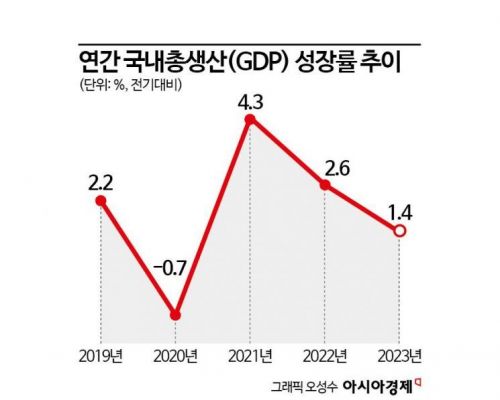
Last year, South Korea's economy grew by only 1.4%. This is the lowest figure in three years since 2020, raising concerns about prolonged low growth. In the fourth quarter of last year, exports, led by semiconductors, improved, resulting in an economic growth rate of 0.6% compared to the previous quarter.
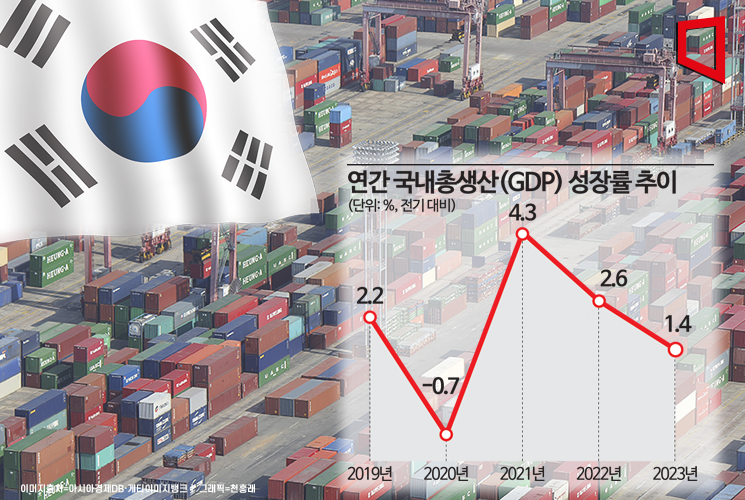
The Bank of Korea announced on the 25th that the country's gross domestic product (GDP) growth rate last year was 1.4%. Although this met the government's previous forecast, it is the lowest figure in three years since the -0.7% recorded in 2020 due to the COVID-19 pandemic.
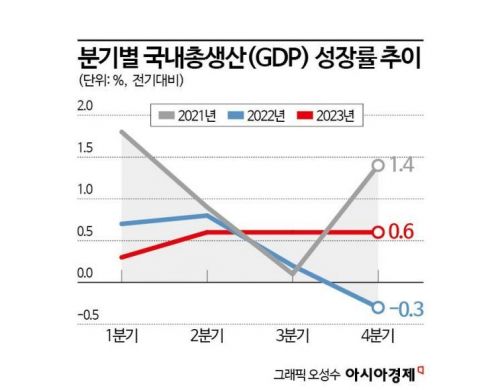
The real GDP growth rate for the fourth quarter was 0.6% compared to the previous quarter. Quarterly GDP growth rates maintained a positive trend from the first quarter (0.3%), second quarter (0.6%), and third quarter (0.6%) of last year, following a contraction of -0.3% in the fourth quarter of 2022.
Lowest Economic Growth Rate in 3 Years, Concerns Over Prolonged Low Growth
South Korea's economic growth rate has declined for three consecutive years, from 4.3% in 2021 to 2.6% in 2022. This is the lowest level since the -0.7% recorded during the COVID-19 crisis in 2020.
Although investment increased, key indicators such as consumption and exports showed sluggish performance. In particular, the private consumption growth rate sharply dropped from 4.1% in 2022 to 1.8%, and government consumption growth also fell from 4.0% to 1.3%. The government consumption rate was the lowest since 0.7% in 2000.
Shin Seung-chul, Director of the Economic Statistics Bureau at the Bank of Korea, explained, "The government is maintaining a sound fiscal policy, and as COVID-19 related quarantine expenditures decrease, overall government consumption is declining."
The export growth rate also fell from 3.4% in 2022 to 2.8% in 2023. Consequently, the private sector's contribution to growth last year was 0.9 percentage points, down from 2.1 percentage points the previous year. The government's contribution to growth also declined from 0.5 percentage points to 0.4 percentage points.
The contribution of net exports (exports minus imports) was negative at -0.1 percentage points, and the contribution of facility investment was zero percentage points. Construction investment improved to 0.2 percentage points from -0.2 percentage points the previous year.
As the downward trend in growth continues, concerns about the entrenchment of a low-growth trend are emerging. Director Shin said, "South Korea's current potential growth rate is about 2.0%, but there is a possibility it could fall to the zero percent range in the future," adding, "The decline in growth is due to various factors including low birth rates, aging population, decreased productivity, and global supply chain restructuring."
Significant Improvement in Semiconductor Exports in Q4, Construction Investment Deteriorates
In the fourth quarter of last year, the economy was driven by exports. Exports in the fourth quarter increased by 2.6% compared to the previous quarter, continuing the improvement trend.
Semiconductor exports, which had been negative throughout the year, turned positive for two consecutive months from November (12.9%) to December (21.8%). This is interpreted as a recovery in the prices of memory semiconductors, South Korea's main export item. Imports increased by 1.0%, mainly due to petroleum products.
Private consumption rose by 0.2%, mainly driven by residents' overseas consumption expenditures. Government consumption increased by 0.4%, mainly due to in-kind benefits such as health insurance benefits and goods expenses, and facility investment grew by 3.0% due to favorable conditions in transportation equipment.
However, construction investment decreased by 4.2% as both building and civil engineering construction declined. The downturn in the real estate market, including the insolvency of real estate project financing (PF), negatively affected this sector.
Professor Seok Byung-hoon of Ewha Womans University’s Department of Economics said, "The PF issue was an unforeseen variable, and it is one of the factors that could lead to a recession in domestic consumption along with construction investment," adding, "If PF loans become unstable, unemployment among construction companies will increase, which could significantly deepen the economic downturn due to unemployment."
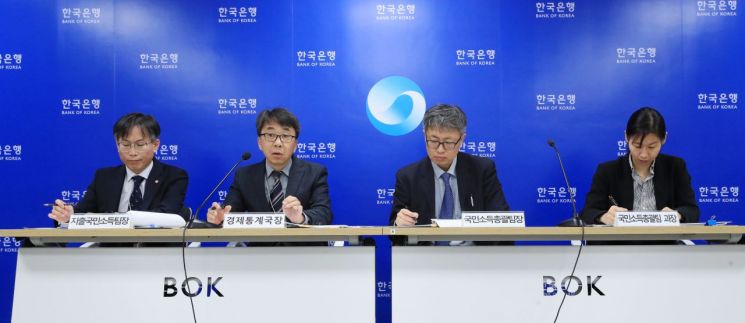 On the morning of the 25th, the Bank of Korea in Jung-gu, Seoul held a briefing on the 2023 Q4 and annual real Gross Domestic Product (preliminary report).
- From the left in the photo: In-gyu Lee, Head of the Expenditure National Income Team; Seung-cheol Shin, Director of the Economic Statistics Bureau; Kwan-gyo Lee, Head of the National Income General Team; Nam-young Ha, Manager of the National Income General Team (Photo by Bank of Korea)
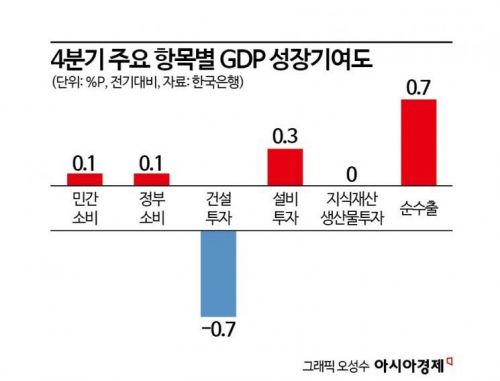
The item that contributed the most to growth in the fourth quarter was net exports (exports minus imports), with a contribution of 0.8 percentage points. Facility investment (0.3 percentage points), private consumption (0.1 percentage points), and government consumption (0.1 percentage points) also recorded positive contributions. Conversely, construction investment lowered the growth rate by 0.7 percentage points.
By industry, agriculture, forestry, and fisheries decreased by 6.1% due to reduced agricultural production, while manufacturing increased by 1.1%, centered on computer, electronic, and optical equipment manufacturing.
The electricity, gas, and water supply sector grew by 11.1%, mainly due to electric power companies. Construction declined by 3.6% as both building and civil engineering construction decreased. The service sector grew by 0.6%, with decreases in finance and insurance but increases in business services, medical and health services, and social welfare services.
The real gross domestic income (GDI) in the fourth quarter increased by 0.4%, lower than the real GDP growth rate of 0.6%. The annual real GDI growth rate (1.4%) matched the real GDP growth rate (1.4%) as terms of trade remained at the previous year's level.
Economic Growth Expected to Remain in the Low 2% Range This Year
Although the export economy, led by semiconductors, is showing signs of recovery, forecasts suggest that South Korea's economic growth rate this year will remain in the low 2% range.
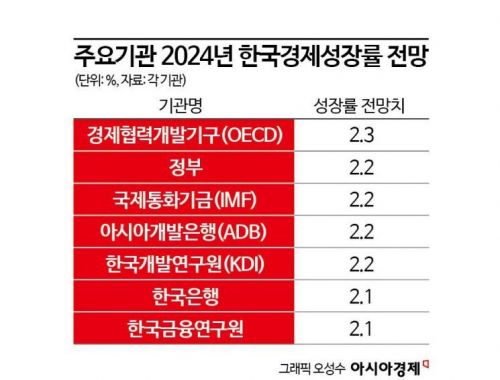
The government predicted a GDP growth rate of 2.2% for 2024 in its economic policy direction announced earlier this month. This is 0.2 percentage points lower than the 2.4% forecast made in July last year. It expects growth to be higher than last year due to a recovery in global trade, with exports, especially semiconductors, expected to rebound.
The Organisation for Economic Co-operation and Development (OECD) projected a slightly higher growth rate of 2.3%. The International Monetary Fund (IMF) and the Asian Development Bank (ADB) forecast 2.2%, matching the government's projection. The Bank of Korea forecasted 2.1%.
While the economy is expected to improve compared to last year, the recovery is considered weak compared to major global economies.
According to the OECD's economic outlook in November last year, the global economy is expected to grow by 2.7% this year, and the Group of Twenty (G20) countries by 2.8%, both higher than South Korea's forecast. The IMF also projected global economic growth of 2.9% this year.
Professor Seok said, "It does not seem easy to achieve the low 2% range economic growth rate expected by the government and the Bank of Korea this year," adding, "Investment is stagnating due to high interest rates, and domestic demand is expected to weaken significantly in the second half of the year."
He added, "The government concentrated fiscal spending in the first half, leaving little room for fiscal policy response in the second half. However, exports are increasing, so growth is expected to be higher than last year."
Professor Kim Jeong-sik of Yonsei University's Department of Economics said, "With elections in April this year, the government is advancing some investments, so growth in the first quarter may be strong," but added, "Overall, high inflation and high interest rates will persist, making it difficult for consumption and investment to increase, so low growth is likely to continue."
© The Asia Business Daily(www.asiae.co.kr). All rights reserved.
![Clutching a Stolen Dior Bag, Saying "I Hate Being Poor but Real"... The Grotesque Con of a "Human Knockoff" [Slate]](https://cwcontent.asiae.co.kr/asiaresize/183/2026021902243444107_1771435474.jpg)

















