Yoon Seong-yong, Director of the National Museum of Korea, Meeting
Gwanggaeto the Great Queen's Reproduction Video and Original Rubbing Unveiled
'Lee Kun-hee Collection' Touring Exhibitions in the US and Europe Starting Next Year
The Gwanggaeto Stele, whose existence was forgotten after the fall of Goguryeo and began to be studied from the 19th century, has been digitally recreated and now stands tall.
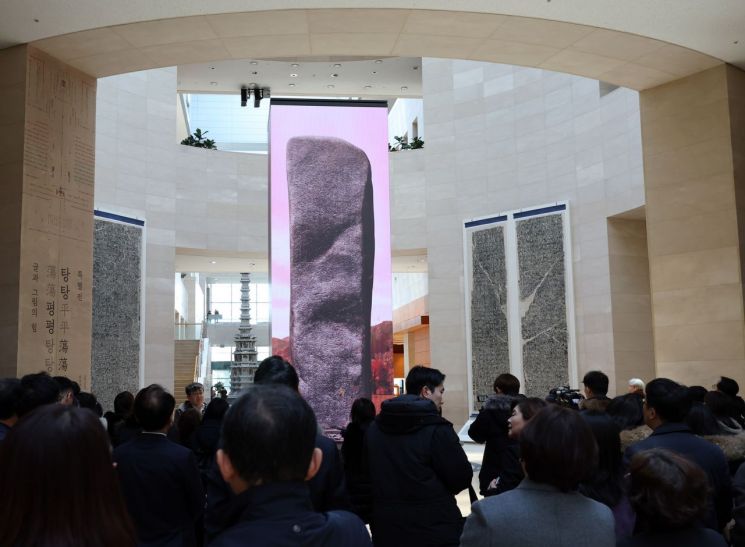 On the 24th, a digitally recreated Gwanggaeto the Great Stele was exhibited at the "Path of History" permanent exhibition hall in the National Museum of Korea, Yongsan-gu, Seoul. The newly restored stele at the museum is an LED pillar measuring 7.5 meters in height (8 meters including the base) and 2.6 meters in width, faithfully replicating the artifact located in Jian (集安), China. The stele's appearance, recreated based on photos and video materials, can be viewed from all sides. [Image source=Yonhap News]
The National Museum of Korea (Director Yoon Sung-yong) announced on the 24th that it will showcase a digitally recreated video of the Gwanggaeto Stele and restored rubbings of the original stone on the 'Path of History,' which connects the lobby and exhibition hall of the permanent exhibition gallery. Taking this opportunity, the museum plans to completely renovate the Prehistoric and Ancient Gallery this year and strengthen its Goguryeo content.
The Gwanggaeto Stele is the largest stele in East Asia and an important resource for examining the history of Northeast Asia, including Goguryeo in the 4th to 5th centuries. It was erected around 414 by King Jangsu (reigned 413?491), son of King Gwanggaeto (reigned 391?412), to commemorate his father's achievements.
The stele is carved with a total of 1,775 characters on four sides of a stone standing 6.39 meters tall at its highest point. It contains the founding myth of Goguryeo, the king's accession, King Gwanggaeto's achievements, and regulations for managing the king's tomb. The digitally displayed stele faithfully reproduces the actual appearance of the original located in Tonghua City, Jilin Province, China.
At a briefing on the New Year's work plan, Yoon Sung-yong, director of the National Museum of Korea, emphasized the significance of the exhibition, saying, “Among the histories of the Three Kingdoms, the Gwanggaeto Stele is a representative cultural heritage managed outside our national borders.” He added, “Following last year's acquisition of the original stone rubbing, we promoted digital restoration on the 'Path of History.'”
Director Yoon further stated, "This stele is indispensable when discussing our ancient history," adding, "It has been one of the museum's desired projects since relocating to Yongsan in 2005."
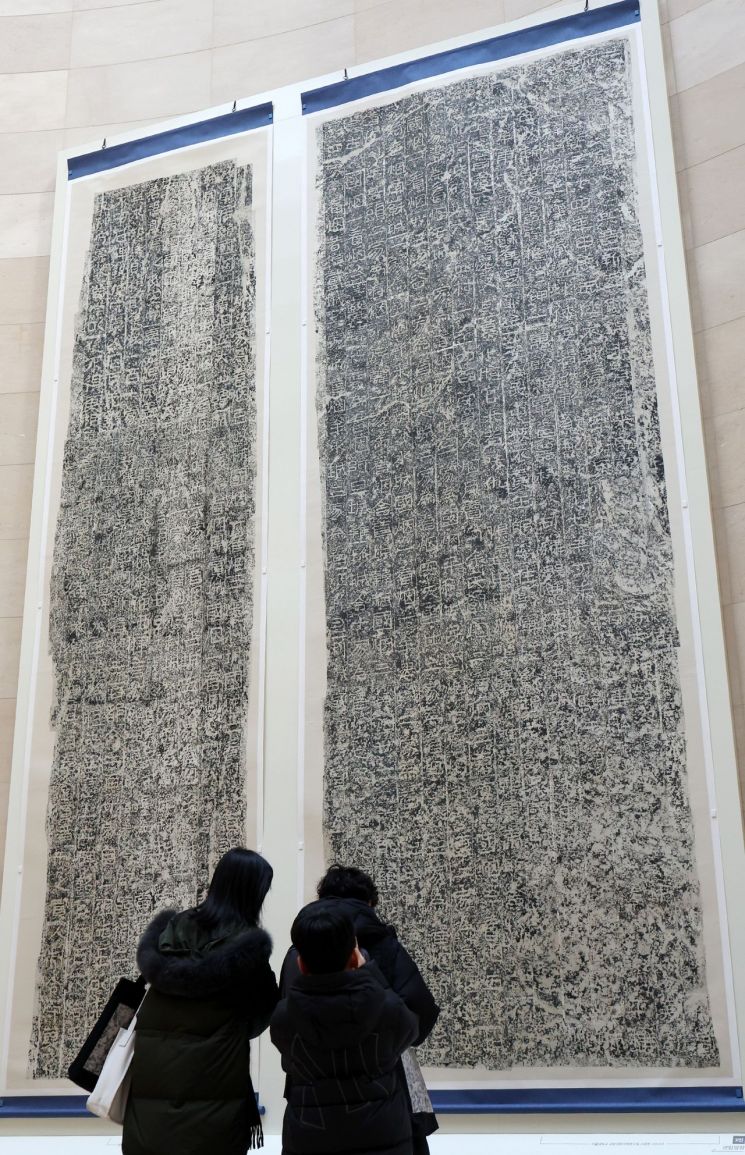 On the 24th, a digital restoration of the original rubbing of the Gwanggaeto the Great Stele is displayed as a scroll in the "Path of History" permanent exhibition hall at the National Museum of Korea in Yongsan-gu, Seoul. [Image source=Yonhap News]
Along with the digitally recreated stele, the museum unveiled the original stone rubbing. The original rubbing revealed today was made before lime was applied to the inscription, capturing a form close to the original, and is thus considered to have greater research value compared to lime rubbings.
There are over 120 types of Gwanggaeto Stele rubbings distributed across Korea, China, and Japan. Only 18 original stone rubbings exist before indiscriminate lime rubbing was conducted, and only three of these are currently preserved in Korea.
Last year, the museum purchased and preserved the 'Cheongmyeongbon,' a collection of original stone rubbings owned by the Confucian scholar Cheongmyeong (靑溟) Im Chang-soon (1914?1999), and exhibited it for the first time in the Goguryeo Gallery. The Cheongmyeongbon was made by Li Yuncong (李雲從) in 1889, who cut the rubbing into groups of three characters and bound them like a book. The collection consists of four volumes and includes a colophon describing the rubbing process, making it highly valuable for research.
After purchasing the Cheongmyeongbon from the family last year, the museum supplemented some damaged and missing characters by cross-referencing with copies held by other institutions such as the Kyujanggak Institute for Korean Studies at Seoul National University. Based on this, four large scrolls, each printed at the original size of one side of the inscription, were also unveiled on the Path of History. The Cheongmyeongbon will be on permanent display in the Goguryeo Gallery starting today.
Ryu Jeong-han, a curator at the National Museum of Korea, explained, "Recent academic research suggests that the Kyujanggak copy is a separated part of the Cheongmyeongbon, and the Japanese materials are also presumed to have been produced by the same person around the same time."
 Yoon Sung-yong, Director of the National Museum of Korea (second from left), is speaking about the main work plans at the 2024 New Year press conference held on the morning of the 24th at the National Museum of Korea in Yongsan-gu, Seoul.
 [Image source=Yonhap News]
Along with the unveiling of the rubbings, the museum plans to strengthen its Goguryeo history and culture content. First, it will renovate approximately 1,613 square meters (about 488 pyeong) of exhibition space from the Paleolithic Room in the Prehistoric and Ancient Gallery to the Goguryeo Gallery. This is the first time multiple exhibition rooms within the Prehistoric and Ancient Gallery have been renovated simultaneously since the museum relocated to Yongsan in 2005. The museum also revealed research plans, including investigations of artifacts excavated from the Jangmu I Tomb (a Goguryeo tomb) in Hwanghae Province.
The 'Goguryeo Gallery,' which covers Goguryeo history and culture, is planned to nearly double in size. According to a survey conducted late last year of 213 men and women aged 15 and older who visited the Prehistoric and Ancient Gallery, more than half (51.2%) identified the Goguryeo Gallery as the most interesting exhibition room.
On the other hand, visitors who expressed little interest in the Goguryeo Gallery pointed out that "many artifacts are located in other regions, so there were not many items on display," and "there was a lack of materials."
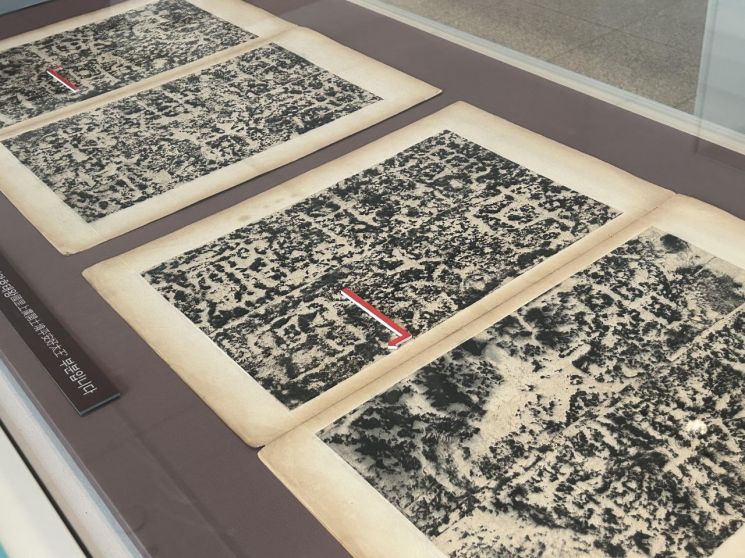 On the 23rd, a rubbing of the original stone of the Gwanggaeto Stele was exhibited in the Goguryeo Room of the Permanent Exhibition Hall at the National Museum of Korea in Yongsan-gu, Seoul. The rubbing of the original stone was taken before lime was applied to the inscription, and the museum purchased the material last year, which had been owned by the Confucian scholar Cheongmyeong (靑溟) Im Chang-sun (1914?1999). [Image source=Yonhap News]
When asked whether the expansion of the Goguryeo Gallery was in response to historical distortions such as China's Northeast Project, Director Yoon explained, "Rather, the biggest reasons are the regular renovations every 10 to 12 years and the acquisition of rubbings." He added, "It was necessary to strengthen the content by reflecting research and survey results from academia, and the exhibition space will be reorganized coherently to allow visitors to intuitively view history in chronological order."
Director Yoon also revealed plans to promote regional touring exhibitions by selecting key artifacts. This initiative was triggered by last year's milestone of surpassing 10 million visitors across affiliated regional museums. The exhibitions will be organized under the motto 'A Museum for Everyone, Traveling Exhibitions,' featuring six themes including 'Gold Crowns,' 'Horse-Riding Figurine Pottery,' 'Inlaid Celadon,' and 'White Porcelain Moon Jars.' A dedicated exhibition space will also be prepared for the Joseon Dynasty's Oegyujanggak Uigwe. The Uigwe are a type of report documenting royal ceremonies and events, and the Oegyujanggak Uigwe was taken to France during the French Campaign against Korea in 1866. It is currently kept at the National Museum of Korea on a permanent loan basis from France.
Additionally, the museum announced five key tasks: ▲strengthening services for culturally vulnerable groups such as people with disabilities ▲expanding professional training for curators ▲holding traveling exhibitions in regions at risk of population decline, among others. The 'Lee Kun-hee Collection' is scheduled for overseas exhibitions starting next year, following exhibitions in Jeju and Chuncheon this year. Beginning in November next year at the National Museum of Asian Art in the United States, special touring exhibitions will continue at the Chicago Museum in March 2026 and the British Museum in September of the same year.
© The Asia Business Daily(www.asiae.co.kr). All rights reserved.
![Clutching a Stolen Dior Bag, Saying "I Hate Being Poor but Real"... The Grotesque Con of a "Human Knockoff" [Slate]](https://cwcontent.asiae.co.kr/asiaresize/183/2026021902243444107_1771435474.jpg)

















