A special bill for the construction of a railway connecting Gwangju and Daegu passed the National Assembly's Legislation and Judiciary Committee review on the 24th.
The Legislation and Judiciary Committee held a plenary session that afternoon and approved the enactment of the 'Special Act for the Construction of the Dalbit Railway.'
The contentious provision exempting the preliminary feasibility study (PFS) also passed as originally proposed.
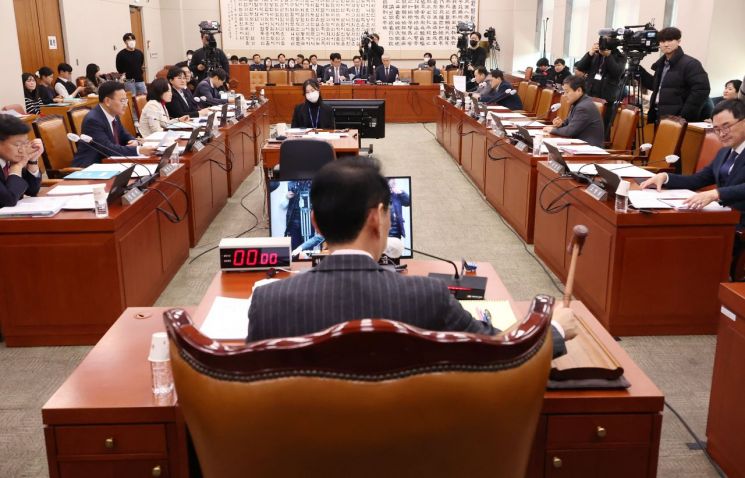
The bill, originally proposed by Yoon Jae-ok, floor leader of the People Power Party, in August last year, was co-sponsored by a record 261 lawmakers from both ruling and opposition parties in the history of the National Assembly.
The bill passed the National Assembly's Land, Infrastructure and Transport Committee on December 21 last year, but its passage within the year was delayed as it was postponed from being submitted to the Legislation and Judiciary Committee.
The Ministry of Economy and Finance maintained its position to delete the PFS exemption clause, citing the need to consider fairness with other regions, but Daegu City and Gwangju City argued that the exemption was necessary for the rapid construction of the railway.
Regarding this, Park Hyung-soo, a People Power Party lawmaker, said, "For national special projects or railways like the Dalbit Railway, which promote harmony between Yeongnam and Honam regions, a different perspective can be taken," adding, "It would be acceptable to include discretionary provisions on PFS exemption as a symbolic bill."
So Byung-chul, the opposition party's secretary from the Democratic Party of Korea, also said, "To create a new economic development momentum in the southern region and promote east-west harmony, the ruling and opposition parties are united in their urgent plea for the passage of the law covering Gwangju, Daegu, Gyeongbuk, and Jeonnam."
The Dalbit Railway, targeted for completion by 2030, will have a total length of 198.8 km, passing through six metropolitan local governments and ten basic local governments including Daegu (Seodaegu), Gyeongbuk (Goryeong), Gyeongnam (Hapcheon, Geochang, Hamyang), Jeonbuk (Jangsu, Namwon, Sunchang), Jeonnam (Damyang), and Gwangju (Songjeong).
© The Asia Business Daily(www.asiae.co.kr). All rights reserved.
![Clutching a Stolen Dior Bag, Saying "I Hate Being Poor but Real"... The Grotesque Con of a "Human Knockoff" [Slate]](https://cwcontent.asiae.co.kr/asiaresize/183/2026021902243444107_1771435474.jpg)















