Postponement Bill Not Addressed at National Assembly on the 25th
Law to Apply to Workplaces with Fewer Than 50 Employees Starting on the 27th
Rising Concerns as Small Businesses Record the Highest Number of Industrial Accidents
The Act on the Punishment of Serious Accidents (Serious Accidents Act) will finally be applied to companies with fewer than 50 employees starting on the 27th. An amendment to the Serious Accidents Act, which would have postponed its application to businesses with fewer than 50 employees, was not submitted to the National Assembly plenary session on the 25th. As a result, the law will immediately apply to 830,000 workplaces, fueling widespread anxiety. Small businesses with fewer than 50 employees experience the highest number of industrial accidents, yet most have not been able to prepare for the law’s enforcement. Due to their limited resources, they have been unable to establish robust safety and health management systems or secure sufficient safety personnel and budgets. Under these circumstances, the application of the law could result in company representatives being prosecuted in the event of a serious accident, potentially leading to business interruptions or closures, and raising concerns that the jobs of more than 8 million workers could be at risk. Small businesses in manufacturing and construction, where industrial accidents are most frequent, have been thrown into panic.
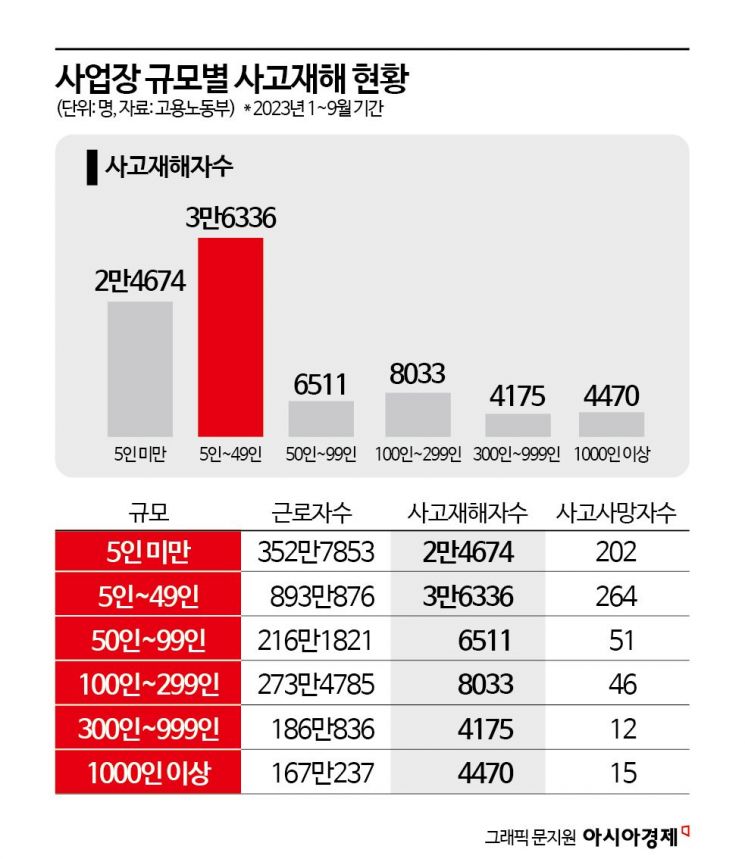
According to the Ministry of Employment and Labor on the 25th, as of September last year, there were 8.93 million employees working at companies with 5 to 49 employees, which are now newly subject to the Serious Accidents Act. When companies are categorized by number of employees, this group represents the largest share of the workforce. The problem is that these companies also experience the highest frequency of industrial accidents. From January to September last year, there were 36,336 accident victims and 264 fatalities at companies with 5 to 49 employees, accounting for 43.1% and 44.7% of the national totals, respectively. By industry, construction and manufacturing recorded the highest number of fatal accidents during the same period. Within manufacturing, frequent accidents occurred in machinery and equipment, metal, non-metal mineral products manufacturing, food manufacturing, chemical and rubber products manufacturing, and shipbuilding and repair.
Industry experts explain that the high proportion of older workers at these companies contributes to the higher frequency of accidents. According to industrial accident statistics compiled by the Ministry of Employment and Labor, as of September last year, accident victims included 10,218 workers aged 50-54, 12,178 workers aged 55-59, and 26,645 workers aged 60 or older, showing that the number of accidents increases with age. Fatalities were also highest among those aged 60 or older, with 275 deaths, followed by 177 deaths among those in their 50s.
The large number of foreign workers at companies with fewer than 50 employees is another factor that makes these businesses more vulnerable to accidents. According to Statistics Korea’s “Survey on the Status and Employment of Immigrants,” as of May last year, there were 923,000 foreign workers in Korea, with 56.9% employed by companies with 5 to 49 employees. It is explained that limited Korean language proficiency among these workers increases the likelihood of accidents.
However, despite these realities, companies with fewer than 50 employees have not been able to prepare for the enforcement of the Serious Accidents Act, as they have been grappling with the triple economic crisis of high inflation, high interest rates, and a strong won following the COVID-19 pandemic. According to a survey by the Korea Federation of SMEs, 80% of businesses with fewer than 50 employees said they were unprepared for the law. In another survey by the Construction Policy Research Institute targeting specialized construction firms, 96.8% responded that they had not taken any measures to comply with the Serious Accidents Act and were maintaining the status quo. Chae Heetae, a researcher at the Korea Small Business Institute, explained, “Small businesses lack the manpower and financial resources to fulfill the safety and health obligations required by the Serious Accidents Act,” adding, “Many do not have concrete implementation plans even as the law comes into effect.”
Ultimately, once the law is applied starting on the 27th, there are concerns that a surge of small businesses will face penalties under the Serious Accidents Act. In many of these companies, the CEO handles everything from production and planning to sales and safety management, so if the CEO is prosecuted for a serious accident, it will be difficult to maintain business operations. The impact will also extend to the employment and job security of the 8 million workers employed at these companies. Jung Jinwoo, a professor of safety engineering at Seoul National University of Science and Technology, said, “Applying the Serious Accidents Act as it is will not only impose a heavy burden, but is also highly likely to cause numerous side effects for both small businesses and overall workplace safety in Korea.”
© The Asia Business Daily(www.asiae.co.kr). All rights reserved.
![Clutching a Stolen Dior Bag, Saying "I Hate Being Poor but Real"... The Grotesque Con of a "Human Knockoff" [Slate]](https://cwcontent.asiae.co.kr/asiaresize/183/2026021902243444107_1771435474.jpg)















