'Sinchon Landmark' McDonald's Also Closes
Tim Hortons and Five Guys... First Stores in Gangnam
The Sinchon commercial district, once considered one of Seoul's major bustling areas and business hubs, is fading away. In the past, when it was crowded with nearby university students, Sinchon served as the 'Korean landing test site' for overseas food franchise brands, but now, most of the first stores chosen by various food brands are located in Gangnam.
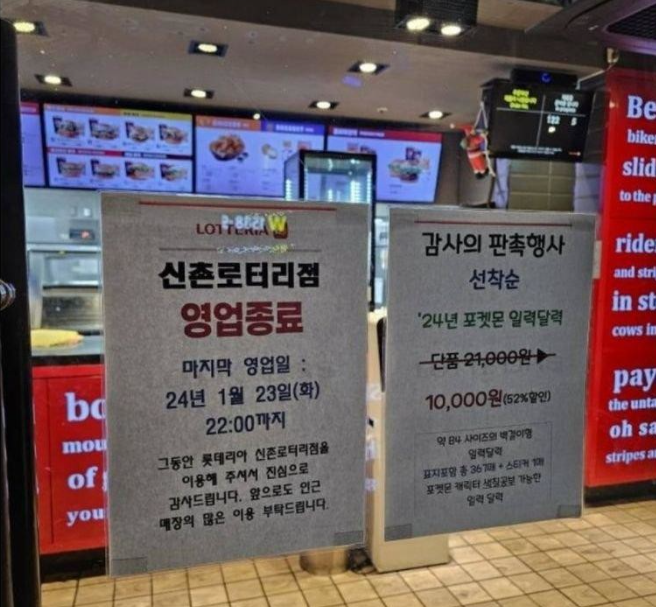 Lotteria Sinchon Rotary Branch closed its business on the 23rd. [Image source=Captured from X (formerly Twitter)]
◆ The Disappearing Veterans of Sinchon... Vacancy Rate at 22%
Starbucks, Krispy Kreme Doughnuts, Lotteria... All of these well-known food brands opened their first stores in Sinchon. With Yonsei University, Sogang University, Ewha Womans University, and several other universities nearby, there was a large floating population. Especially, the biggest advantage of this area was that young consumers who were open to trying new dining cultures gathered here. The famous coffee brand Starbucks officially entered Korea by opening its first store in front of Ewha Womans University’s main gate in August 1999, and the American doughnut brand Krispy Kreme Doughnuts opened its first store in Asia in Sinchon in 2004.
However, recently, the 'veteran' franchise first stores in Sinchon have been closing one after another. The Lotteria Sinchon Rotary branch, which had been operating for 18 years, closed on the 23rd, and prior to that, Twosome Place Sinchon branch closed in December last year. The Krispy Kreme Doughnuts first store and the McDonald’s Sinchon branch, famous as a landmark near Sinchon Station, also closed in 2017 and 2018 respectively.
The decline of the Sinchon commercial district is also evident in statistics. According to data released by the Korea Real Estate Board on the 24th, the vacancy rate of small-scale stores in the Sinchon and Ewha commercial districts was 22% as of the third quarter of last year. The vacancy rate, which was 12.3% in the first quarter and dropped to 9.0% in the second quarter of the same year, more than doubled in the third quarter. This figure far exceeds the overall vacancy rate of small-scale stores in Seoul, which is 5.6%. It is interpreted that stores are closing because they cannot afford high rents, and students naturally left the commercial district during the COVID-19 pandemic due to remote classes, making it difficult for the area to regain its former vitality.
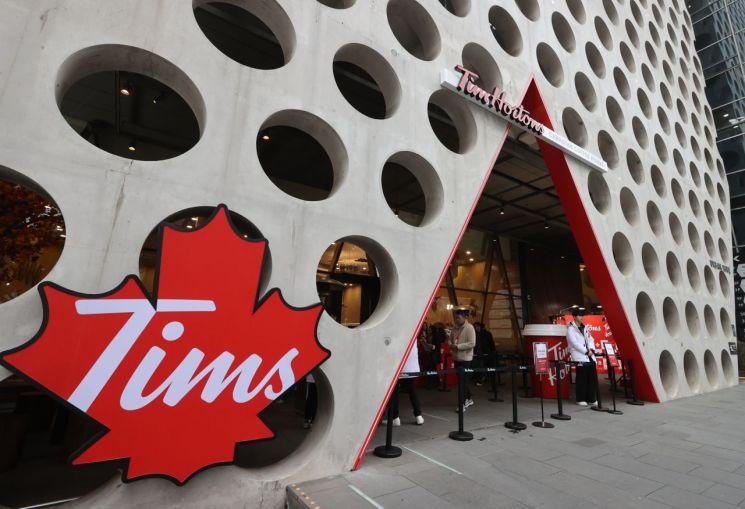
◆ Gangnam: The New Battleground for Dining
While the Sinchon commercial district has declined, Gangnam has become the new commercial district where franchise 'first stores' are gathering. Gangnam is a transportation hub served by Subway Line 2, the Shinbundang Line, and metropolitan buses, and it is close to office districts, so it has many consumers with higher purchasing power compared to university areas. The floating population reaches hundreds of thousands daily, making brand advertising effects significant.
In fact, the vacancy rate of small-scale stores in the Gangnam commercial district was very low at 0.8% in the third quarter of last year. The vacancy rate in Gangnam was 4.7% in the fourth quarter of 2022, then steadily decreased to 2.9% in the first quarter and 0.99% in the second quarter of last year. Especially, areas such as Nambu Terminal, Nonhyeon Station, Dosan-daero, Sinsa Station, Apgujeong, and Cheongdam had a vacancy rate of 0% as of the third quarter of last year.
Gangnam has already established itself as a foothold for overseas food franchise brands entering Korea. Starting with the hamburger brand Shake Shack in July 2016, Five Guys and Super Duper opened in June and November of last year respectively. Last month, the Canadian coffee brand Tim Hortons opened its first store in Korea near Sinnonhyeon Station and its second store near Seolleung Station.
© The Asia Business Daily(www.asiae.co.kr). All rights reserved.
![Clutching a Stolen Dior Bag, Saying "I Hate Being Poor but Real"... The Grotesque Con of a "Human Knockoff" [Slate]](https://cwcontent.asiae.co.kr/asiaresize/183/2026021902243444107_1771435474.jpg)
















