Promotion of Mandatory Holiday Conversion to Weekdays
Allowing Online Delivery During Restricted Business Hours
Union Opposition and Difficulties in Amending the Distribution Industry Development Act
The government is pushing for a significant relaxation of operating regulations for large supermarkets, raising expectations within the distribution industry. However, with opposition from small business owners and large supermarket labor unions, as well as the need to amend laws such as the Distribution Industry Development Act, difficulties are expected until actual implementation.
On the 22nd, at a public discussion on regulatory reform for daily life, the government announced plans to remove the principle of designating mandatory holidays as public holidays to promote a shift from Sunday closures to weekday closures, and to allow online delivery during restricted operating hours.
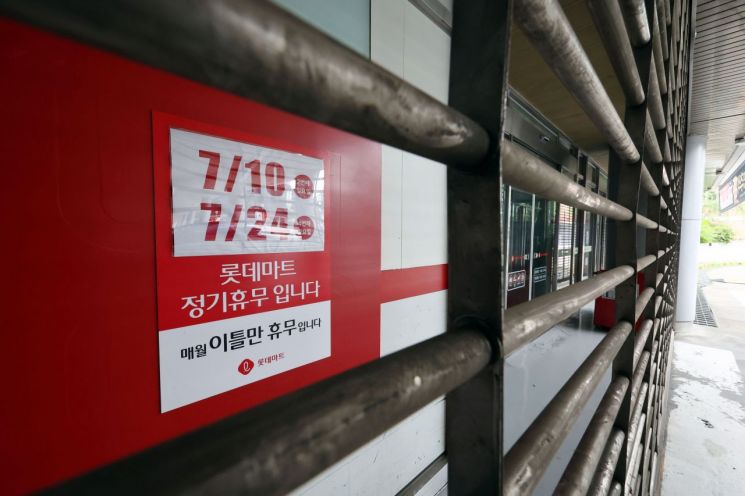
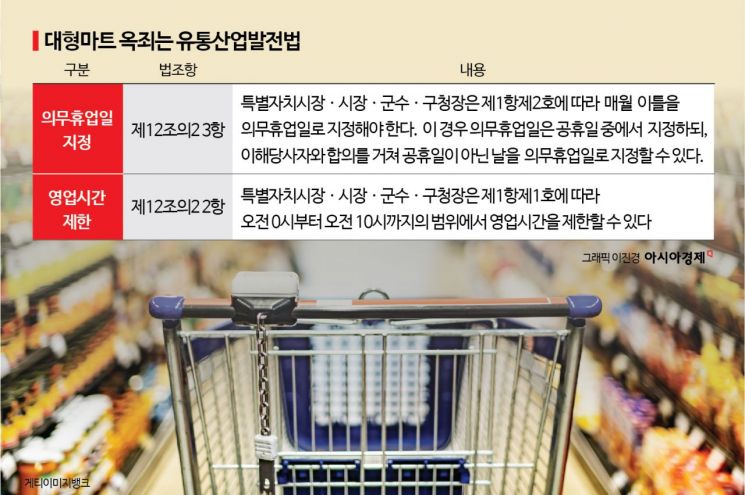
The mandatory closure regulation for large supermarkets was introduced under the amended Distribution Industry Development Act of 2012 to prevent damage to local businesses and protect the health rights of supermarket workers. The key provisions require local governments to restrict operating hours from midnight to 8 a.m. and designate the second and fourth Sundays of each month as mandatory closure days.
Will the Dawn Delivery Path Open for Large Supermarkets?
The large supermarket industry is hopeful that fair competition with the e-commerce sector will become possible. Until now, large supermarkets have been subject to mandatory closure and operating hour restrictions, while e-commerce companies have not faced such regulations, leading to complaints about an "uneven playing field." In particular, if operating hour restrictions on large supermarkets are lifted, dawn delivery to nearby areas from each large supermarket will become possible, strengthening the competitiveness of the online market currently dominated by e-commerce companies like Coupang.
An industry insider said, "Large supermarkets have been subjected to regulations that e-commerce companies do not face at all, making fair competition impossible," adding, "If the regulations are lifted, it will basically create a structure for fair competition, which is encouraging." The insider also noted, "This is not just about shifting mandatory closure days to weekdays and allowing online delivery during restricted hours, but it is interpreted as the government’s willingness to ease various regulations imposed on large supermarkets."
Academics foresee that easing these regulations on large supermarkets could invigorate the consumer market. Lee Dong-il, a professor in the Department of Business Administration at Sejong University, said, "This is a necessary issue to revitalize the domestic economy," adding, "From that perspective, it is true that there is a sense of expectation as the government eases unnecessary regulations." He further stated, "Previously, issues such as coexistence with local businesses were obstacles, but now it is believed that each large supermarket has the capacity to manage these adjustments."
Currently, the domestic economy is experiencing frozen consumer sentiment due to prolonged high interest rates and high inflation. In fact, the Consumer Confidence Index (CCSI), which reflects consumer sentiment toward the domestic economy, rose to 103.2 in July last year but has remained below the average value of 100 for four consecutive months since August. Professor Lee expressed optimism that easing regulations on large supermarkets will stimulate consumption and open the way for domestic economic recovery.
There have been consistent criticisms that mandatory weekend closures of large supermarkets do not benefit local businesses and instead cause inconvenience to consumers. Accordingly, recently, cases of local governments such as Daegu, Cheongju, and Seoul’s Seocho-gu and Dongdaemun-gu shifting large supermarket closure days to weekdays have been increasing.
Weekday Closure Shift for Large Supermarkets Increases Small Business Sales by 25%
The effects of shifting mandatory closure days to weekdays have already been proven. Concerns that this might negatively impact nearby small businesses have been partially alleviated. According to a study presented by Professor Cho Cheon-han’s team from Gyeonggi Science and Technology University at last year’s Korean Distribution Science Society Summer Convergence Conference, analyzing Daegu’s mandatory closure days, retail and restaurant sales in Daegu city increased by 25.9% during the three months from February to April, when weekday mandatory closures began. As large supermarkets operated normally on weekends, the increase in foot traffic also boosted sales for retailers and restaurants.
However, even with government support, it seems difficult to uniformly shift mandatory closure days for large supermarkets to weekdays immediately. Under the current Distribution Industry Development Act, mandatory closure days for large supermarkets are determined by local government ordinances. This means that the will of local government heads to shift closure days to weekdays and the process of amending ordinances are required. Opposition from local small business owners and large supermarket workers is also considered a hurdle in this process.
Allowing online delivery outside operating hours is even more challenging. To permit large supermarkets to conduct online deliveries during restricted hours, the Distribution Industry Development Act itself must be amended. However, the related amendment bill has been pending in the National Assembly for over three years, and significant differences in views between ruling and opposition parties make it unlikely to pass soon. Industry insiders are aware of this situation. One industry representative said, "There is a long and complicated road ahead," adding, "With the general election approaching, it is expected that amendments will not be made immediately."
© The Asia Business Daily(www.asiae.co.kr). All rights reserved.
![Clutching a Stolen Dior Bag, Saying "I Hate Being Poor but Real"... The Grotesque Con of a "Human Knockoff" [Slate]](https://cwcontent.asiae.co.kr/asiaresize/183/2026021902243444107_1771435474.jpg)

















