Two-thirds Funded by Banks... JP Morgan $8.5 Billion
Companies Rush to Issue Bonds to Lower Interest Costs
Investors Secure Long-Term Yields Before Rate Cuts
The U.S. corporate bond market is experiencing its biggest 'bull market' in 30 years. The scale of bond issuance this year has already surpassed $150 billion.
On the 21st (local time), major foreign media outlets, citing data from the London Stock Exchange Group (LSEG), reported that U.S. investment-grade companies issued bonds worth $153 billion (approximately 204 trillion won) this month. This is the highest level since 1990 for the same period.
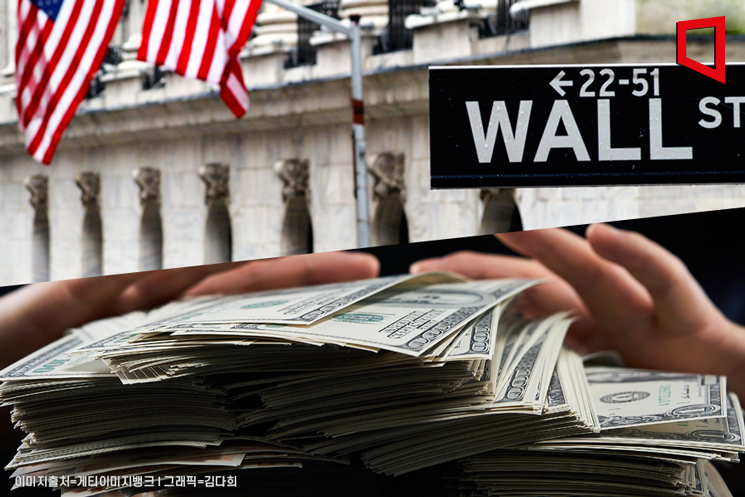
More than two-thirds of the borrowings were made by companies classified as financial institutions by banks and LSEG. JP Morgan, Wells Fargo, and Morgan Stanley raised $8.5 billion (about 11.3535 trillion won), $8 billion (about 10.6856 trillion won), and $6.75 billion (about 9.016 trillion won), respectively. Among non-financial companies, energy group Energy Transfer issued $3 billion (about 4.0071 trillion won), natural gas producer EQT issued $750 million (about 1.0018 trillion won), telecommunications company T-Mobile issued $3 billion (about 4.005 trillion won), and Canadian Liberty Utilities issued $850 million (about 1.1353 trillion won) in corporate bonds.
Companies are rushing to issue bonds to reduce interest costs, while investors are trying to buy bonds before the U.S. begins to cut interest rates in earnest later this year. The demand from both sides has aligned. Richard Jogev, head of Citigroup's Global Debt Capital Markets, said, "The market is on fire," adding, "Investors want to secure long-term yields ahead of the rate cuts." Jogev explained that the increased bond issuance demand from banks is partly due to concerns that regulatory capital requirements may increase, but the main reason is that many financial institutions postponed bond issuance plans after the collapse of Silicon Valley Bank last year, suppressing demand.
After the Federal Reserve signaled the end of rate hikes late last year, corporate borrowing costs, which had surged, have recently been falling again. The yield on U.S. investment-grade corporate bonds is 5.34% per annum. Although higher than at the end of last year, it is lower than the mid-November level when it was in the 6% range.
According to the ICE Bank of America (BofA) index, the spread between corporate bond yields and U.S. Treasury yields has narrowed to 1.01 percentage points. This is the lowest level in two years. Matt Brill, senior portfolio manager of fixed income at Invesco, said, "It is much cheaper to borrow now than just a few months ago."
Although the Fed is expected to cut interest rates, there is also an analysis that companies are proactively raising funds rather than waiting for further declines. Maureen O'Connor, head of Wells Fargo's Global High-Grade Bond Syndicate, said, "Everyone agrees on the possibility of a soft landing, but there are also catalysts that could cause short-term volatility, which is a concern." A senior bank executive stated, "A CFO won't be fired for raising funds at an interest rate 10 to 15 basis points (1bp = 0.01 percentage points) higher, but if they fail to raise funds on time and the market goes into a recession, they could be fired."
© The Asia Business Daily(www.asiae.co.kr). All rights reserved.
![Clutching a Stolen Dior Bag, Saying "I Hate Being Poor but Real"... The Grotesque Con of a "Human Knockoff" [Slate]](https://cwcontent.asiae.co.kr/asiaresize/183/2026021902243444107_1771435474.jpg)
















