"Efforts for Fundamental Improvement of the PF System"
Choi Sang-mok, Deputy Prime Minister for Economy and Minister of Strategy and Finance, pointed out that "there is a distorted aspect of corporate governance in our companies due to inheritance tax."
Deputy Prime Minister Choi appeared on 'KBS Sunday Diagnosis Live' on the 21st and said, "There is an issue that our country's inheritance tax rate is higher compared to advanced countries." Earlier, President Yoon Seok-yeol hinted at the need to ease inheritance tax during a public discussion on the 17th, stating, "Inheritance tax is said to be an excessive surcharge tax, but a national consensus is needed."
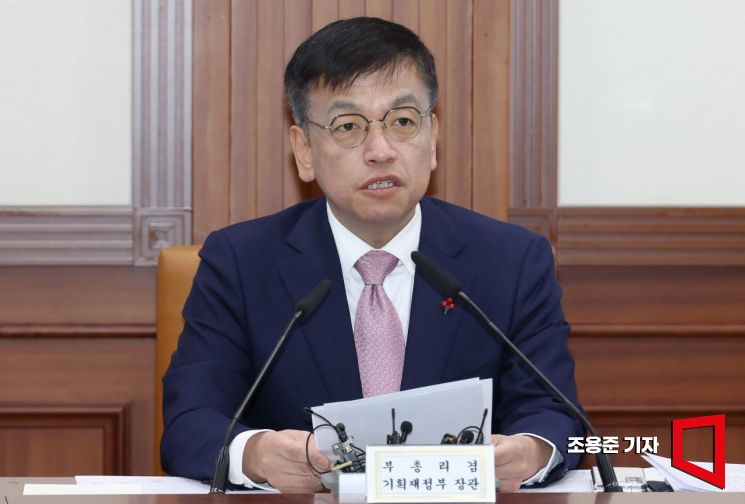 Choi Sang-mok, Deputy Prime Minister for Economic Affairs and Minister of Economy and Finance, is speaking on the impact of export-import logistics due to the Yemen rebel conflict at the Emergency Economic Ministers' Meeting and Price-related Ministers' Meeting held at the Government Seoul Office in Jongno, Seoul on the 16th. Photo by Jo Yong-jun jun21@
South Korea's highest inheritance tax rate (50%) is the second highest after Japan (55%). It is also pointed out that this rate is excessively high compared to the average inheritance tax rate (15%) among 38 OECD countries.
Deputy Prime Minister Choi said, "The President's remarks raised the fundamental principle," adding, "Since taxation has pros and cons, we will carefully proceed by comprehensively judging social consensus." He also mentioned a cautious approach to lowering inheritance tax, saying, "We are listening to both sides of the inheritance tax debate."
Regarding the abolition of the Financial Investment Income Tax (hereafter, Financial Investment Tax), which has been criticized as a 'tax cut for the rich' mainly by opposition parties and civic groups, he emphasized, "There are 14 million stock investors, and if you include investments through funds, it exceeds 20 million," adding, "It is not a tax cut for the rich but a tax cut for 20 million investors."
On the background of pushing for the abolition of the Financial Investment Tax, he said, "Our household assets are still heavily invested in tangible assets," and "It is a crucial time to guide investments toward productive sectors through the capital market."
Regarding concerns that the government's successive tax cut policies may lead to a shortage of tax revenue and destabilize sound fiscal management, he explained, "Tax support related to the capital market or support for people's livelihood is not on a large scale," and "The government is striving to create a virtuous cycle structure where the tax base is expanded through economic revitalization."
Regarding the current real estate project financing (PF) system, he pointed out, "In advanced countries, PF basically involves buying land with equity capital and then raising finance to build buildings or conduct business, but in our country, loans are raised to buy land first," adding, "As a result, if the sale price collapses, it causes a chain reaction."
He added, "Under the current structure, crisis situations like this are bound to repeat," and "We will simultaneously work on fundamental structural improvements of the PF system through research projects."
He cited inflation and domestic demand as factors of instability in the Korean economy this year. He said, "The consumer price inflation rate is expected to remain in the 3% range until the first half of the year and then fall to the low 2% range in the second half," adding, "The most urgent task is to firmly establish a price stabilization trend."
© The Asia Business Daily(www.asiae.co.kr). All rights reserved.

















