Last Year, Jeju Airport Delay Rate Reached 25%
Top Cause of Delays: 'Aircraft Connection'
Last year, one out of every four flights connecting to Jeju International Airport experienced delays.
According to aviation statistics released on the 19th by the Korea Airports Corporation, the total number of flight delays at 14 airports nationwide (excluding Incheon Airport) in 2023 was 100,226. This accounts for 22.6% of the total flights operated (442,033 flights). The delay rate in 2022 was 7.6%, meaning the delay occurrence rate nearly tripled in just one year.
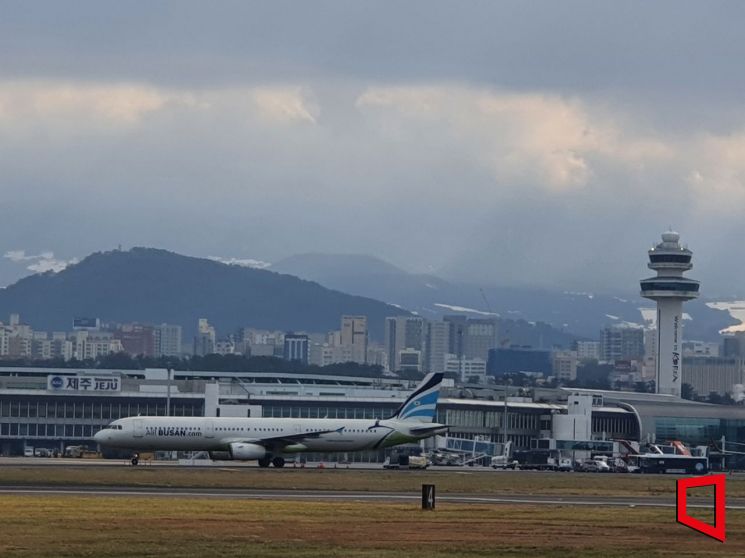
The sharp increase in the delay rate is due to a change in the criteria. Until 2022, the delay standard was exceeding 30 minutes for domestic takeoffs and landings and 60 minutes for international flights. However, starting last year, the criteria were tightened to delays exceeding 15 minutes from the scheduled departure or arrival time at the gate for both domestic and international flights.
Among the seven international airports managed and operated by the Korea Airports Corporation (Gimpo, Yangyang, Cheongju, Daegu, Gimhae, Muan, Jeju), Jeju Airport had the highest delay rate over the past year. At Jeju Airport last year, 40,427 flights were delayed, accounting for 24.7% of the total 163,125 flights. The delay rate in 2022 was 9.7%. Notably, departure delays were more frequent than arrival delays.
The overwhelming cause of flight delays at Jeju Airport was 'aircraft (A/C) connections.' Delays caused by aircraft connections numbered 31,215, making up 77.2% of the total delays. Following this were delays due to airport and immigration procedures, air traffic flow, passenger and aircraft handling, and weather conditions. Additionally, chain delays caused by densely packed flight schedules exceeding the airport runway's capacity also contributed to the increased delay rate. Since most flight delay causes were not due to unavoidable situations like bad weather but rather operational management issues, there are calls for urgent service improvements by airlines.
Meanwhile, the Ministry of Land, Infrastructure and Transport and the Korea Airports Corporation announced that the number of passengers using Jeju International Airport in 2023 was 29,096,271. Although this is a decrease of 607,391 passengers (2.04%) compared to 29,703,662 in 2022, it marks the second consecutive year since the COVID-19 pandemic that the number of passengers exceeded 29 million.
The number of passengers at Jeju International Airport first surpassed 30 million in 2019, recording 31,316,394 passengers, but sharply dropped to 21,054,696 in 2020 due to the COVID-19 pandemic. Since then, as domestic tourists gradually increased, the passenger numbers were 25,802,550 in 2021, 29,703,662 in 2022, and 29,096,271 in 2023.
© The Asia Business Daily(www.asiae.co.kr). All rights reserved.
![Clutching a Stolen Dior Bag, Saying "I Hate Being Poor but Real"... The Grotesque Con of a "Human Knockoff" [Slate]](https://cwcontent.asiae.co.kr/asiaresize/183/2026021902243444107_1771435474.jpg)
















