Yoon Mentions Easing Heavy Taxation on Multiple Homes in Turn-Based Public Livelihood Debates
Sung Tae-yoon Says "Not Immediate... Public Consensus Needed" on Inheritance Tax Relief
Low Birthrate Issue Takes a Different Path from Previous Government... Expanding 'Work-Family Balance'
"Expansion of Medical School Quotas Absolutely Necessary"... No Specific Numbers Given
On the 18th, the Presidential Office stated that President Yoon Suk-yeol's recent tax reduction policy direction presented at the livelihood discussion forum focuses on "improving areas where large-scale tax revenue reductions do not occur." This refers to the easing of heavy taxation on multiple home ownership and the abolition of financial investment income tax mentioned in the previous four forums, arguing that reducing regulatory costs is also effective in responding to the economy. In particular, regarding the low birthrate measures under government review, the policy direction is to promote 'work forms that allow the coexistence of work and family' rather than pouring astronomical budgets.
Seong Tae-yoon, Director of Policy at the Presidential Office, held a briefing at the Yongsan Presidential Office in the afternoon and said, "We are discovering tax bases among various taxes that cause severe economic distortions but do not significantly reduce tax revenue," referring to the above.
President Yoon Proposes Successive Tax Reduction Policies... Democratic Party Raises Concerns About Feasibility and Criticizes "Tax Cuts Everywhere"
Since early this month, President Yoon has chaired livelihood discussion forums in housing, semiconductor, and financial sectors, suggesting possibilities such as easing heavy taxation on multiple home ownership, lowering inheritance tax, reducing securities transaction tax, and abolishing financial investment income tax. However, opposition parties like the Democratic Party and some civic groups criticized these as "policies that further reduce already decreased tax revenues this year." Although the intention is to revise unreasonable systems to reduce the tax burden on citizens and stimulate the market, concerns were raised about the feasibility itself.
Yoo Dong-soo, Deputy Floor Policy Chief of the Democratic Party, strongly criticized at the National Assembly, saying, "Recently, wherever President Yoon goes, he presents tax laws and tax reduction plans. It seems as if President Yoon is recklessly issuing policies without understanding tax laws or the economy." He added, "It has been less than a month since the tax law determining this year's revenue was passed. If you are going to reduce this year's tax law, it should have been included in last year's tax law amendment. If you are going to discuss election-oriented tax cuts right now, you should also bring a supplementary budget for this year's tax adjustment reduction."
However, the Presidential Office rebutted, saying, "The focus is on improving areas where large-scale tax revenue reductions do not occur." Director Seong explained, "It is also an effort to improve unreasonable elements that existed during the economic growth process as much as possible," adding, "It is not about removing all regulations unconditionally, but focusing on minimizing parts that cause inconvenience to citizens or require high costs."
Regarding the part where President Yoon hinted at easing inheritance tax at the livelihood forum the day before, the office cautioned against overinterpretation, saying, "It can be discussed in the form of reforming the multiple taxation system, but it is not something to be done immediately." He emphasized, "Inheritance tax must be discussed at a level that citizens can agree upon. There can be no unilateral abolition or strengthening of inheritance tax." However, he explained, "In the early stages of economic development, it was very difficult to secure tax bases, so inheritance tax was used as a major source. But now, with digitalization progressing, many tax bases are captured, and after paying income tax and others, the multiple forms of taxation can be considered."
Additionally, regarding President Yoon's statement that "excessive tax systems must be reformed to solve Korea Discount (the undervaluation of the Korean stock market)," the office explained that "issues related to corporate governance and tax are important factors" and that "the intention is to solve these through institutional improvements."
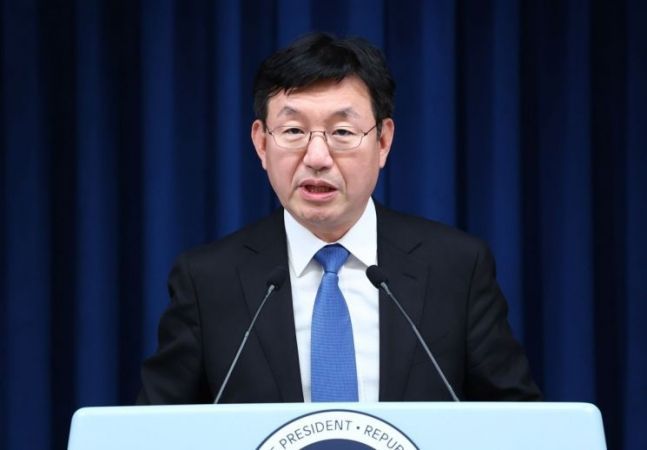 Sung Tae-yoon, Chief of Policy Office, is giving a briefing on the public discussion related to housing, semiconductors, and finance sectors at the Presidential Office building in Yongsan, Seoul on the 18th.
 [Photo by Yonhap News]
Avoid Pouring Budgets into Low Birthrate Solutions... "Reduce Excessive Competition and Spread Flexible Work Culture"
Regarding the low birthrate issue, the administration expressed its intention to approach differently from previous governments. Rather than pouring astronomical budgets into various policies to rebound the birthrate, the aim is to reform systems that encourage competitive societies such as education and work, expand jobs in local areas, and reverse the social atmosphere that discourages having children.
Director Seong said, "The birthrate issue is important not only for the current generation but also for future generations, so revolutionary policies are needed." The resolution of unnecessary excessive competition was pointed out by President Yoon as one of the causes of low birthrate at the Cabinet meeting on December 26 last year and on the 1st of this year. He continued, "The paradigm of birthrate policy must change. Excessive competition must be reduced," emphasizing, "Effective and productivity-enhancing competition is important, but it is necessary to avoid situations where excessive competition makes it difficult to have children."
He also explained, "Reducing excessive competition and ensuring that families can live well, find jobs, and attend good schools even if they are not in Seoul is a very important task to solve the low birthrate." Furthermore, he added, "Flexible work forms that allow men and women to balance family life are another important link in addressing the low birthrate issue."
Regarding the expansion of medical personnel, considered an essential element to prepare for a low birthrate and aging society, Director Seong clearly stated, "Expanding medical school quotas is absolutely necessary." It is known that the Ministry of Health and Welfare recently officially requested the Korean Medical Association (KMA) for specific opinions on the scale of medical school admission quota increases to be applied from the 2025 academic year. The government considers the '350-person increase' proposed by the Korean Association of Medical Colleges (KAMC) on the 9th of this month to fall far short of public expectations.
Director Seong explained the necessity, saying, "It is a personnel issue to ensure that basic treatments, including emergency medical care, can be provided in local areas without difficulties. Demand is increasing amid social structural problems," adding, "Not only semiconductors but also medical and health sectors can be industrial elements of our country. To comprehensively accommodate personnel, expanding medical school quotas is absolutely necessary."
However, the government decided not to specify a particular number. This is a judgment considering consensus with related organizations and social perspectives. Director Seong said, "It is necessary to have a process where each related organization or stakeholder submits how many personnel they need or expect, along with demand surveys and some form of personnel analysis." He added, "It would be good if a consensus number emerges, but if not, it should be decided from the perspective of 'what is the most appropriate number for our society and the future of the Republic of Korea.'"
In response to a reporter's question about whether expanding medical school quotas would worsen the concentration in medical schools given the shortage of talent in science and technology fields such as semiconductors, he replied, "There must also be measures to prevent difficulties in other fields," adding, "For reference, we are actively supporting universities to increase personnel in semiconductor departments and are also considering ways to reduce tuition burdens."
© The Asia Business Daily(www.asiae.co.kr). All rights reserved.
![Clutching a Stolen Dior Bag, Saying "I Hate Being Poor but Real"... The Grotesque Con of a "Human Knockoff" [Slate]](https://cwcontent.asiae.co.kr/asiaresize/183/2026021902243444107_1771435474.jpg)
















