GM Surpasses Ford and Volkswagen Group
Electric Vehicle Market in Focus Since 2017
"Aggressive Technology Investment is the Key to Growth"
As competition in the electric vehicle (EV) market intensifies in the United States, foreign media reports have emerged that Hyundai Motor Company and Kia have surpassed global competitors to become Tesla's biggest rivals.
On the 17th (local time), The Wall Street Journal (WSJ) reported that Hyundai and Kia ranked second in U.S. electric vehicle sales.
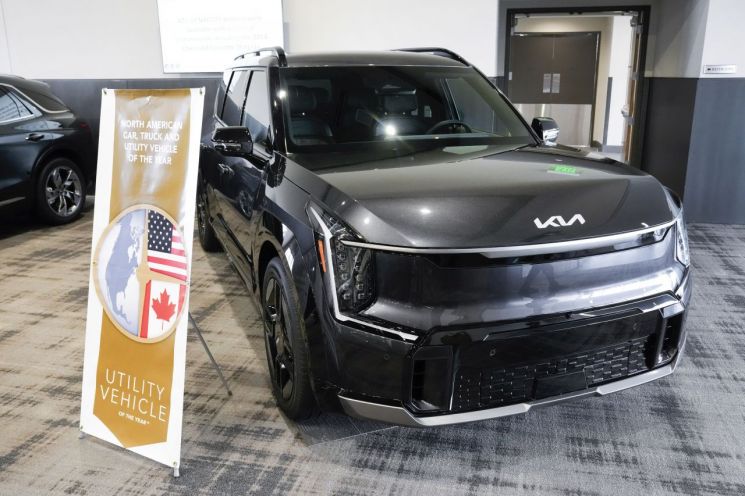
Last year, 55% of electric vehicles sold in the U.S. were Teslas. While Tesla still wields strong influence in the American EV market, its market share has declined in recent years due to the emergence of competitors like Hyundai and Kia. Combined sales of Hyundai, Kia, and Genesis account for 8% of EV sales in the U.S., surpassing strong competitors such as General Motors (GM), Ford, and the Volkswagen Group.
WSJ stated, "As the range of electric vehicle options expands, Hyundai and Kia have gained an advantage. They have broadened the market beyond early adopters to mainstream consumers." Hyundai and Kia offer a lineup of nine models, ranging from the $32,000 (approximately 42.86 million KRW) Hyundai Kona to the Kia EV9 starting at $55,000 (approximately 73.67 million KRW). These models are especially popular among family buyers. In contrast, Tesla sells only five models, with the cheapest starting at $39,000 (approximately 52.24 million KRW).
This year, Korean automakers are expected to continue their strong performance in the U.S. electric vehicle market. Analysts have noted that Hyundai and Kia are prepared to widen the gap with Tesla and other competitors through new model launches and aggressive pricing strategies.
The automotive industry and WSJ attribute Hyundai and Kia's growth to their investments in technology. WSJ reported, "Behind Hyundai and Kia's growth is a decade of aggressive technology investment," adding, "As EV sales have increased in recent years, these efforts have materialized." Hyundai and Kia offer various models, including large family SUVs, affordable battery-powered crossovers, and sedans, featuring battery technology that enables fast charging.
Matthew Phillips, CEO of Car Pros Automotive Group, commented, "Simply put, Hyundai and Kia have taken a step further in their investments," and praised them for "appropriately combining style, functionality, and price in their launches."
Although the amendment to the U.S. Inflation Reduction Act (IRA) has disqualified them from receiving the $7,500 (approximately 10.05 million KRW) tax credit, they introduced leasing options to allow consumers to purchase vehicles at lower costs. They also benefited from competitors' setbacks, such as GM's manufacturing delays causing postponed EV model launches.
WSJ noted that just ten years ago, Hyundai and Kia were considered weak players in the U.S. market, producing low-cost vehicles, but their image has changed dramatically with the recent surge in EV sales. Riding on the success of the Tesla Model 3 launch, Hyundai and Kia focused early on the EV market in 2017. They viewed the transition to electric vehicles as an opportunity to revamp their image and attract affluent customers who previously paid little attention to Hyundai and Kia.
Tyson Jomini, Vice President of Data and Analytics at JD Power, said, "In internal combustion engine vehicles, Kia SUVs cannot be compared to luxury vehicles like Cadillac in terms of price or features, but this is not the case with electric vehicles."
According to S&P Global Mobility, about 100 new electric vehicle models are expected to enter the market this year. Unlike competitors who compete primarily on low prices, Hyundai and Kia are targeting the market with a diverse product lineup, which means they are likely to face fierce competition. Recently, the automotive industry has expressed concerns that demand for electric vehicles in the U.S. may decline. In response, Hyundai and Kia are accelerating their U.S. market strategy by building new factories and battery manufacturing facilities in Georgia and investing over $200 million in local plants.
© The Asia Business Daily(www.asiae.co.kr). All rights reserved.
![Clutching a Stolen Dior Bag, Saying "I Hate Being Poor but Real"... The Grotesque Con of a "Human Knockoff" [Slate]](https://cwcontent.asiae.co.kr/asiaresize/183/2026021902243444107_1771435474.jpg)















