About 3 Times Increase Compared to Last Year
About 10 Elite Defectors from North Korea
Rising Proportion Saying "Dislike North Korean Regime"
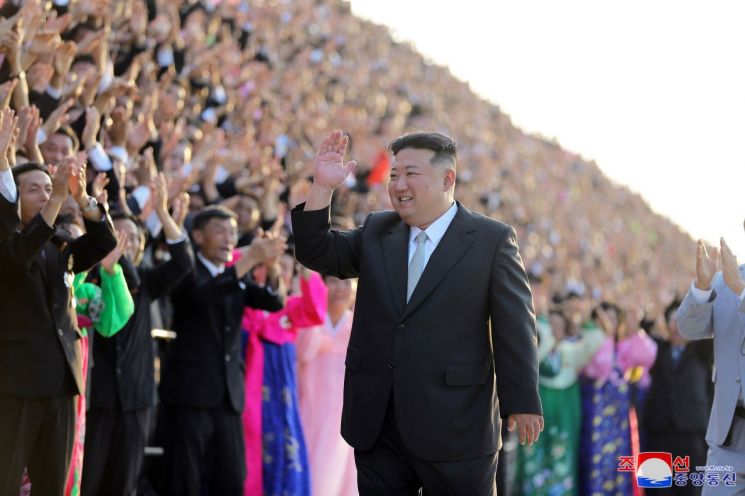 North Korean Supreme Leader Kim Jong-un waves to participants at the '9.9 Day' event on September 9 last year, marking the 75th anniversary of the regime's establishment.
 [Image source=Yonhap News]
The number of North Korean defectors who entered the country last year was recorded at 196. This is about three times the number compared to the previous year. More than half are young adults, and it is known that about 10 individuals belong to the so-called North Korean 'elite' class.
On the 18th, the Ministry of Unification announced that the number of North Korean defectors entering last year was 196, with 32 men and 164 women. This is about three times the numbers in 2021 (63) and 2022 (67). Compared to 2020, before COVID-19 (229), it has recovered to about 85%. The total cumulative number of entrants is 34,078.
Occupations such as workers, housewives, and farm workers accounted for 74%, and 72% had middle or high school education. The regions of origin were mostly border areas, with Yanggang Province and Hamgyong Province accounting for 70%.
Among last year’s defectors, the elite class was reported to be around 10 people. A Ministry of Unification official said, "Even for the elite class, the economic burden and the burden of operating overseas diplomatic missions are quite significant," adding, "Personal psychological pressure and long-term overseas stay experiences are expected to act as considerable obstacles to re-entering North Korea."
According to the Ministry of Unification, most defectors last year entered after long-term stays in third countries. The number of maritime defections also increased. On May 6 last year, 9 defectors arrived via the West Sea, and on October 24, 4 defectors arrived via the East Sea.
The Ministry of Unification explained, "The diversification of defection routes indicates that the situation inside North Korea is very difficult," and "Last year’s maritime defectors commonly cited food shortages as their reason for defecting."
The trend of young generations defecting is also increasing. The number of entrants in their 20s and 30s has generally exceeded half of the total entrants, and last year, more than half of the entrants (99 people) were in their 20s and 30s.
The reasons for defection are also changing. In the past, many cited 'food shortages' as the reason, but recently, the proportion of those who said they defected because they 'dislike the North Korean regime' slightly surpasses that. The Ministry of Unification stated in this regard, "It is presumed to be related to the changing perceptions of the MZ generation (Millennials + Generation Z) within North Korea."
The Ministry of Unification explained, "While making every effort to support the settlement of defectors entering the country, we are closely monitoring the possibility that defectors crossing the border may gradually increase if North Korea opens the North Korea-China border in the future."
© The Asia Business Daily(www.asiae.co.kr). All rights reserved.
![Clutching a Stolen Dior Bag, Saying "I Hate Being Poor but Real"... The Grotesque Con of a "Human Knockoff" [Slate]](https://cwcontent.asiae.co.kr/asiaresize/183/2026021902243444107_1771435474.jpg)















