Last Year, Local Media Exposed 'Illegal Adoption'
Investigation into Suspicions of Document Forgery, Kidnapping, and Money Transactions
Norway is facing controversy after deciding to prevent the illegal removal of children from Asian countries, including Korea, under the pretext of adoption.
Norway Recommends Temporary Suspension of Overseas Child Adoptions Following 'Revelations' by Adoptees

On the 17th (local time), major foreign media including the US daily The New York Times (NYT) reported that Norway's Ministry of Children, Youth and Families is considering a temporary suspension of overseas child adoptions. Earlier, on the 16th, a Norwegian policy agency issued such a recommendation, prompting the government to begin a review including whether to approve it. The main point of this recommendation is to suspend all overseas adoptions temporarily until investigations into allegations of forged documents, legal violations, profiteering, and kidnapping are completed.
The majority of children adopted into Norway are known to come from Korea, the Philippines, Thailand, Taiwan, and Colombia.
The reason for this recommendation stems from reports last year exposing that some overseas adoptions were conducted illegally and corruptly. Local media reported a story of a Norwegian woman adoptee who only learned she was a baby taken from Korean parents 50 years ago after reading a previously hidden letter. Another woman revealed that despite having a biological father, her grandmother secretly sent her to an orphanage, ultimately leading to her becoming an adoptee.
Following these reports, an investigative committee was formed to examine adoption practices. However, Norway's Ministry of Children, Youth and Families requested additional information from this committee regarding the measure and expressed concerns about potential impacts of the adoption suspension. The committee's recommendation for a temporary halt to overseas adoptions requires approval from the Ministry to be implemented. Adoption organizations also urged careful consideration, warning that a prolonged suspension could financially harm legitimate adoption agencies.
Nevertheless, Norway stated that it will individually review adoption procedures that were underway prior to this measure.
Sweden and Denmark Have Already Reduced Adoptions... Investigations Requested Over Document Forgery in Overseas Adoption Cases
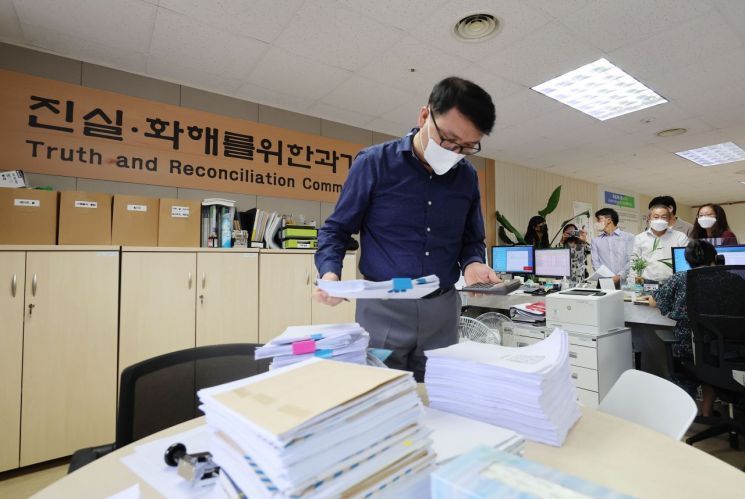 On the morning of September 13, 2022, in the Civil Complaints Office of the Truth and Reconciliation Commission in Jung-gu, Seoul, an official is reviewing documents submitted by the Denmark Korean Truth-Seeking Group claiming human rights violations. [Image source=Yonhap News]
Norway is not the only country facing controversy over overseas child adoption. Sweden announced in 2021 that it would conduct an internal review of overseas adoptions from the 1960s to 1990s and subsequently suspended adoptions of Korean children last year.
In Denmark, allegations of illegal money transactions arose in November last year during the adoption process of children from Madagascar. As a result, Denmark’s only overseas adoption organization, DIA, decided to gradually reduce overseas adoptions following concerns from policy agencies. Overseas adoptions in Denmark reached 400 to 500 cases annually in the 1970s but have reportedly decreased to 20 to 40 cases in the past three years.
A Danish official emphasized, "When we help a child meet a family on the other side of the globe, we must ensure that the adoption is properly conducted with the biological parents."
Meanwhile, Korea’s international adoption, which began by sending orphans overseas due to the Korean War and other factors, was concentrated in the 1970s and 1980s. During this period, approximately 200,000 children were adopted to the United States, Europe, and other regions through four government-approved private adoption agencies.
However, in 2022, 375 adoptees adopted between the 1960s and 1990s in 11 countries including Denmark, the United States, and Sweden requested an investigation by the Truth and Reconciliation Commission (TRCK) on suspicions that their orphan status was fabricated during the adoption process.
© The Asia Business Daily(www.asiae.co.kr). All rights reserved.
![Clutching a Stolen Dior Bag, Saying "I Hate Being Poor but Real"... The Grotesque Con of a "Human Knockoff" [Slate]](https://cwcontent.asiae.co.kr/asiaresize/183/2026021902243444107_1771435474.jpg)
















