Lower Consent Rate for Redevelopment Landowners
Maintain Existing Land Area Standard (50%)
Raise Redevelopment Review Threshold from 15% to 20%
Clarify District Mayor's Role When Review or Cancellation Conditions Are Met
In Seoul, redevelopment projects can proceed if more than 50% of landowners agree. When project advancement is difficult and a review is requested, the opposition consent rate will be raised from 15% to 20%.
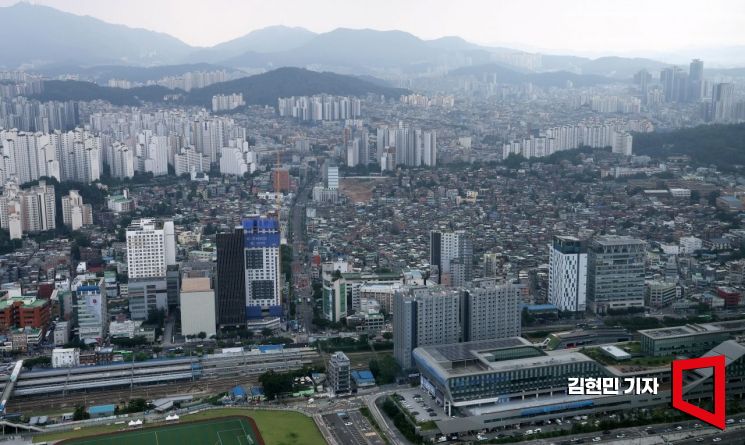 View of the Noryangjin redevelopment site in Seoul from the 63 Building observatory. Photo by Hyunmin Kim kimhyun81@
On the 18th, the Seoul Metropolitan Government announced that it had approved a revised draft of the 2025 Urban and Residential Environment Maintenance Basic Plan at the first Urban Planning Committee meeting held the previous day.
Going forward, when drafting redevelopment maintenance plans in Seoul, the consent rate of landowners will be relaxed from 66% to 50%. However, the land area criterion (50%) will be maintained as before. This is to uphold the purpose of designating maintenance zones reflecting the intentions of major landowners.
The standards for reconsidering or canceling plan drafts in areas where opposition rates are high and project advancement is realistically difficult have also been reorganized. The criteria for reconsideration and cancellation of plan drafts have been clarified according to the project entity.
The reconsideration threshold for redevelopment projects promoted by the private sector has been raised to 20% or more. In the case of public redevelopment implemented solely by the public sector, the opposition consent rate has been adjusted to 25% or more. Previously, the standards for public inspection and opinion hearing required only a 15% opposition consent rate among landowners.
If the reconsideration requirements are met, the district mayor must establish an action plan such as partially excluding or changing the district boundaries and submit the district mayor’s opinion, including whether to proceed with the project, to the Seoul Metropolitan Government. If necessary, the district mayor may conduct a resident opinion survey to refer to when deciding whether to proceed.
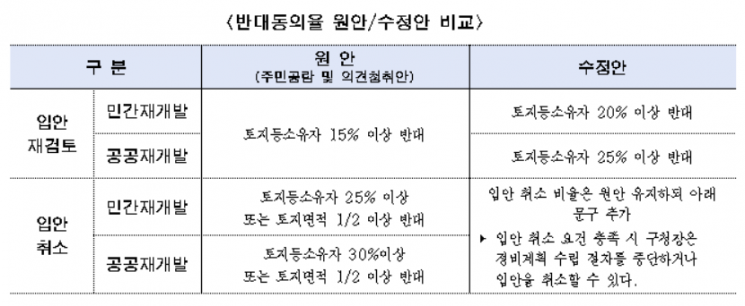
For districts where project advancement is difficult due to strong resident opposition, a regulation allowing the district mayor to cancel the maintenance plan draft has been codified. Maintaining the existing cancellation rates of 25% or more for private redevelopment and 30% or more for public redevelopment, if these conditions are met, the district mayor will comprehensively review the current status of the area, resident trends, and the necessity of maintenance to decide on cancellation.
A Seoul city official explained, "In the early stages of redevelopment projects, district offices faced many difficulties in areas where there were project promoters but strong opposition. Although reconsideration and cancellation were possible before, this clarifies and codifies the role of the district mayor, who holds the drafting authority."
The Seoul Metropolitan Government stated, "Through this basic plan revision, projects that can proceed quickly will be promoted through rapid district designation. For districts with strong resident opposition, it is expected that a system will be established to minimize resident conflicts and decide the direction of promotion early through reconsideration and other measures."
© The Asia Business Daily(www.asiae.co.kr). All rights reserved.
![Clutching a Stolen Dior Bag, Saying "I Hate Being Poor but Real"... The Grotesque Con of a "Human Knockoff" [Slate]](https://cwcontent.asiae.co.kr/asiaresize/183/2026021902243444107_1771435474.jpg)

















